Note_Tech
All technological notes.
Project maintained by simonangel-fong Hosted on GitHub Pages — Theme by mattgraham
PyTorch - Linear Regression
Linear regression
Linear regression- find the linear relationship between the dependent and independent variable by minimizing the distance.
- a supervised machine learning approach.
Example:
-
Suppose linear regression relationship:
Y=AX+bAis the slope.bis y-intercept.
-
three essential component
- model
- objective function(loss functions)
- algorithm
Model class
- using
nn.Module nn.Module: Base class for all neural network modules.forward(): Define the computation performed at every call.
Optimizer
-
Optimizer- used to optimize weight to fit the model into the dataset.
-
optimization algorithms
- algorithms used for optimizer
- e.g., gradient descent and backpropagation
-
torch.optimpackageoptim.SGD(params): Implements stochastic gradient descentoptim.Adam(params): Implements Adam algorithm.
-
.step(): implemented by all optimizer, which updates the parameters.每个算法都有.- two ways to use:
Optimizer.step()Optimizer.step(closure)
- two ways to use:
Criterion
criterionloss function,- used to find loss.
- e.g.,
nn.MSELoss(size_average = False)
Example: Linear Regression
nn.Linear(in_features, out_features):- Applies a linear transformation to the incoming data
import torch
from torch.autograd import Variable
# prepare data
xdata = Variable(torch.Tensor([[1.0], [2.0], [3.0]]))
print(xdata)
# tensor([[1.],
#         [2.],
#         [3.]])
ydata = Variable(torch.Tensor([[2.0], [4.0], [6.0]]))
print(ydata)
# tensor([[2.],
#         [4.],
#         [6.]])


# define model
class LRM(torch.nn.Module):
    def __init__(self):
        super(LRM, self).__init__()
        # nn.Linear(in_features, out_features): Applies a linear transformation to the incoming data
        self.linear = torch.nn.Linear(1, 1)

    # define Activation function
    def forward(self, x):
        ypred = self.linear(x)
        return ypred


# create model
ourmodel = LRM()
# define criterion, objective function
criterion = torch.nn.MSELoss(size_average=False)
# define optimizer, algorithm.
optimizer = torch.optim.SGD(ourmodel.parameters(), lr=0.01)

# train model
for epoch in range(100):
    predy = ourmodel(xdata)         # get predited value
    loss = criterion(predy, ydata)  # get loss

    optimizer.zero_grad()           # Reset gradients of all model parameters.
    loss.backward()                 # Computes the gradient/To compute derivatives
    optimizer.step()                # Performs optimization, Update the parameters
    print('epoch {}, loss {}'.format(epoch, loss.item()))

# create a data for prediction
newvar = Variable(torch.Tensor([[4.0]]))
predy = ourmodel(newvar)
print(predy.data)   # tensor([[7.3094]])
Prediction .forward()
import torch
from torch.nn import Linear

torch.manual_seed(42)
model = Linear(in_features=1, out_features=1)
print(model.bias)               # the value assosicated with seed.
# Parameter containing:
# tensor([0.8300], requires_grad=True)
print(model.weight)             # the value assosicated with seed.
# Parameter containing:
# tensor([[0.7645]], requires_grad=True)

# -------- For single data
# define a single data
x = torch.tensor([2.0])
print(model(x))     # prediction
# tensor([2.3591], grad_fn=<AddBackward0>)


# -------- For multiple data
x = torch.tensor([[2.0], [4.0], [6.0]])
print(model(x))
# tensor([[2.3591],
#         [3.8882],
#         [5.4172]], grad_fn=<AddmmBackward0>)
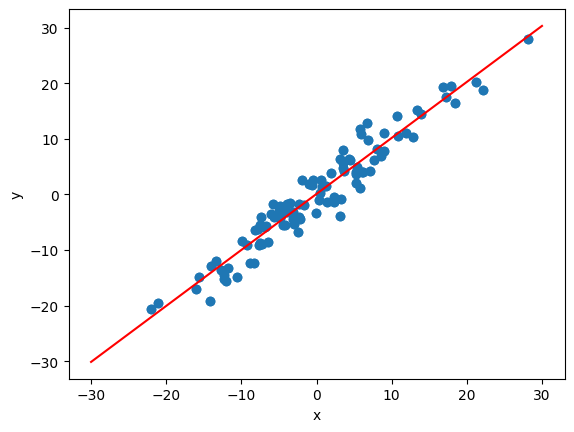
Example: Linear Regression - plot
- Define Data
import torch
import matplotlib.pyplot as plt
import numpy as np

# Define data
X = torch.randn(100, 1)*10
y = X+3*torch.randn(100, 1)

#  plot data
plt.plot(X.numpy(), y.numpy(), 'o')
plt.ylabel('y')
plt.xlabel('x')
- Define Model
import torch
import torch.nn as nn

class LR(nn.Module):
    def __init__(self, input_size, output_size):
        super().__init__()
        self.linear = nn.Linear(input_size, output_size)

    # activation function
    def forward(self, x):
        pred = self.linear(X)
        return pred

# set seed
torch.manual_seed(42)  # For consistency of random result
# create model
model = LR(1, 1)

print(model)
# LR(
#   (linear): Linear(in_features=1, out_features=1, bias=True)
# )
- Define Objective function and algorithm
# defein objective function
criterion = nn.MSELoss()  # Using Loss Function
# define algorithm
# Using optimizer which uses GD algorithm
optimizer = torch.optim.SGD(model.parameters(), lr=0.01)
- Train
[a, b] = model.parameters()  # Unpacking of parameters
epochs = 100
losses = []

for i in range(epochs):
    ypred = model.forward(X)            # predict

    loss = criterion(ypred, y)          # get loss
    print("epoch:", i, "loss:", loss.item())
    losses.append(loss)

    # gradient descent
    optimizer.zero_grad()
    loss.backward()
    optimizer.step()
- Plot LR
# get weight and bias


def grtparameters():
    return (a[0][0].item(), b[0].item())

# plot


def plotfit(title):
    plt.title = title
    a1, b1 = grtparameters()
    x1 = np.array([-30, 30])
    y1 = a1*x1+b1
    plt.plot(x1, y1, 'r')
    plt.scatter(X, y)
    plt.show()


plotfit('Trained Model')