Note_Tech
All technological notes.
Project maintained by simonangel-fong Hosted on GitHub Pages — Theme by mattgraham
DBA - Architecture
Architecture Overview
-
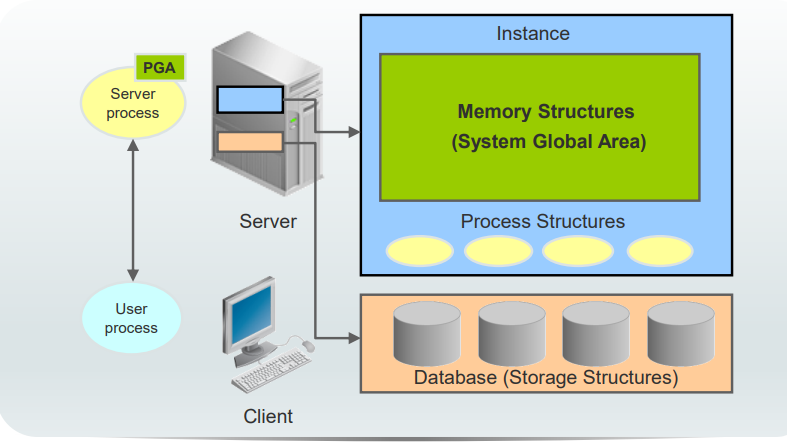
Three major structures in Oracle Database server architecture:
- memory structures
- process structures
- storage structures.
-
A basic
Oracle database systemconsists of-
an Oracle database
-
The
databaseconsists of bothphysical structureslogical structures.
-
Because the
physicalandlogicalstructures are separate, thephysical storageof data can be managed without affecting access tological storage structures.
-
-
a database instance.
-
The
instanceconsists of-
memory structures- Every time an instance is started, a shared memory area called the
System Global Area (SGA)is allocated,
- Every time an instance is started, a shared memory area called the
-
background processesassociated with that instance.- Every time an instance is started the background processes are started.
- Processes are jobs that work in the memory of computers.
- A process is defined as a “thread of control” or a mechanism in an operating system that can run a series of steps.
-
- After starting a database instance, the Oracle software associates the instance with a specific database. This is called mounting the database.
- The database is then ready to be opened, which makes it accessible to authorized users.
-
-
-
Summary:
-
Architecture:
- memory structure
- process structure
- storage structure
-
DB System:
- db
- physical storage structure
- logical storage structure
- isntance
- memory structures: memory area
- SGA: shared
- PGA: nonshared
- background processes
- memory structures: memory area
- db
Logical and Physical Database Structures
-
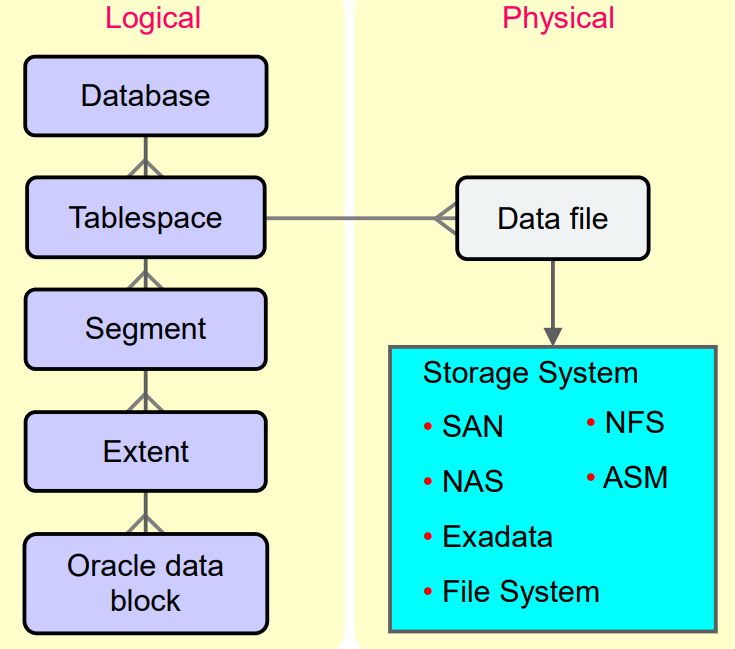
The database has logical structures and physical structures.
-
Databases- Each
databaseis logically divided into two or moretablespaces.
- Each
-
Tablespaces- A
databaseis divided into logical storage units calledtablespaces, which group related logical structures or data files together.- For example, tablespaces commonly group all of an application’s
segmentsto simplify some administrative operations.
- For example, tablespaces commonly group all of an application’s
- A
-
Data Files - One or more
data filesare explicitly created for eachtablespaceto physically store the data of allsegmentsin a tablespace. - If it is a
TEMPORARY tablespace, it has a temporary file instead of a data file. -
A tablespace’s data file can be physically stored on any supported storage technology.
-
bigfile tablespaces- You can also create
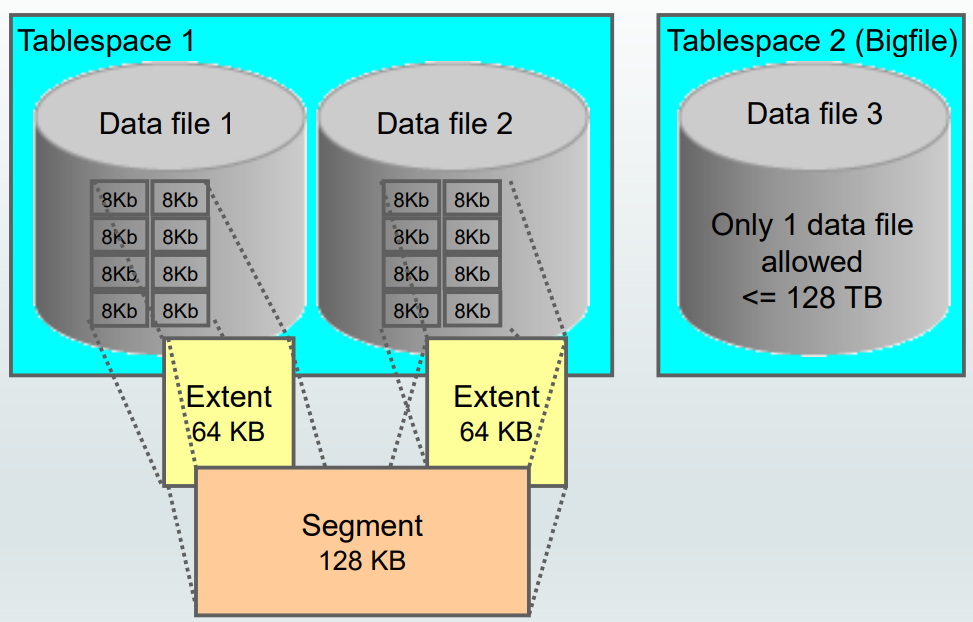
bigfile tablespaces, which have only one file that is often very large. The file may be of any size up to the maximum that the row ID architecture permits. - The maximum size of the single data file or temp file is 128 terabytes (TB) for a tablespace with 32 K blocks and 32 TB for a tablespace with 8 K blocks.
- Traditional smallfile tablespaces (which are the default) may contain multiple
data files, but the files cannot be as large.
- You can also create
-
segments- Segments exist in a tablespace.
- store subsets of database objects
- such as tables and indexes
Segmentsare collections ofextents.- Each
segmentcontains one or moreextents. - Standard 128 k
- Each
-
extentExtentsare collections ofdata blocks.- An extent consists of contiguous data blocks, which means that each extent can exist only in one data file.
-
Data BlocksData blocksare mapped to disk blocks.- the smallest unit of I/O in the database.
- At the finest level of granularity, an Oracle database’s data is stored in
data blocks. - One
data blockcorresponds to a specific number of bytes of physical space on the disk. - A
data blocksize is specified for each tablespace when it is created. - A
databaseuses and allocates free database space in Oracle data blocks. - Each row has unique row id.
-
The size of the data block can be set at the time of database creation.
- The default size of 8 KB is adequate for most databases.
- The maximum block size depends on your OS.
- The minimum Oracle block size is 2 KB; it should rarely (if ever) be used.
- If your database supports a data warehouse application that has large tables and indexes, a larger block size may be beneficial.
- If your database supports a transactional application in which reads and writes are random, specifying a smaller block size may be beneficial.
-
When the database requests a set of
data blocksfrom the operating system (OS), the OS maps this to an actual file system or disk block on the storage device.- Because of this, you do not need to know the physical address of any of the data in your database.
- This also means that a data file can be striped or mirrored on several disks.
Default Tablespaces
| Tablespace | Description |
|---|---|
SYSTEM |
used for core functionality. |
SYSAUX |
helps reduce the load on the SYSTEM tablespace. |
TEMP |
contains schema objects only for a session’s duration. |
UNDO |
stores the data needed to roll back, or undo, changes to the database. |
USERS |
stores user objects and data. |
-
SYSTEM:- mandatory, must be online
- stores the
data dictionary(metadata that describes the objects in the database) and tables that contain administrative information about the database.- All this information is contained in the
SYSschema and can be accessed only by theSYS useror other administrative users with the required privilege.
- All this information is contained in the
-
SYSAUX:- mandatory, must be online
- an auxiliary tablespace to the SYSTEM tablespace and helps reduce the load on the SYSTEM tablespace.
-
TEMP:- contains schema objects only for a session’s duration.
- Objects in temporary tablespaces are stored in temp files.
- Your temporary tablespace is used when you execute a SQL statement that requires the creation of temporary segments (such as a large sort or the creation of an index).
- Just as each user is assigned a default tablespace for storing created data objects, each user is assigned a temporary tablespace.
-
UNDO:- stores the data needed to roll back, or undo, changes to the database.
-
USERS:- stores user objects and data.
- If no default tablespace is specified when a user is created, then the USERS tablespace is the default tablespace for all objects created by that user.
- For the SYS and SYSTEM users, the default permanent tablespace is
SYSTEM.
-
Each Oracle database must contain a
SYSTEMtablespace and aSYSAUXtablespace.- They are automatically created when the database is created.
-
bigfile tbsp
- The system default is to create a smallfile tablespace. You can also create bigfile tablespaces, which enable the Oracle database to manage ultralarge files.
-
Accesibility
- A tablespace can be online (accessible) or offline (not accessible).
- The
SYSTEMtablespace is always online when the database is open. It stores tables that support the core functionality of the database, such as the data dictionary tables. - The SYSAUX tablespace stores many database components and must be online for the correct functioning of all database components.
- Note: The
SYSAUXtablespace may be taken offline to perform tablespace recovery, whereas this is not possible for the SYSTEM tablespace.
- Note: The
- Neither of them may be made read-only.
-
Application’s data
- The
SYSTEMandSYSAUXtablespaces are not recommended for storing an application’s data. - Additional tablespaces can be created for this purpose.
- The
Interacting with an Oracle Database: Memory, Processes, and Storage
- Example:
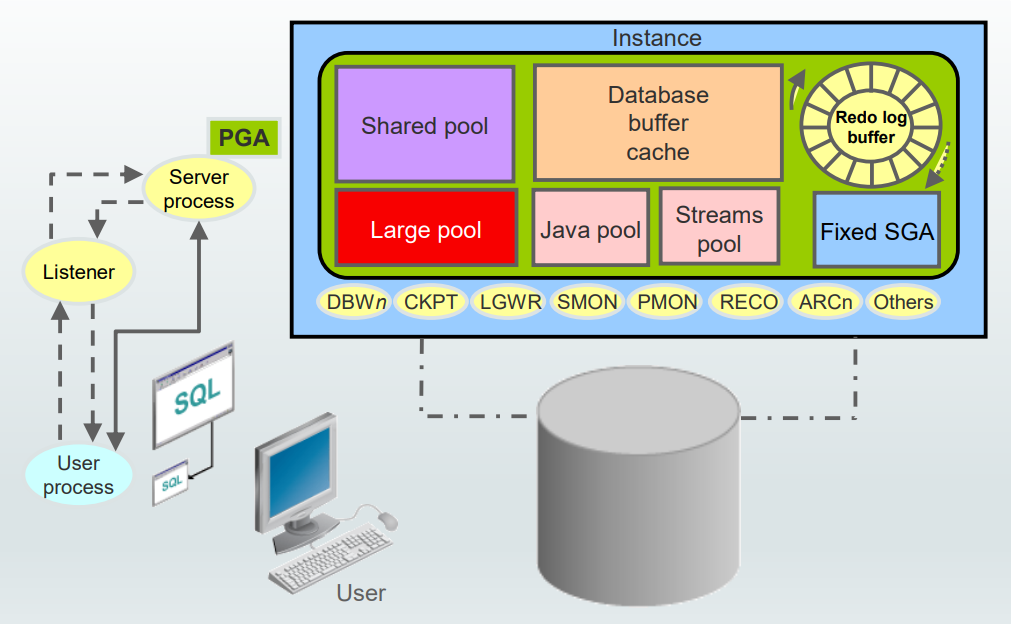
- It illustrates an Oracle database configuration in which the user and associated server process are on separate computers, connected through a network.
- An
instancehas started on a node where Oracle Database is installed, often called thehostordatabase server. - A user starts an application spawning a
user process. The application attempts to establish a connection to the server. (The connection may be local, client/server, or a three-tier connection from a middle tier.) - The server runs a
listenerthat has the appropriate Oracle Net Services handler. Thelistenerdetects the connection request from the application and creates a dedicatedserver processon behalf of the user process. - The user runs a DML-type SQL statement and commits the transaction. For example, the user changes the address of a customer in a table and commits the change.
- The
server processreceives the statement and checks theshared pool(an SGA component) for any shared SQL area that contains an identical SQL statement.- If a shared SQL area is found, the server process checks the user’s access privileges to the requested data, and the existing shared SQL area is used to process the statement.
- If a shared SQL area is not found, a new shared SQL area is allocated for the statement so that it can be parsed and processed.
- The
server processretrieves any necessary data values, either from the actual data file (table) or from values stored in thedatabase buffer cache. - The
server processmodifies data in the SGA. Because the transaction is committed, theLog Writer process (LGWR)immediately records the transaction in theredo log file. TheDatabase Writer process (DBWn)writes modified blocks permanently to disk when it is efficient to do so.