Note_Tech
All technological notes.
Project maintained by simonangel-fong Hosted on GitHub Pages — Theme by mattgraham
DBA - Architecture: Memory Stucture
Memory Structures
-
Oracle Database creates and uses memory structures for various purposes.
- For example, memory stores program code being run, data that is shared among users, and private data areas for each connected user.
-
Two basic memory structures are associated with an instance:
-
System Global Area (SGA) -
Program Global Area (PGA)
-
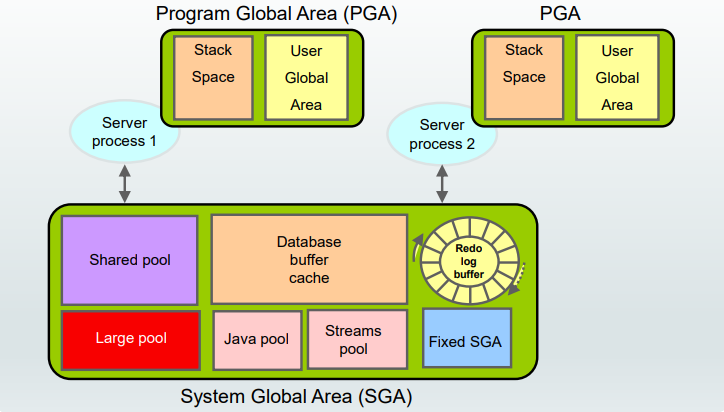
System Global Area (SGA)
-
System Global Area (SGA):- Group of shared memory structures, known as SGA components, which contains data and control information for one Oracle Database instance.
- The SGA is shared by all server and background processes.
- Examples of data stored in the SGA include cached data blocks and shared SQL areas.
SGA: Shared pool
-
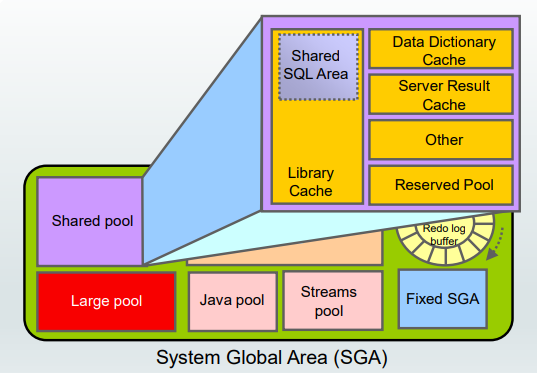
shared pool- portion of the SGA
- contains
- the library cache: data dict
- Shared SQL area
- the data dictionary cache: data dict(row)
- the server result cache containing the SQL query result cache and the PL/SQL function result cache, buffers for parallel execution messages, and control structures.
- the library cache: data dict
-
data dictionary- a collection of database tables and views containing reference information about the database, its structures, and its users.
- Oracle Database accesses the data dictionary frequently during SQL statement parsing.
- This access is essential to the continuing operation of Oracle Database.
-
The
data dictionaryis accessed so often by Oracle Database that two special locations in memory are designated to hold dictionary data.- One area is called the
data dictionary cache, also known as therow cachebecause it holds data as rows instead of buffers (buffers hold entire blocks of data). - The other area in memory that holds dictionary data is the
library cache.
- One area is called the
-
All Oracle Database user processes share these two caches for access to data dictionary information.
-
Oracle Database represents each SQL statement that it runs with a shared SQL area (as well as a private SQL area kept in the PGA). Oracle Database recognizes when two users are executing the same SQL statement and reuses the
shared SQL areafor those users.
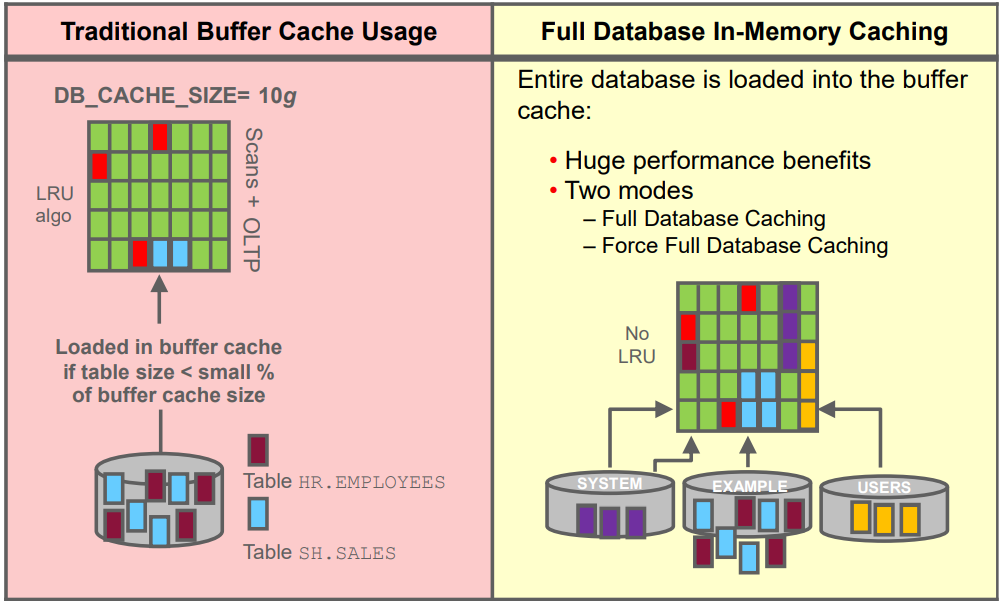
SGA: Database Buffer Cache
-
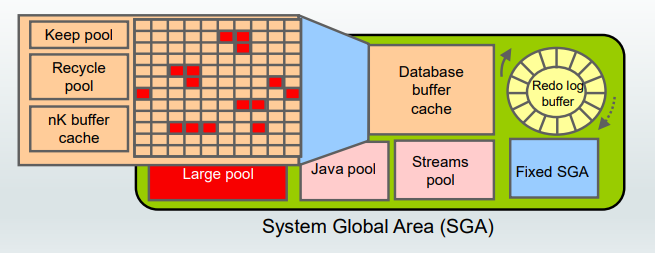
database buffer cache- the portion of the SGA
- holds block images read from data files or constructed dynamically to satisfy the read consistency model.
- All users who are concurrently connected to the instance share access to the database buffer cache.
-
The first time an Oracle Database user process requires a particular piece of data, it searches for the data in the database buffer cache.
- If the process finds the data already in the cache (a
cache hit), it can read the data directly from memory. - If the process cannot find the data in the cache (a
cache miss), it must copy the data block from a data file on disk into a buffer in the cache before accessing the data. - Accessing data through a
cache hitis faster than accessing data through acache miss.
- If the process finds the data already in the cache (a
-
The buffers in the cache are managed by a complex algorithm that uses a combination of
least recently used (LRU)lists and touch count.- The LRU helps to ensure that the most recently used blocks tend to stay in memory to minimize disk access.
-
The
keep buffer pooland therecycle buffer poolare used for specialized buffer pool tuning. keep buffer pool- designed to retain buffers in memory longer than the LRU would normally retain them.
-
recycle buffer pool- designed to flush buffers from memory faster than the LRU normally would.
- Additional
buffer cachescan be configured to hold blocks of a size that is different from the default block size.
SGA: Redo Log Buffer
-
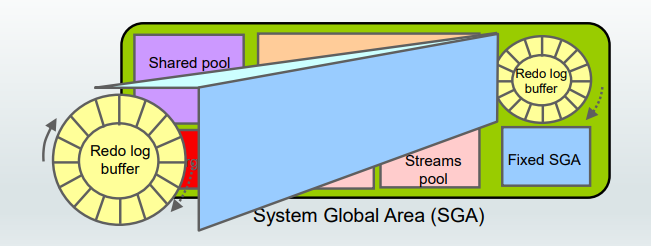
redo log buffer- a circular buffer in the SGA that holds information about changes made to the database.
- This information is stored in
redo entries.
-
Redo entries- contain the information necessary to reconstruct (or redo) changes that are made to the database by
DML,DDL, or internal operations. - used for database recovery, if necessary.
- contain the information necessary to reconstruct (or redo) changes that are made to the database by
-
As the server process makes changes to the buffer cache, redo entries are generated and written to the redo log buffer in the SGA. The redo entries take up continuous, sequential space in the buffer.
-
Process
- The
log writerbackground process writes theredo log bufferto the activeredo log file(or group of files) on disk.
- The
SGA: Large Pool
-
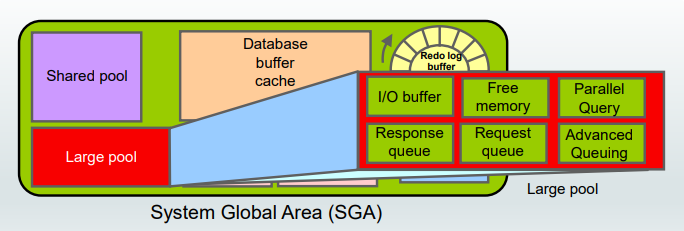
Large Pool- Provides large memory allocations for:
- Session memory for the shared server and the Oracle XA interface (used where transactions interact with multiple databases)
- I/O server processes
- Oracle Database backup and restore operations
- Parallel Query operations
- Advanced Queuing memory table storage
- Provides large memory allocations for:
-
By allocating session memory from the large pool for shared server, Oracle XA, or parallel query buffers, Oracle Database can use the shared pool primarily for caching shared SQL and** avoid the performance overhead** that is caused by shrinking the shared SQL cache.
-
In addition, the memory for Oracle Database backup and restore operations, for I/O server processes and for parallel buffers, is allocated in buffers of a few hundred kilobytes. The large pool is better able to satisfy such large memory requests than the shared pool.
-
The large pool is not managed by a
least recently used (LRU)list.
SGA: Java Pool
-
Java pool memory- used to store all session-specific Java code and data in the
Java Virtual Machine (JVM). - used in different ways, depending on the mode in which Oracle Database is running.
- used to store all session-specific Java code and data in the
SGA:Streams Pool
-
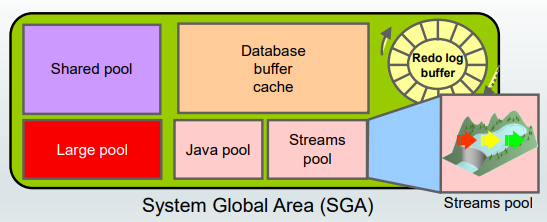
Streams pool memory is used exclusively by Oracle Streams to:
- Store buffered queue messages
- Provide memory for Oracle Streams processes
Streams pool- used exclusively by
Oracle Streams. - stores buffered queue messages and provides memory for
Oracle Streamscapture processes and apply processes.
- used exclusively by
- Unless you specifically configure it, the size of the Streams pool starts at zero.
- The pool size grows dynamically as needed when Oracle Streams is used.
PGA
-
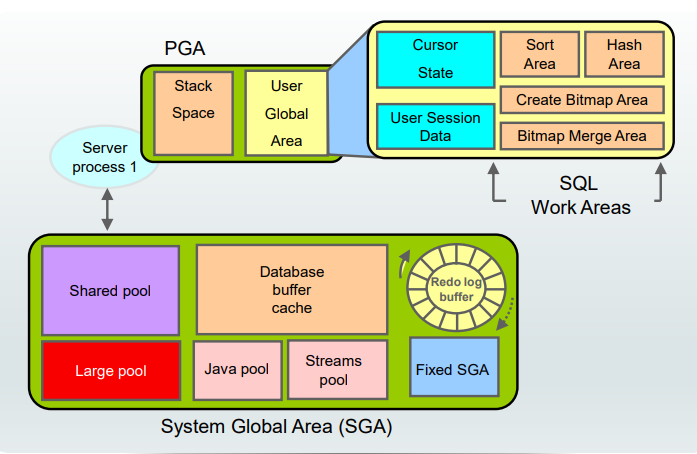
Program Global Area (PGA)- a private memory region containing data and control information for a server process.
-
A PGA is nonshared memory created by Oracle Database when a server or background process is started.
- 一对一: process <-> PGA
- Access to the PGA is exclusive to the server process.
- Each server process and background process has its own PGA.
- 一对一: process <-> PGA
- Each
server processhas a distinctPGA.- Access to it is exclusive to that server process, and it is read only by Oracle code acting on behalf of it.
- It is not available for developer’s code.
- Every PGA contains stack space.
-
In a dedicated server environment, each user connecting to the database instance has a separate server process. For this type of connection, the PGA contains a subdivision of memory known as the
User Global Area (UGA).-
The
UGAis composed of:- Cursor area for storing runtime information on cursors
- User session data storage area for control information about a session
- SQL working areas for processing SQL statements consisting of:
- A sort area for functions that order data such as
ORDER BYandGROUP BY - A hash area for performing hash joins of tables
- A create bitmap area used in bitmap index creation common to data warehouses
- A bitmap merge area used for resolving bitmap index plan execution
- A sort area for functions that order data such as
-
In a shared server environment, multiple client users share the server process.
- In this model, the UGA is moved into the
SGA(shared poolorlarge poolif configured), leaving the PGA with only stack space.
- In this model, the UGA is moved into the
-
-
Summary:
- Server Process <-> PGA
-
read only: not available for developer’s code
-
Dedicated PGA:
- stack space
- UGA
- Cursor
- Session
- SQL
- sort
- hash
- create bitmap
- bitmap area
- Shared PGA:
- stack space
In-Memory Column Store
-
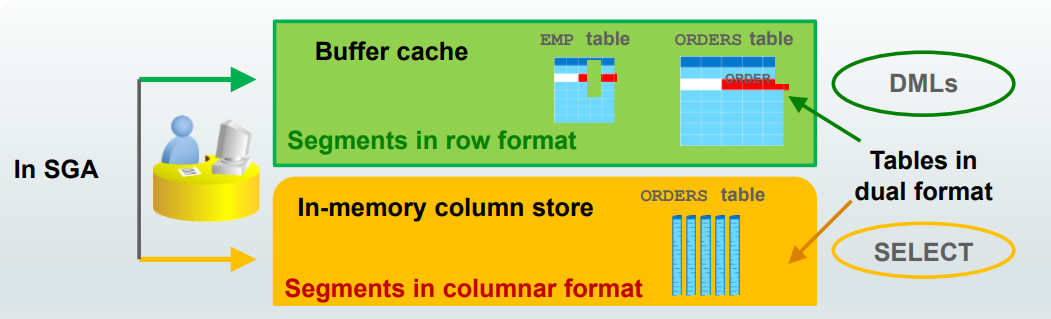
In-Memory Column Store- enables objects (tables, partitions, and other types) to be stored in memory in a new format known as the
columnar format.
- enables objects (tables, partitions, and other types) to be stored in memory in a new format known as the
-
columnar format- enables scans, joins, and aggregates to perform much faster than the traditional on-disk format, thus providing fast reporting and DML performance for both
OLTPandDWenvironments. - useful for analytic applications that operate on few columns returning many rows rather than for OLTP that operates on few rows returning many columns.
- The DBA must define the segments that are to be populated into the in-memory column store (IM column store), such as hot tables, partitions, and, more precisely, the more frequently accessed columns.
- enables scans, joins, and aggregates to perform much faster than the traditional on-disk format, thus providing fast reporting and DML performance for both
-
When a segment, such as a table or a partition, is populated into the
IM column store, the on-disk format segment is automatically converted into a columnar format and optionally compressed.- The columnar format is a pure in-memory format.
- There is no columnar format storage on disk. It never causes additional writes to disk and therefore does not require any logging or undo space.
- All data is stored on disk in the traditional row format.
-
The in-memory columnar format does not replace the on-disk or buffer cache format. It is a consistent copy of a table or of some columns of a table converted to the new columnar format that is independent of the disk format and only available in memory.
- Because of this independence, applications are able to transparently use this option without any changes.
-
Moreover, the columnar format of a segment is a transaction-consistent copy of the segment either on disk or in the buffer cache. Transaction consistency between the two pools is maintained.
- For the data to be converted into the new columnar format, a new pool is requested in the
SGA. The pool is theIM column store.- If sufficient space is allocated for the
IM column store, a query that accesses objects that are candidates to be populated into the IM column store performs much faster. - The improved performance allows ad hoc analytic queries to be executed directly on the real-time transaction data without impacting the existing workload.
- A lack of IM column store space does not prevent statements from executing against tables that could have been populated into the IM column store.
- If sufficient space is allocated for the
Summary
| portion of the SGA | Process | File | Desc |
|---|---|---|---|
Shared pool |
data dict,sql statement | ||
Database Buffer Cache |
DBWn |
data file |
holds block images read from data files |
Redo Log Buffer |
LGWR |
redo log file |
holds information about changes |
Large Pool |
Session, IO, Query, queue | ||
Java Pool |
JVM | ||
Streams Pool |
Streams processes |
Queue messages |