Note_Tech
All technological notes.
Project maintained by simonangel-fong Hosted on GitHub Pages — Theme by mattgraham
DBA - Undo
- DBA - Undo
Undo
-
undo:- records of the actions of transactions, primarily before being committed, that are used to roll back, or undo 撤消, changes to the database.
-
Undo recordsare used to support:- Rollback operation
- When a
ROLLBACKstatement is issued,undo recordsare used to undo changes that were made to the database by the uncommitted transaction.
- When a
- Recover the database
- During database recovery,
undo recordsare used to undo any uncommitted changes applied from theredo logto the data files. (Roll forward + roll back)
- During database recovery,
Oracle Flashback Query,Oracle Flashback Transaction, andOracle Flashback Table- Read consistency queries
Undo recordsprovide read consistency by maintaining thebefore imageof the data for users who are accessing the data at the same time that another user is changing it.
- Rollback operation
failed transaction:- occurs when a
user sessionends abnormally (possibly because of network errors or a failure on the client computer) before the user decides to commit or roll back the transaction. 用户端 - occurs when the instance crashes or you issue the
SHUTDOWN ABORTcommand.服务器端
- occurs when a
Undo datacan be used to recover fromfailed transaction
- Example:

- UserA update data but not commit.
- UserA is the only one who can see updated value, 6000, because he did not commit yet.
- Other user queries the tb, they see old value, 5000. This is
Read Consistency.
- The old value, 5000, is the
undo data, which is stored inundo segment.
-
The Oracle Database server saves the old value (
undo data) when a process changes data in a database.- It stores the data as it exists before modifications.如同未改变
- Retained at least until the transaction is ended.保存直到交易结束.
-
How the transaction ends?
- User undoes a transaction using
ROLLBACKclause. (transaction rolls back). - session terminates abnormally (transaction rolls back).
- User ends a transaction (transaction commit).
- User session terminates normally with an exit (transaction commits).
- User executes a
DDLstatement, such as aCREATE,DROP,RENAME, orALTERstatement.(transaction implicitly commits)
- User undoes a transaction using
Transactions and Undo Data
-
Undo segments- specialized segments that are automatically created by the database server as needed to support transactions.自动创建
- are made up of
extents, which, in turn, consist ofdata blocks.结构 - automatically grow and shrink as needed, acting as a circular storage buffer for their assigned transactions.自动缩涨
- 如果有太多交易没有提交, 则可能面临 undo 不够空间的情况. 解决方法是, 当交易达到某个数量, 如 loop 1000, 提交交易. 则交易完成, undo 会自动清理旧数据.
Undo segmentsare automatically created and always owned bySYS.-
Because the
undo segmentsact as a circular buffer, each segment has a minimum of twoextents. 至少有两个- The default maximum number of extents depends on the database block size but is very high (32,765 for an 8 KB block size).
-
Undo segments& Transactions:- Each transaction is assigned to only one
undo segment. 每个交易只分配到一个 segment - An
undo segmentcan service more than one transaction at a time. 一个 segment 可以同时服务多个交易 - When a transaction starts, it is assigned to an
undo segment.- Throughout the life of the transaction, when data is changed, the original (before the change) values are copied into the
undo segment.一旦修改数据, 则原有值会被复制到 undo
- Throughout the life of the transaction, when data is changed, the original (before the change) values are copied into the
- Each transaction is assigned to only one
-
V$TRANSACTIONview:- see which transactions are assigned to which
undo segments
- see which transactions are assigned to which
-
undo tablespace:- a tbsp to store
undo segmentsthat containundo data. - cannot create other segment types, such as tables, in the
undo tablespace
- a tbsp to store
Undo tablespacesare permanent,locally managed tablespaceswithautomatic extent allocation. ASSM- They are automatically managed by the database.
- Because
undo datais required to recover fromfailed transactions(such as those that may occur when an instance crashes),undo tablespacescan be recovered only while the instance is in theMOUNTstate.
- The
Database Configuration Assistant (DBCA)automatically creates asmallfile undo tablespace.默认小文件- You can also create a
bigfile undo tablespace.
- You can also create a
- However, in a high-volume
online transaction processing (OLTP)environment with many short concurrent transactions, contention could occur on thefile header. 并发会在文件头产生资源争夺.- An
undo tablespace, stored in multipledatafiles, can resolve this potential issue.解决方法: 多个 DF - Although a database may have many
undo tablespaces, only one of them at a time can be designated as thecurrent undo tablespacefor any instance in the database.可以有多个 undo TBSP,只有一个 tbsp 能被分配.
- An
Categories of Undo
-
Active Undo data:- the uncommitted undo information
- required if a user wants to roll back or if the transaction has failed.
- Uncommitted undo information is never overwritten. 与保留期无关, 不会被覆盖.
-
Unexpired Undo data:- Committed undo information
- Old undo information with an age that is less than the current
undo retention period - retained for
consistent readandOracle Flashbackoperations
-
Expired Undo data:- Expired undo information
- Old (committed) undo information that is older than the current
undo retention period - its space is available to be overwritten by new transactions. 可以被覆盖.
Lab: Undo Data
Commit Transaction
- Setup env
show user;
-- USER is "PDBTS_ADMIN"
show con_name;
--CON_NAME
----------------------------
--PDBTS

-- create tb
create table emp
(
    n number,
    sal number
);
- insert transactions
-- insert data
insert into emp values (1,500);
insert into emp values (2,400 );

-- query transaction within current session
select a.sid, a.serial#, a.username, b.used_urec, b.used_ublk
from   v$session a,
       v$transaction b
where  a.saddr = b.ses_addr
order by b.used_ublk desc;
-- 43	19457	PDBTS_ADMIN	2	1
--USED_UBLK = Number of undo blocks used
--USED_UREC = Number of undo records used
- the number of undo records is the number of transaction made.
- make one additional transaction
- the number of undo records updated.
insert into emp values (3,700);

select a.sid, a.serial#, a.username, b.used_urec, b.used_ublk
from   v$session a,
       v$transaction b
where  a.saddr = b.ses_addr
order by b.used_ublk desc;
--43	19457	PDBTS_ADMIN	3	1
-- one more undo record
- Commit transaction and query undo records
commit; --this mean end of transaction

select a.sid, a.serial#, a.username, b.used_urec, b.used_ublk
from   v$session a,
       v$transaction b
where  a.saddr = b.ses_addr
order by b.used_ublk desc;
-- return no row
-- undo data will be removed when transaction ends.
Rollback Transaction
insert into emp values (1,500);
insert into emp values (2,400 );

select s.sid, s.serial#, s.username, t.used_urec, t.used_ublk
from   v$session s,
       v$transaction t
where  s.saddr = t.ses_addr
order by t.used_ublk desc;
-- 43	19457	PDBTS_ADMIN	2	1

rollback;

select s.sid, s.serial#, s.username, t.used_urec, t.used_ublk
from   v$session s,
       v$transaction t
where  s.saddr = t.ses_addr
order by t.used_ublk desc;
-- return no row
Implicitly Commit by DDL
- Change before DDL
- 2 uncommited record in undo.
-- DDL

SELECT count(*)
FROM emp;
-- 3

insert into emp values (1,500);
insert into emp values (2,400);

select s.sid, s.serial#, s.username, t.used_urec, t.used_ublk
from   v$session s,
       v$transaction t
where  s.saddr = t.ses_addr
order by t.used_ublk desc;
-- 43	19457	PDBTS_ADMIN	2	1
- Issue DDL by rename
- undo data are removed
- change committed
-- DDL
ALTER TABLE emp
RENAME COLUMN sal TO sale;

select s.sid, s.serial#, s.username, t.used_urec, t.used_ublk
from   v$session s,
       v$transaction t
where  s.saddr = t.ses_addr
order by t.used_ublk desc;
-- return no row

SELECT count(*)
FROM emp;
-- 5
Undo Data VS Redo Data
Redo log files:- stores changes to the database as they occur and are used for data recovery.
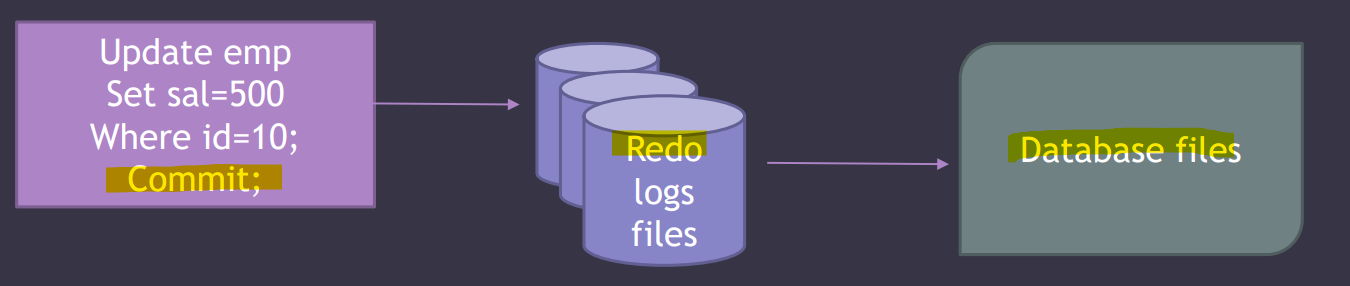
- When update and commit, the data will first go to the redo log files.
- The data will move from redo log file to the database file.
| Undo | Redo | |
|---|---|---|
| Used for | Rollback, Read Consistency, Flashback | Rolling Forward |
| Stored in | Undo segments | Redo Log Files |
- Redo log and backup
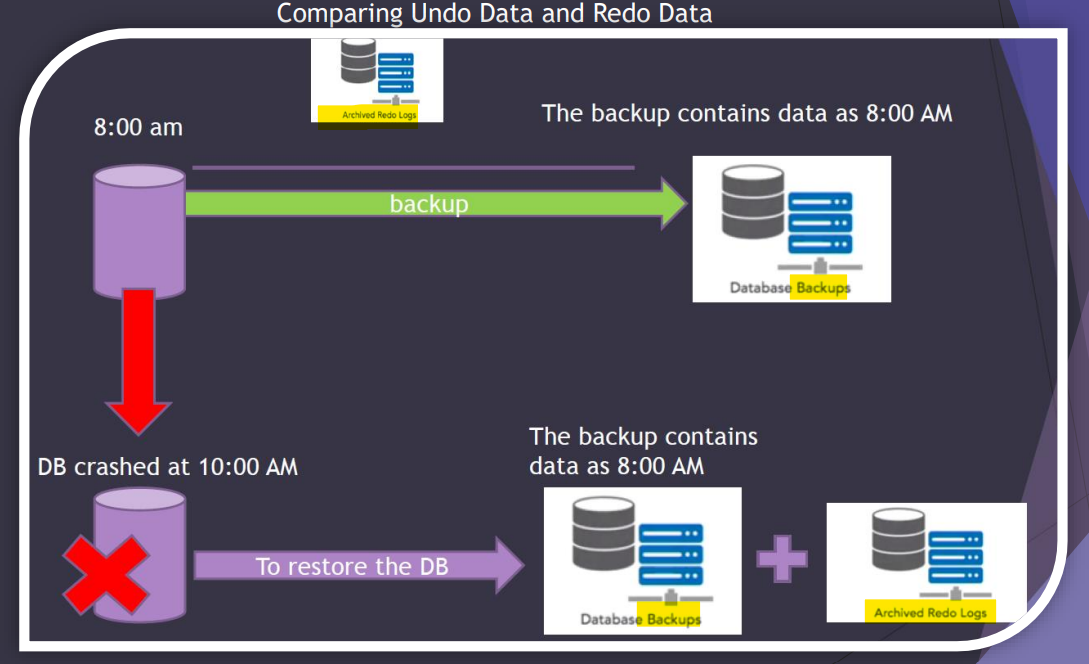
- backup + archive redo log => Restore and Recovery
UNDO TABLESPACE
Lab: Undo TBSP
- Setup Env
- Create a tbsp using dbca
- name: pdbundo
- admin: PDBUNDO_ADMIN
dbca

sqlplus /  as sysdba
show user
show con_name

-- move session to the pdbundo
alter session set container=pdbundo;
show con_name

-- grant pdb admin privileges
grant create session, dba to pdbundo_admin;

-- verify
connect pdbundo_admin@pdbundo as sysdba
show user
show con_name
Manually Create undo tbsp
show CON_NAME
--CON_NAME
--------------------------------
--PDBUNDO
show user
--USER is "PDBUNDO_ADMIN"

-- query tbsp in current pdb
SELECT TABLESPACE_NAME, BLOCK_SIZE, STATUS, CONTENTS, LOGGING, SEGMENT_SPACE_MANAGEMENT, COMPRESS_FOR
FROM dba_tablespaces;
--SYSTEM	8192	ONLINE	PERMANENT	LOGGING	    MANUAL
--SYSAUX	8192	ONLINE	PERMANENT	LOGGING	    AUTO
--UNDOTBS1	8192	ONLINE	UNDO	    LOGGING	    MANUAL
--TEMP	    8192	ONLINE	TEMPORARY	NOLOGGING	MANUAL
--USERS	    8192	ONLINE	PERMANENT	LOGGING	    AUTO
-- by default, oracle creates undo tbsp for a pdb.

-- ddl of default undo tbsp
-- note the autoextend
SELECT dbms_metadata.get_ddl('TABLESPACE','UNDOTBS1') FROM dual;
--"CREATE UNDO TABLESPACE "UNDOTBS1" DATAFILE
--  SIZE 104857600
--  AUTOEXTEND ON NEXT 5242880 MAXSIZE 32767M
--  BLOCKSIZE 8192
--  EXTENT MANAGEMENT LOCAL AUTOALLOCATE"

-- the database know which undo to be used from the parameter UNDO_TABLESPACE
SHOW PARAMETER undo_tablespace
--NAME            TYPE   VALUE
----------------- ------ --------
--undo_tablespace string UNDOTBS1
-- the current db uses UNDOTBS1

-- create undo tbsp
CREATE UNDO TABLESPACE undotbs_k
DATAFILE '/u01/app/oracle/oradata/ORCL/pdbundo/undotbs_k01.dbf'
SIZE 10M;

-- query ddl
SELECT dbms_metadata.get_ddl('TABLESPACE','UNDOTBS_K') FROM dual;
--"CREATE UNDO TABLESPACE "UNDOTBS_K" DATAFILE
--  '/u01/app/oracle/oradata/ORCL/pdbundo/undotbs_k01.dbf' SIZE 10485760
--  BLOCKSIZE 8192
--  EXTENT MANAGEMENT LOCAL AUTOALLOCATE"
--
- note: undo tbsp is not autoextend
Error due to limited space
-- switch undo tbsp
ALTER SYSTEM SET undo_tablespace=undotbs_k SCOPE=BOTH;

-- show current undo tbsp
show parameter undo_tablespace
--NAME            TYPE   VALUE
----------------- ------ ---------
--undo_tablespace string UNDOTBS_K

-- create tb
CREATE TABLE test100
(
    emp_id number,
    name varchar2(100)
);

-- query ddl
SELECT dbms_metadata.get_ddl('TABLE','TEST100') FROM dual;
--"
--  CREATE TABLE "PDBUNDO_ADMIN"."TEST100"
--   (	"EMP_ID" NUMBER,
--	"NAME" VARCHAR2(100)
--   ) SEGMENT CREATION DEFERRED
--  PCTFREE 10 PCTUSED 40 INITRANS 1 MAXTRANS 255
-- NOCOMPRESS LOGGING
--  TABLESPACE "USERS" "

INSERT INTO test100
VALUES(1,400);

-- query undo
select s.sid, s.serial#, s.username, t.used_urec, t.used_ublk
from   v$session s,
       v$transaction t
where  s.saddr = t.ses_addr
order by t.used_ublk desc;
-- 42	46524	PDBUNDO_ADMIN	1	1
-- have one record

-- insert 400000 data
BEGIN
    FOR i IN 1..400000
    LOOP
        INSERT INTO test100 VALUES (i, 'any dummy name');
    END LOOP;
    -- note: commit after insert all data, leading to insufficient size of undo
    COMMIT;
END;
--Error report -
--ORA-30036: unable to extend segment by 8 in undo tablespace 'UNDOTBS_K'
--ORA-06512: at line 4
--30036. 00000 -  "unable to extend segment by %s in undo tablespace '%s'"
--*Cause:    the specified undo tablespace has no more space available.
--*Action:   Add more space to the undo tablespace before retrying
--           the operation. An alternative is to wait until active
--           transactions to commit.
/
Local Undo Mode Versus Shared Undo Mode
-
Two UNDO modes:
SHAREDLOCAL
-
There is only one
shared UNDO tablespace(in CDB root). - There can be a
local UNDO tablespacein each PDB - You can set a CDB in
local UNDO modeeither at CDB creation or by altering the CDB property.- table:
DATABASE_PROPERTIESpropertyLOCAL_UNDO_ENABLED=true - note: it is
trueby default in release 18c
- table:

-
Use case of local UNDO mode
- Hot cloning
- Near-zero downtime PDB relocation
-
Command to enable local UNDO mode
STARTUP UPGRADE
ALTER DATABASE LOCAL UNDO ON;
- Clone when in local mode: Default
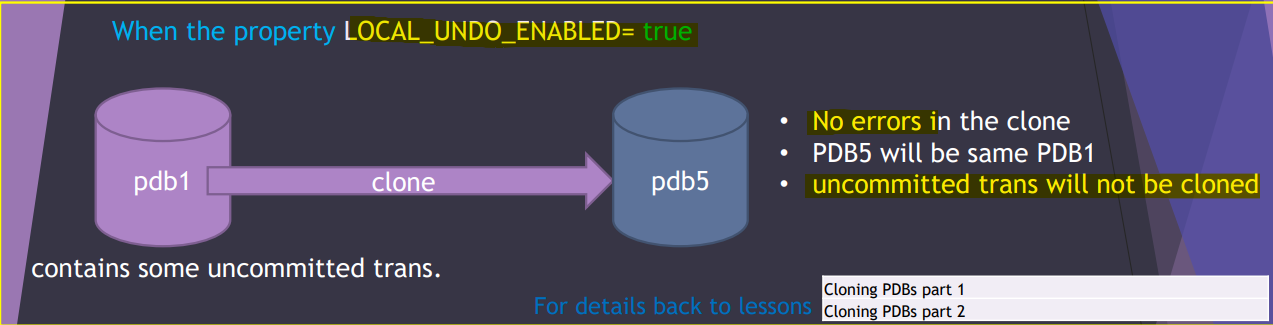
- Uncommitted data will not be cloned since only the clean data and committed transactions are copied.
- Clone when in shared mode:
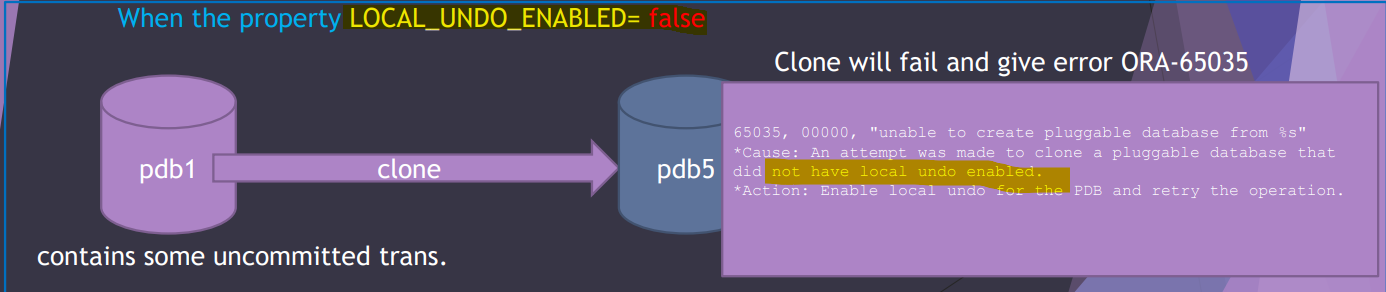
- fails because in shared mode, database has only one shared undo tbsp. The clone of one pdb will affect other pdb.
Lab: Shared Undo Mode and clone pdb
sqlplus / as sysdba

-- confirm in the root
show user
show con_name

-- query undo mode
select property_value
from database_properties
where property_name='LOCAL_UNDO_ENABLED';
-- PROPERTY_VALUE
-- ------------------------------------------------------------------------------
-- TRUE

-- set local undo mode to be false
shutdown immediate
startup upgrade;
alter database local undo off;
shutdown immediate;
startup

-- verify
select property_value from database_properties where property_name='LOCAL_UNDO_ENABLED';
-- PROPERTY_VALUE
-- ------------------------------------------------------------------------------
-- FALSE
- try to clone pdb in shared undo mode with uncommitted data
-- move to a pdb
show pdbs
alter session set container=orclpdb;
show con_name
-- CON_NAME
-- ----------------------------
-- ORCLPDB
alter pluggable database open;

-- create table then do uncommited trans
create table test (n number);
insert into test values (1);
- Open a new terminal
-- create path for dest pdb
mkdir /u01/app/oracle/oradata/ORCL/pdbkh1

sqlplus / as sysdba
show user
show con_name -- in root

-- clone pdb
create pluggable database pdbkh1 from orclpdb
create_file_dest = '/u01/app/oracle/oradata/ORCL/pdbkh1';
-- ERROR at line 1:
-- ORA-65035: unable to create pluggable database from ORCLPDB

-- get info of the error
host oerr ora 65035
-- 65035, 00000, "unable to create pluggable database from %s"
-- // *Cause:  An attempt was made to clone a pluggable database that did not have
-- //          local undo enabled.
-- // *Action: Enable local undo for the PDB and and retry the operation.
- Reset the local undo mode
shutdown immediate
startup upgrade;
alter database local undo on;
shutdown immediate;
startup

-- verify
select property_value from database_properties where property_name='LOCAL_UNDO_ENABLED';
-- TRUE

-- Now it can clone pdb.
create pluggable database pdbkh1 from orclpdb
create_file_dest = '/u01/app/oracle/oradata/ORCL/pdbkh1';  2
-- Pluggable database created.

-- clean up
DROP PLUGGABLE DATABASE pdbkh1 INCLUDING DATAFILES;
Automatic Undo Management
- Oracle provides a fully automated mechanism for managing undo information and space.
- the database manages
undo segmentsin anundo tablespace. -
Automatic undo management- the default mode for a newly installed database.
-
An auto-extending
undo tablespacenamedUNDOTBS1is automatically created when you create the database withDatabase Configuration Assistant (DBCA). -
When the database instance starts, the database automatically selects the first available undo tablespace.
- If no undo tablespace is available, then the instance starts without an undo tablespace and stores undo records in the
SYSTEMtablespace.- This is not recommended, and an alert message is written to the
alert log fileto warn that the system is running without an undo tablespace.
- This is not recommended, and an alert message is written to the
- If no undo tablespace is available, then the instance starts without an undo tablespace and stores undo records in the
-
UNDO_MANAGEMENTparameter:- specifies which undo space management mode the system should use.
- Values:
AUTO: Default, the instance starts inautomatic undo management mode.MANUAL: manual undo management mode,undo spaceis allocated externally asrollback segments.- Space management for
rollback segmentsis complex. Oracle strongly recommends leaving the database inautomatic undo management mode
- Space management for
- Note:In a CDB, the
UNDO_MANAGEMENTinitialization parameter must be set toAUTO, and anundo tablespaceis required to be created to manage the undo data.
UNDO_TABLESPACEparameter:- specifies the
undo tablespaceto be used when an instance starts. - If this parameter is specified when the instance is in
manual undo management mode, then an error will occur and startup will fail.
- specifies the
Flashback
Lab: Flashback Table
- Setup env
- Connect with orclpdb using user hr
select * from employees;

-- create a tb copying from employees
create table emp_copy3
as
select * from employees;

select * from emp_copy3;
- Drop tb and query recyclebin
-- drop tb
--  DDL statement automatically committed
drop table emp_copy3;

select * from emp_copy3;
-- ORA-00942: table or view does not exist
-- 00942. 00000 -  "table or view does not exist"

-- query recyclebin
select * from recyclebin;
-- BIN$GouL2faYaDngYyUAqMBjcw==$0	EMP_COPY3	DROP	TABLE	USERS	2024-06-10:11:07:23	2024-06-10:11:10:14	11200544		YES	YES	73404	73404	73404	8
- Note the DROPSCN: 11200544
SCN:- an internal number maintained by the database management system to log changes made to a database.
- Whenever an application commits a transaction, the
log writer process (LGWR)writes records from theredo log buffersin theSGAto the onlineredo logson disk. 将记录从 buffer 写入 redo log -
LGWRalso writes the transaction’s SCN to the onlineredo log file. 同时将 SCN 写入. - Flashback tb
flashback  table emp_copy3 to before drop;

-- verify
select * from emp_copy3;

-- query recyclebin
select * from recyclebin;
-- return no row

-- Command to empty the recycle bin
purge recyclebin
Lab: Flashback Version Query
Oracle Flashback Version Query:- used to retrieve the different versions of specific rows that existed during a given time interval.
- A row version is created whenever a
COMMITstatement is executed.
- setup env
-- query before new row version
select salary from
employees
where employee_id=107;
-- 4200

-- update tb to create a new row version
update
employees
set salary=salary+100
where employee_id=107;
commit; -- thi will make new scn

-- query after new row version
select salary from
employees
where employee_id=107;
-- 4300
- Query version
-- query version
select
    versions_starttime
    , versions_endtime
    , salary
from employees
versions between scn minvalue and maxvalue  -- specify time interval
where employee_id=107;
--10-JUN-24 11.21.01.000000000 AM   (null)                          4300
--(null)                            10-JUN-24 11.21.01.000000000 AM	4200

-- create a new row version
update
employees
set salary=salary+100
where employee_id=107;
commit;

-- query version
select
    versions_starttime
    , versions_endtime
    , salary
from employees
versions between scn minvalue and maxvalue  -- specify time interval
where employee_id=107;
--10-JUN-24 11.27.51.000000000 AM	  (null)	                            4400
--10-JUN-24 11.21.01.000000000 AM   10-JUN-24 11.27.51.000000000 AM     4300
--(null)                            10-JUN-24 11.21.01.000000000 AM	    4200
-
Question: until when i can see these records ???
- This depend on many factors:
-
- Tablespace type (fixed or auto extend)
-
- The retention period
UNDO_RETENTION
- The retention period
-
- Retention Guarantee
-
- This depend on many factors:
-
Query after 15min
-- query after 15min
select
    versions_starttime
    , versions_endtime
    , salary
from employees
versions between scn minvalue and maxvalue
where employee_id=107;
-- (null)   (null)  4400
Undo Retention Period
-
Undo retention period- the minimum amount of time that Oracle Database attempts to retain old undo information before overwriting it.
- Prerequisites:
- when automatic undo management is enabled.
-
Ater a transaction is committed, undo data is no longer needed for rollback or transaction recovery purpose. But for 2 reasons, old data are kept in undo:
- For consistent read purposes, long-running queries my require this old undo information for producing older images of data blocks.为读取一致性
- It is better to set undo retention longer than the longest-running query.
- Furthermore, the success of several Oracle
Flashbackfeatures can also depend upon the availability of older undo information. 为闪回
- For consistent read purposes, long-running queries my require this old undo information for producing older images of data blocks.为读取一致性

UNDO_RETENTION:- pecifies (in seconds) the low threshold value of undo
- default: 900s (15m)
Automatic Tuning of Undo Retention
-
Oracle Database automatically tunes the
undo retention periodbased on how theundo tablespaceis configured.-
If the
undo tablespaceis configured with theAUTOEXTENDoption,- the database dynamically tunes the
undo retention periodto be somewhat longer than the longest-running active query on the system. 一般保留期会长于最长的查询 - However, this retention period may be insufficient to accommodate Oracle
Flashbackoperations. 但可能不满足闪回 - Oracle
Flashbackoperations resulting insnapshot too olderrors are the indicator that you must intervene to ensure that sufficient undo data is retained to support these operations. - To better accommodate Oracle Flashback features, you can either set the
UNDO_RETENTIONparameter to a value equal to the longest expected OracleFlashbackoperation, or you can change theundo tablespaceto fixed size. 保留期等于最长闪回, 或设置为固定大小
- the database dynamically tunes the
-
If the
undo tablespaceis fixed size,- It ignore the value of
undo_retentionUnless you enableretention guarantee. -
the database dynamically tunes the
undo retention periodfor the best possible retention for that tablespace size and the current system load. 如果是固定大小, 则保留期根据大小和载荷动态调优. - This best possible retention time is typically significantly greater than the duration of the longest-running active query.通常远大于最长查询
- It ignore the value of
-
If you decide to change the
undo tablespaceto fixed-size,- you must choose a tablespace size that is sufficiently large. 变为固定大小, 则需要足够大空间
- If you choose an
undo tablespacesize that is too small, the following two errors could occur: 可能引起两种错误- DML could fail because there is not enough space to accommodate undo for new transactions.
- Long-running queries could fail with a
snapshot too olderror, which means that there was insufficientundo dataforread consistency.
-
Lab: Undo Retention
- Confirm
- undo parameter
undo_retentionis 900s
- PDB undo tablespace is
- noguarantee
- autoextend
- undo parameter
show user;
-- USER is "PDBTS_ADMIN"
show con_name;
--CON_NAME
--------------------------------
--PDBTS

-- query parameter
show parameter undo
--NAME              TYPE    VALUE
------------------- ------- --------
--temp_undo_enabled boolean FALSE
--undo_management   string  AUTO
--undo_retention    integer 900
--undo_tablespace   string  UNDOTBS1

-- query tbsp
-- note the retention: NOGUARANTEE
-- NOGUARANTEE:
select *
from DBA_TABLESPACES;
-- UNDOTBS1	8192	65536		1	2147483645	2147483645		65536	ONLINE	UNDO	LOGGING	NO	LOCAL	SYSTEM	NO	MANUAL	DISABLED	NOGUARANTEE	NO	HOST	NO		DISABLED					SHARED	DISABLED					OFF	N

-- query ddl
SELECT DBMS_METADATA.GET_DDL('TABLESPACE','UNDOTBS1') FROM dual;
--  CREATE UNDO TABLESPACE "UNDOTBS1" DATAFILE
--  SIZE 120586240
--  AUTOEXTEND ON NEXT 120586240 MAXSIZE 32767M
--  BLOCKSIZE 8192
--  EXTENT MANAGEMENT LOCAL AUTOALLOCATE
-- note: enable AUTOEXTEND
- RETENTION:
NOGUARANTEE
- Oracle will ignore the retention period. The old data can be overwritten more or less than 900, according to the size of undo tbsp.
- UNDO Tablespace: enable
AUTOEXTEND
- Oracle will adjust the undo_retention automaticlly (for active query)
- but flashback operations ( maybe or maybe not work )
- In Session A
-- change the retention
alter system set undo_retention=1;

-- create tb
create table xyz
(id number primary key, val number );

-- insert data
begin
for i in 1..500000
loop
insert into xyz values (i,500);
end loop;
commit;
end;
/

-- verify data
select * from xyz
order by 1;

--now do this without commit

-- update data
update xyz
set val=0
where id =500000;
-- data is in the undo tbsp
- Change the parameter
undo_retentionto 1s.- The updated data is in the undo and only can be seen in the current session.
- Open a new session B
-- In session B

-- create tb
create table xyz_copy
(id number primary key, val number );

--this wil insert the data from xyz to xyz_copy
begin
for i in (select * from xyz)
loop
insert into xyz_copy values (i.id, i.val );
end loop;
commit;
end;
/
- note: the value of id 500000 still 500 because the user did not commit
- While the plsql is executed in session B, commit the updated data in session A.
-- session A
commit
- Query data in session B
-- verify the data
select * from xyz_copy
where id=500000;
-- 500000	500
- Oracle adjust the
undo retentionautomatically when the undo tbsp is autoextend, and it ignore the paramter.
- In this example,
undo tablespaceis autoextend andundo_retentionis set to be 1s.- When the session A committed the data, the committed data became
unexpired undo, which is used by active query or flashback.
unexpired undois supposed to be kept for 1s.- Actually, Oracle automatically adjust the undo retention.
- The Oracle ignores the
undo_retentionparameter.- The value in session B is the old version, 500, due to
read consistency.
- The commit in session A is after the plsql in session B. To keep the read consistency in session B, the old version in undo is used.
- This also proves that the actual retention is automatically managed, ignoring the value in the paramter.
- Test Flashback
--flashback maybe or maybe not work

select versions_starttime,versions_endtime, val from
 xyz
versions between scn minvalue and maxvalue
where id=500000;
--10-JUN-24 12.46.22.000000000 PM		0
--	10-JUN-24 12.46.22.000000000 PM	500
- Even flashback works for this case, it cannot work. It depends on the size of undo tbsp.
Retention Guarantee
-
To guarantee the success of long-running queries or Oracle Flashback operations, you can enable
retention guarantee. - If
retention guaranteeis enabled,- then the specified
minimum undo retentionis guaranteed; - the database never overwrites
unexpired undo dataeven if it means that transactions fail due to lack of space in the undo tablespace.
- then the specified
-
If
retention guaranteeis not enabled,- then the database can overwrite
unexpired undowhen space is low, thus lowering the undo retention for the system. This option is disabled by default.
- then the database can overwrite
-
WARNING:
- Enabling
retention guaranteecan cause multipleDMLoperations to fail. Use with caution.
- Enabling
-
To enable
retention guaranteeRETENTION GUARANTEEclause for theundo tablespacewith- the
CREATE DATABASEOrCREATE UNDO TABLESPACEstatement. - an
ALTER TABLESPACEstatement.
- the
-
To disenable
retention guaranteeRETENTION NOGUARANTEEclause.
RETENTIONcolumn inDBA_TABLESPACESview:- determine the retention guarantee setting for the undo tablespace.
- values:
GUARANTEE,NOGUARANTEE, OrNOT APPLY, whereNOT APPLYis used for tablespaces other than the undo tablespace.