Note_Tech
All technological notes.
Project maintained by simonangel-fong Hosted on GitHub Pages — Theme by mattgraham
DBA - SGA: Database Buffer Cache
Database Buffer Cache
-
database buffer cache/buffer cache- the memory area that stores copies of data blocks read from data files.
-
buffer- a main memory address in which the buffer manager temporarily caches a currently or recently used data block.
- All users share access to the buffer cache.
-
Purpose
- Optimize physical I/O
- update data block -> store in
redo log buffer-> write toonline redo log->DBWlazy write to data file. 不是马上写入,而是先缓存, 再由 DBW 写入. - 常考: when a transaction committed, the data will not be writen directly to the data file.
- Transaction happens in the memory, the buffer cache.
- update data block -> store in
- Keep frequently accessed blocks in the buffer cache and write infrequently accessed blocks to disk
- Optimize physical I/O
Buffer States
-
A buffer can be in any of the following mutually exclusive states: 以下状态之一, 不能同时.
-
Unused- it has never been used or is currently unused.
- available for use
- the easiest buffers for the database to use.
-
Clean- was used earlier and now contains a read-consistent version of a block as of a point in time.
- The block contains data but does not need to be checkpointed.
- The database can pin the block and reuse it.
-
Dirty- The buffer contain modified data that has not yet been written to disk.
- The database must checkpoint the block before reusing it.
-
-
access mode:- Every buffer has an
access mode: pinned or free (unpinned). - A buffer is “pinned” in the cache so that it does not age out of memory while a user session accesses it. 访问期间不会过期
- Multiple sessions cannot modify a pinned buffer at the same time.但不能同时修改.
- Every buffer has an
Buffer Modes
-
Buffer Modes- the mode of retrieved buffers from the buffer cache.
- either
current modeorconsistent mode.
-
Current modecurrent mode get/db block get:- a retrieval of a block as it currently appears in the buffer cache.
- e.g.: a current mode get retrieves the block with uncommitted rows.
- The database uses db block gets most frequently during modification statements, which must update only the current version of the block.
- a retrieval of a block as it currently appears in the buffer cache.
Consistent modeconsistent read get- a retrieval of a read-consistent version of a block.
- Typically, a query retrieves blocks in consistent mode.
Buffer I/O
-
buffer I/O/logical I/O- refer to reads and writes of buffers in the buffer cache.
-
When a requested buffer is not found in memory,
- the database performs a
physical I/Oto copy the buffer from either the flash cache or disk into memory. - The database then performs a
logical I/Oto read the cached buffer.
- the database performs a
Buffer Replacement Algorithms
-
Buffer Replacement Algorithms- the algorithm to decide which buffers to cache in memory, and which to access from disk, to make buffer access efficient
-
LRU-based, block-level replacement algorithm- default, algorithms
-
uses a
least recently used (LRU)list that contains pointers to dirty and non-dirty buffers. -
LRU list- has a hot end and cold end.
-
cold buffer- a buffer that has not been recently used.
-
hot buffer- frequently accessed and has been recently used.
- There is only one
LRU- but for data concurrency the database actually uses several
LRUs.
- but for data concurrency the database actually uses several
-
Temperature-based, object-level replacement algorithm- the
automatic big table cachingfeature enables table scans to use a different algorithm in the following scenarios: - Parallel queries
- single-instance + RAC
- Enable when the
DB_BIG_TABLE_CACHE_PERCENT_TARGET= nonzero value, andPARALLEL_DEGREE_POLICY=autooradaptive.
- Serial queries
- single-instance only
- Enable when
DB_BIG_TABLE_CACHE_PERCENT_TARGET= nonzero value,
- the
- When a table does not fit in memory, the database decides which buffers to cache based on access patterns.
- e.g.: if only 95% fits in memory, then leave 5% of the blocks on disk
- When caching multiple large objects, the database considers more popular tables hotter and less popular tables cooler, which influences which blocks are cached.
- The
DB_BIG_TABLE_CACHE_PERCENT_TARGETinitialization parameter sets the percentage of the buffer cache that uses this algorithm. - 该参数影响算法
- The
Buffer Writes
-
database writer (DBW) processperiodically writes cold, dirty buffers to disk. -
DBW writes buffers to disk when:
- Dirty buffer threshold, cannot find clean buffers for reading new blocks into the database buffer cache.
- free buffer for some operations is needed
- shutdown (normal, transactional, immediate)
- if shutdown abort, the dirty buffer will not be writen to data files.
- change the status for tbsp (e.g., read-onlye)
- during a checkpoint.
Buffer Reads
-
When the number of unused buffers is low, the database must remove buffers from the buffer cache.
-
The algorithm depends on whether the
flash cacheis enabled:-
Flash cachedisabled- The database re-uses each clean buffer as needed, overwriting it.
- If the overwritten buffer is needed later, then the database must read it from magnetic disk.
- 当需要重用缓存时, 覆盖缓存. 如果原缓存需要时, 从磁盘读取.
-
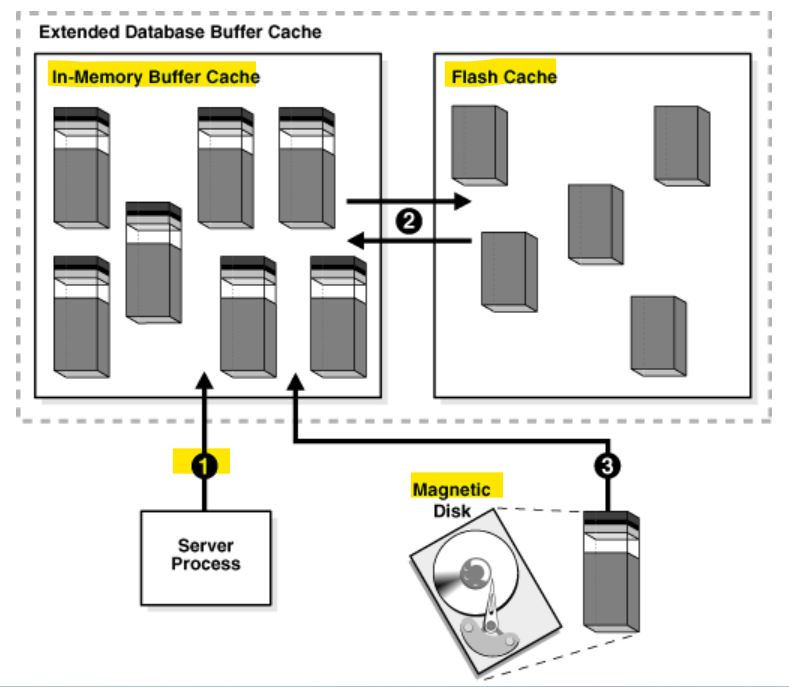
Flash cacheenabled- DBW can write the body of a clean buffer to the
flash cache, enabling reuse of itsin-memory buffer. - The database keeps the buffer header in an LRU list in main memory to track the state and location of the buffer body in the flash cache.
- If this buffer is needed later, then the database can read it from the flash cache instead of from magnetic disk.
- 将缓存体写入闪存, 保留缓存头在缓存. 当原缓存需要时, 从闪存中读取而不是从磁盘读取.
- DBW can write the body of a clean buffer to the
-
-
When a client process requests a buffer, the server process searches the buffer cache for the buffer.
-
cache hit- when the proces finds the buffer in memory.
-
cache miss- when the proces does not find the buffer in memory
-
Buffer Search order:
-
- The server process searches for the whole buffer in the buffer cache.
- If the process finds the whole buffer, then the database performs a
logical readof this buffer.
- If the process finds the whole buffer, then the database performs a
- The server process searches for the whole buffer in the buffer cache.
-
- The server process searches for the buffer header in the flash cache LRU list.
- If the process finds the buffer header, then the database performs an
optimized physical readof the buffer body from the flash cache into the in-memory cache.
- If the process finds the buffer header, then the database performs an
- The server process searches for the buffer header in the flash cache LRU list.
-
- If the process does not find the buffer in memory (a
cache miss), then the server process performs the following steps:-
- Copies the block from a data file on disk into memory (a physical read)
-
- Performs a
logical readof the buffer that was read into memory
- Performs a
-
- If the process does not find the buffer in memory (a
-
Performance:
- In general, accessing data through a
cache hitis faster than through acache miss. -
The
buffer cache hit ratio: -** how often** the database found a requested block in the buffer cache without needing to read it from disk. -
physical readscan be performed from- either a
data fileReadsfrom a data file are followed bylogical I/Os.- 读取数据文件后是逻辑输入输出
- or a
temp file.- occur when insufficient memory forces the database write data to a
temporary tableand read it back later. - bypass the buffer cache and do not incur a
logical I/O. - 仅当内存不足需要将数据写入临时表的情况. 绕过 buffer 从而不会发生逻辑 IO
- occur when insufficient memory forces the database write data to a
- either a
Buffer Touch Counts
-
touch count- used to measures the frequency of access of buffers on the LRU list. 衡量使用 LRU 缓存的频率
- enables the database to increment a counter when a buffer is pinned instead of constantly shuffling buffers on the LRU list.
- 会影响 LRU 算法的因素, 3 秒法则.
-
The database does not physically move blocks in memory.
- The movement is the change in location of a pointer on a list.
- When a buffer is pinned, the database determines when its touch count was last incremented.
- If the count was incremented over three seconds ago, then the count is incremented;
- otherwise, the count stays the same.
-
The
three-second ruleprevents a burst of pins on a buffer counting as many touches.- 不会因为暴涨的 pin 而影响 touch count, 从而影响 cold/hot, 影响算法.
- If a buffer is on the cold end of the LRU, but its
touch countis high, then the buffer** moves to the hot end**.- If the
touch countis low, then the buffer ages out of the cache.
- If the
Buffer Pools
-
buffer pool- a collection of buffers.
-
The b
uffer cacheis divided into one or morebuffer pools, which manage blocks in mostly the same way.- The pools do not have radically different algorithms for aging or caching blocks.
-
DBA can manually configure separate
buffer poolsthat either keep data in the buffer cache or make the buffers available for new data immediately after using the data blocks.- DBA can then assign specific schema objects to the appropriate
buffer poolto control how blocks age out of the cache. - e.g., can segregate segments into hot, warm, and cold buffer pools.
- 可以手动分缓存池.
- DBA can then assign specific schema objects to the appropriate
-
possible buffer pools
-
Default pool- the location where blocks are normally cached.
- Unless manually configure separate pools, the default pool is the only buffer pool.
-
The optional configuration of the other pools has no effect on the default pool.不受其他池影响
big table cache- an optional section of the
default poolthat uses atemperature-based, object-level replacement algorithm. 参见算法部分.
- an optional section of the
-
Keep pool- intended for blocks that were accessed frequently, but which aged out of the default pool because of lack of space.
- The purpose of the keep buffer pool is to retain objects in memory, thus avoiding I/O operations.
-
Recycle pool- intended for blocks that are used infrequently.
- A recycle pool prevent objects from consuming unnecessary space in the cache. 节省空间
-
- nondefault block size pool
- a tablespace can be created with a nondefault block size
- Each nondefault block size has its own pool.
- the blocks in these pools are managed in the same way as in the default pool.
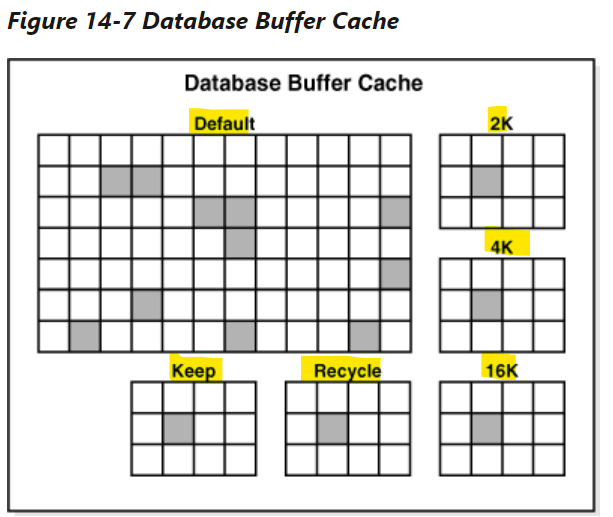
multiple pools are used.
- The cache contains
default,keep, andrecyclepools.- The default block size is 8 KB.
- The cache contains separate pools for tablespaces that use the nonstandard block sizes of
2KB,4KB, and16KB.