Note_Tech
All technological notes.
Project maintained by simonangel-fong Hosted on GitHub Pages — Theme by mattgraham
DBA - Physical Storage Architecture: Control File
Control File
- The database
control file:- is a small binary file associated with only one database.
- Each database has one unique control file, although multiple identical copies are permitted. 虽然可以有多份, 但一一对应.
Use of Control Files
-
control file- used to to locate
database filesand to manage the state of the database generally.
- used to to locate
-
control filecontains:- The
database nameanddatabase unique identifier (DBID) - The time stamp of database creation
- Information about
data files,online redo log files, andarchived redo log files TablespaceinformationRMANbackups
- The
-
purposes:
- It contains information required to open the database.
- The control file tracks structural changes to the database.
- e.g., when an administrator adds, renames, or drops a data file or online redo log file, the database updates the
control fileto reflect this change.
- e.g., when an administrator adds, renames, or drops a data file or online redo log file, the database updates the
- It contains
metadatathat must be accessible when the database is not open.- e.g., information required to recover the database, including
checkpoints. A checkpoint indicates theSCNin the redo stream where instance recovery would be required to begin. Every committed change before a checkpoint SCN is guaranteed to be saved on disk in the data files. At least every three seconds the checkpoint process records information in the control file about the checkpoint position in the online redo log.
- e.g., information required to recover the database, including
-
Oracle Database reads and writes to the control file continuously during database use and must be available for writing whenever the database is open.
- e.g., recover a database involves reading from the control file the names of all the data files contained in the database.
- e.g., Other operations, such as adding a data file, update the information stored in the control file.
Multiple Control Files
-
Oracle Database enables multiple, identical
control filesto be open concurrently and written to the same database.- By multiplexing a control file on different disks, the database can achieve redundancy and thereby avoid a single point of failure.
-
If a
control filebecomes unusable, then the databaseinstancefails when it attempts to access the damaged control file.- When other current control file copies exist, then you can remount the database and open it without media recovery.
-
If all
control filesof a database are lost, however, then the databaseinstancefails andmedia recoveryis required.- Media recovery is not straightforward if an older backup of a control file must be used because a current copy is not available.
Control File Structure
-
sectionof Control File:- Each section is a set of records about an aspect of the database.
- e.g., one section in the control file tracks data files and contains a set of records, one for each data file.
- Each section is stored in multiple logical control file blocks.
- Records can span blocks within a
section.
- Each section is a set of records about an aspect of the database.
-
types of records:
-
Circular reuse records- contains noncritical information that is eligible to be overwritten if needed.
- When all available record slots are full, the database either expands the control file to make room for a new record or overwrites the oldest record.
- e.g., records about
archived redo logfiles andRMAN backups.
-
Noncircular reuse records- contains critical information that does not change often and cannot be overwritten.
- e.g., include
tablespaces,data files,online redo log files, andredo threads. Oracle Database never reuses these records unless the corresponding object is dropped from the tablespace.
- e.g., include
- contains critical information that does not change often and cannot be overwritten.
-
-
only the database can modify the information in the control file.
-
Reading and writing the
control file blocksis different from reading and writingdata blocks.- For the control file, Oracle Database reads and writes directly from the disk to the
program global area (PGA). - Each process allocates a certain amount of its PGA memory for control file blocks.
- For the control file, Oracle Database reads and writes directly from the disk to the
-
Views:
V$DATABASE- to view the information stored in the control file
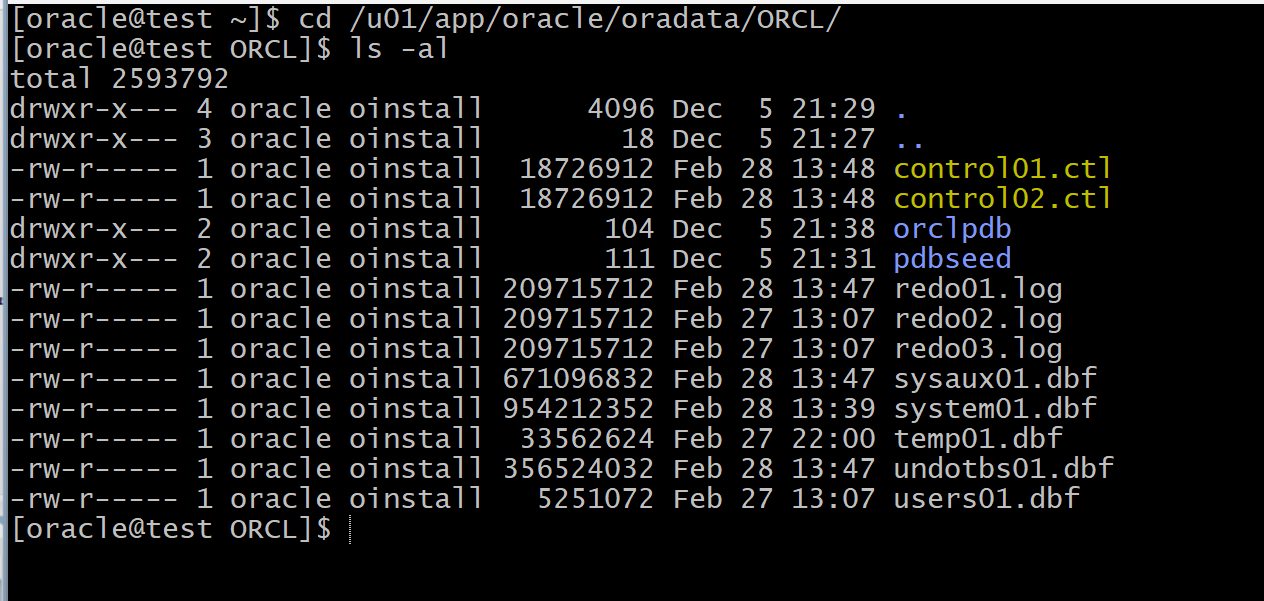
Lab: Query Control File
- Control files
- Stores metadata about the datafiles and online redo log files ( like names ,locations and statuses ) and this info is required by the database instance to open the database.
- very imprtant note: Control files exists in the whole instance, not for particular container
select * from V$CONTROLFILE;