Note_Tech
All technological notes.
Project maintained by simonangel-fong Hosted on GitHub Pages — Theme by mattgraham
Flashback - Flashback Data Archives
- Flashback -
Flashback Data Archives
Flashback Data Archives
Archive 不使用 undo, 而是使用 temporal table/tbsp
-
保留更长的
-
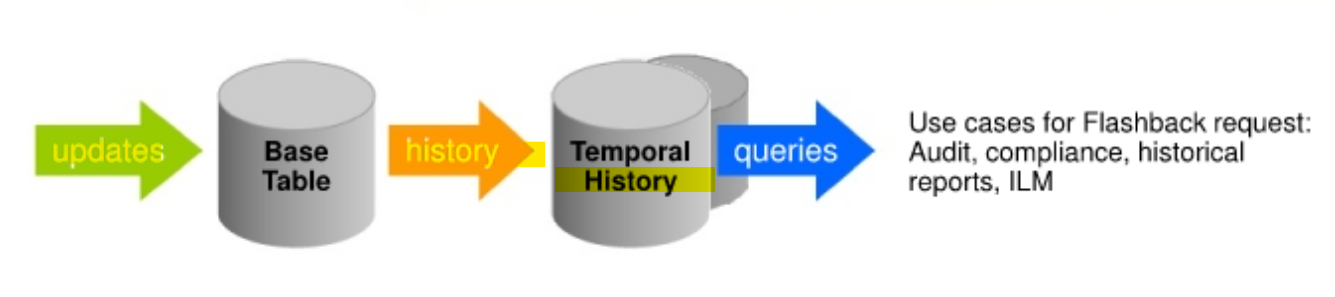
Flashback data archives:- enable to track and store all transactional changes to a “tracked” table over its lifetime.
-
Enable at the table level with specified retention period.
- Records older than retention period are automatically removed.
-
FDA have SQL-level access to the versions of database objects without getting a snapshot-too-old error.
- All subsequent changes are transparently stored and tamper 干预 proof.
-
You can use this technology for compliance, audit reports, data analysis, and decision-support systems.
- It is no longer necessary to build this intelligence into your application.
Creating a Temporal History and Enabling Archiving
- A
flashback data archiveconsists of one or moretablespaces. - You can have multiple
flashback data archives. - They are configured with retention duration.
- Based on your retention duration requirements, you should create different archives
- e.g.,
- one for all records that must be kept for two years,
- another for all records that must be kept for five years.
-
The database server will automatically purge all historical information on the day after the retention period expires.
-
Steps:
- Create a
tablespacefor yourFDA.- The size depends on the
base tableand the expectedDMLandDDLactivity.
- The size depends on the
-
Create a
flashback data archivewith retention time, by default, with duplication and without compression.- Data archived in FDA is retained for the retention time.
- This task requires the
FLASHBACK ARCHIVE ADMINISTERsystem privilege. - If different
retention periodsare needed, differentarchivesmust be created. - With the
OPTIMIZE DATAclause, the flashback data archive is created with compression and deduplication.
- Create a
-- creat a flashback archive named fda1
-- point the fda1 to the tbsp fda_tbs1
-- define a retention as one year
-- use optimize data to enable efficient storage
CREATE FLASHBACK ARCHIVE fda1 TABLESPACE fda_tbs1
OPTIMIZE DATA QUOTA 10M RETENTION 1 YEAR;
- Enable the flashback archiving (or disable it) for a (whole) table.
- This task requires the
FLASHBACK ARCHIVEobject privilege. - By default, flashback archiving is off for any table.
- Although flashback archiving is enabled for a table, some
DDLstatements are not allowed on that table.
- This task requires the
-- turn on flashback archive for the table to fda1
ALTER TABLE HR.EMPLOYEES FLASHBACK ARCHIVE fda1;
How the Flashback Data Archive Works
-
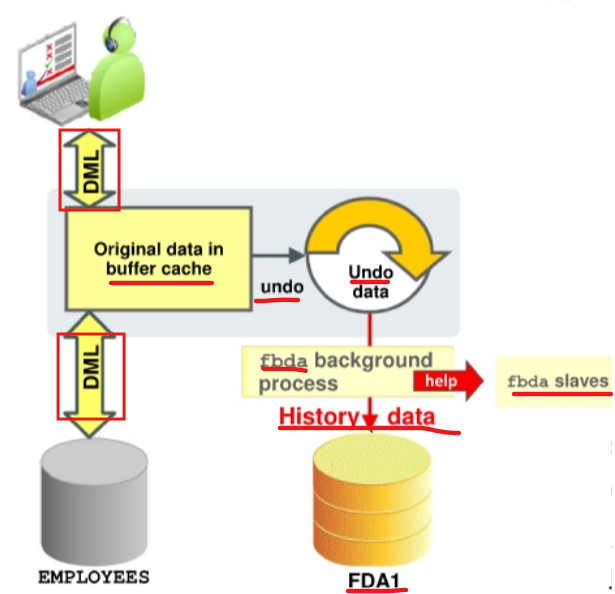
History data:
- Row captured asynchronously from
undo(andbuffer cache) by the£dbabackground process at self-tuned intervals.- default: 5 min
- The entire
base tablerow that is updated is stored, no matter how many columns are updated. 更新的行都会存储
- Automatically purged per
retention policy
- Row captured asynchronously from
-
Storage:
- default nonoptimized 没有优化
- Using
OPTIMIZE DATAclause:- compressed and deduplicated
-
OPTIMIZE DATAclause:- automatically turn on table and LOB compression and LOB deduplication
- enable features:
- Advanced Row table compression, SecureFiles Intelligent Compression, SecureFiles Intelligent Deduplication, and segment-level and row-level ILM compression.
- ILM is enabled to allow new data to be archived as uncompressed and over time is compressed in the background.
- Note: If the base table is compressed with Hybrid Columnar compression, the table cannot be enabled for flashback data archiving.
-
FDA
history tablesalready compressed and deduplicated in releases prior to 12.1 are not changed. Their storage continues compressed and deduplicated. -
To stop optimization on FDA
history tables:ALTER FLASHBACK ARCHIVE flal NO OPTIMIZE DATA;
Partitions
- Partitions automatically created based on time and volume 自动
-
Flashback queriesto the archives skip unrelated partitions. - Each
flashback archivepartition is at least1day and1 MBof data, partitioned onENDSCN.
process and slaves:
- Up to 10
flashback archiverslaves can be called upon by the£bdaprocess. 最多 10 个 - If the
flashback archiveprocess and slaves are too busy, archiving may be performed inline, which significantly affects the user’s response time.影响客户响应时间
Collecting User Context in Temporal History
-
The user context of a transaction executed on a table with
Temporal Historyis collected and retrievable. GET SYS CONTEXT (USERENV)function:- get user context of the current session.
DBMS_FLASHBACK_ARCHIVE.GET_SYS_CONTEXTfunction:- used to get user context
-
DBMS_FLASHBACK_ARCHIVE.SET_CONTEXT_LEVELfunction:- used to set parameter of user context collection
-
value:
- Default:
NONE, no user context is collected. TYPICAL: gets database user ID, global user ID, client identifier, service name, module name, or host name.ALL
- Default:
- Rows in these tables are purged when the commit time is older than the retention of the flashback archive with the longest retention.
-
Each row of the user context can be read only by the DBA or the owner of the transaction.
- Example:
EXEC DBMS_FLASHBACK_ARCHIVE.SET_ CONTEXT LEVEL ('TYPICAL')
/
SELECT
    DBMS_FLASHBACK_ARCHIVE.GET_SYS_CONTEXT
    (VERSIONS_XID, 'USERENV', 'SESSION USER'),
    VERSIONS_XID,
    VERSIONS_STARTTIME,
    VERSIONS_ENDTIME,
    employee_id,
    salary
FROM hr.employees VERSIONS BETWEEN SCN MINVALUE
AND MAXVALUE ;
Transparent Schema Evolution
-
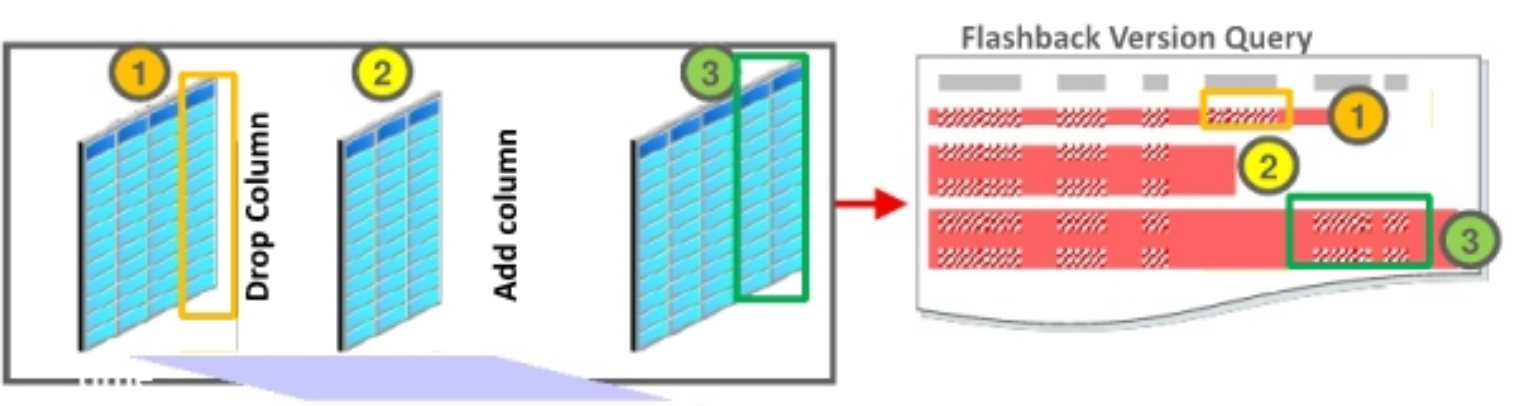
DDL commands supported by
flashback data archives:- Add, drop, rename, and modify column
- Drop and truncate partition
- Rename and truncate table
- When a schema has evolved in the above DDL,
Temporal Historytechnology automatically keeps track of the changes. Flashback queryappropriately returns the row or rows with the corresponding schema.
Full Schema Evolution
-
Disassociate or associate procedures in the
DBMS_FLASHBACK_ARCHIVEpackage:- Disable
Flashback Archiveon specified tables and allow more complexDDL(upgrades, split tables, and so on). -
Enforce schema integrity during association. (
Base tableandhistory tablemust be the same schema.) - Note: This function should be used with care and with the understanding that the archive can no longer be guaranteed to be immutable because the history could have been altered during the time of disassociation.
- Disable
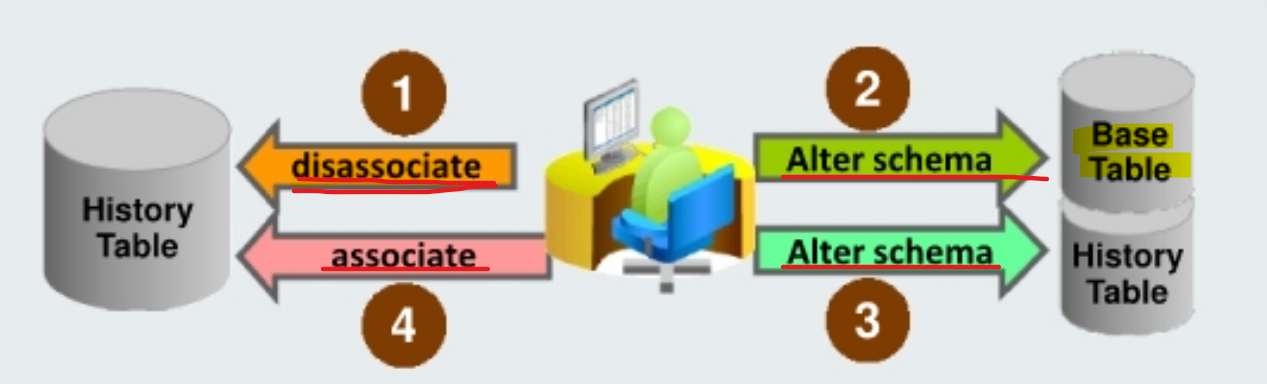
- If you have the
FLASHBACK ARCHIVE ADMINISTERprivilege, you can disassociate thearchivefrom thebase tablewith theDTSASSOCTATE_FBAprocedure.- Make the necessary changes to the
base table.- Make the necessary changes to the corresponding
archive.- Then associate the
tablewith thearchivewithin the same schema with theRESASSOCIATE_FBAprocedure.
Temporal Historyvalidates that the schemas are the same upon association.
- There is no transportability of
history tables. - Some DDL statements cause error
ORA-55610when used on a table enabled for FDA.- e.g.,
- ALTER TABLE …with UPGRADE TABLE clause
- ALTER TABLE statement that moves or exchanges a partition or subpartition operation
- DROP TABLE statement
- e.g.,
Temporal Validity and History
-
Distinguish active from nonactive rows:
Temporal validity:Temporal History: System-managed transaction time in a separate tablespace
-
Temporal validity:- temporal attribute to annotate 注释 the validity of a fact recorded in a table with dates or time stamps that are relevant to the underlying business;
- e.g., the hire date of an employee in HR applications and the effective date of coverage in the insurance industry.
-
User-managed effective date in the same table
- controlled by the user who defines the valid-time dimension at table creation.创建时定义
Temporal validitydates or time stamps are different from the dates or time stamps annotated when the fact was recorded in the database.标记的时间不同于录入时间.
- temporal attribute to annotate 注释 the validity of a fact recorded in a table with dates or time stamps that are relevant to the underlying business;
-
Temporal History/flashback data archiveattributes:- The date or time stamp when the fact was recorded in the database
- system managed.
-
Example
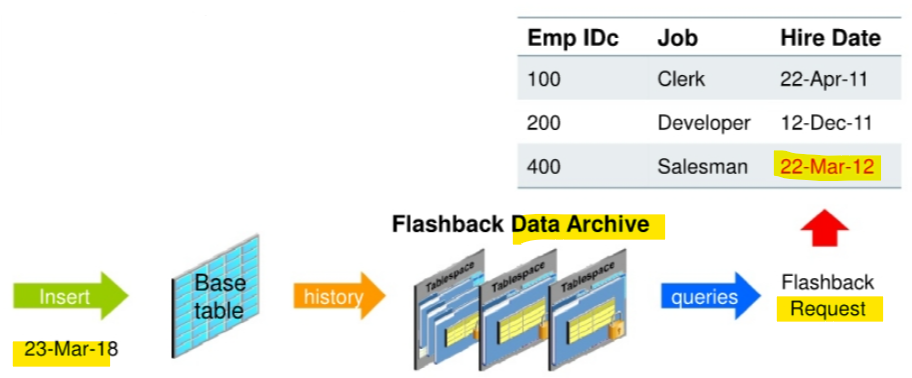
- employee 400 was hired on March 22
- the row was entered in the HR.EMP table on March 23.
- 22-MAR-12 is the
valid time temporaldate- 23-MAR-12 is the
transaction time temporaldate
- Benefits:
- By using the
valid time temporalimplicit filter on the valid-time dimension, queries can show rows that are currently valid or that will be valid in the future. 用来过滤时间有效的数据- The query is able to hide rows whose facts are not currently valid.
- Bi-temporal queries can use both
valid-time temporalandtransaction time temporaldate.
- By using the
Using the PERIOD FOR Clause
-
valid-time dimension:- used to keep both active and nonactive data in the same table.
- defined at table creation.
- consists of two date-time columns
-
PERIOD FORclause- Explicitly define the two date-time columns.
- Or automatic valid-time columns are created.
- The database server creates two hidden columns using the name of the valid-time dimension as a prefix for the names of the two columns.
- The valid-time dimension name is used to drop the dimension if required.
- To hide valid-time dimension columns, just specify a PERIOD FOR clause name without any date columns.
-
Note: A check constraint is automatically added to ensure that the end time is later than the start time. 一个约束会自动生成
-
Example
-- Explicitly define the two date-time columns
CREATE TABLE emp
(
  empno number, salary number, deptid number,
  name VARCHAR2 (100),
  user_time_start DATE, user_time_end DATE,   -- Explicitly define
  PERIOD FOR user_time (user_time_start, user_time_end)
);

-- automatic valid-time columns
CREATE TABLE emp2
(
  empno number, salary number, deptid number,
  name VARCHAR2 (100),
  PERIOD FOR user_time    -- automatic define
  -- name of the valid-time dimension is user_time
  -- USER_TIME is used as the prefix for the two date columns automatically created: USER_TIME_START and USER_TIME_END.
);
- Insert rows by explicitly naming the valid-time columns.
-- insert
INSERT INTO emp2
(empno, salary, deptid, name, user_time_start, user_time_end)
VALUES (1,1000,20, 'John', SYSDATE, NULL);

-- query
select EMPNO, user_time_start, user_time_end from emp2;
-- EMPNO  USER_TIME_START                       USER_TIME_END
-- 1      17-AUG-12 09.58.03.000000 AM +00:00
Filtering on Valid-Time Columns
-
To filter on valid-time columns:
- Use the
SELECTstatement with thePERIOD FORclause - or use the
DBMS_FLASHBACK_ARCHIVEprocedure.
- Use the
- Return:
- There is one set of data that is “valid” based on its valid-start and valid-end times and the query time (AS OF or undecorated).
- Alternatively, there is the other set of rows where the query time falls outside the valid-start and valid-end times.
- Both sets of rows data reside in the same table.
- However, by controlling the visibility of data to the valid rows, you can limit what queries and DMLs affect.
- Now you can do as-of and versions queries for valid time. 对有效时间进行版本查询
Example:
-
Scenario:
- For each new employee that you inserted in the table, you included the hire dates, valid-time start dates, and valid end dates. The dates represent the activeness of each row. These dates are entered by the application and correspond to valid dates.
- The time that the rows were inserted and committed in the table corresponds to the
transaction date.
- Query:
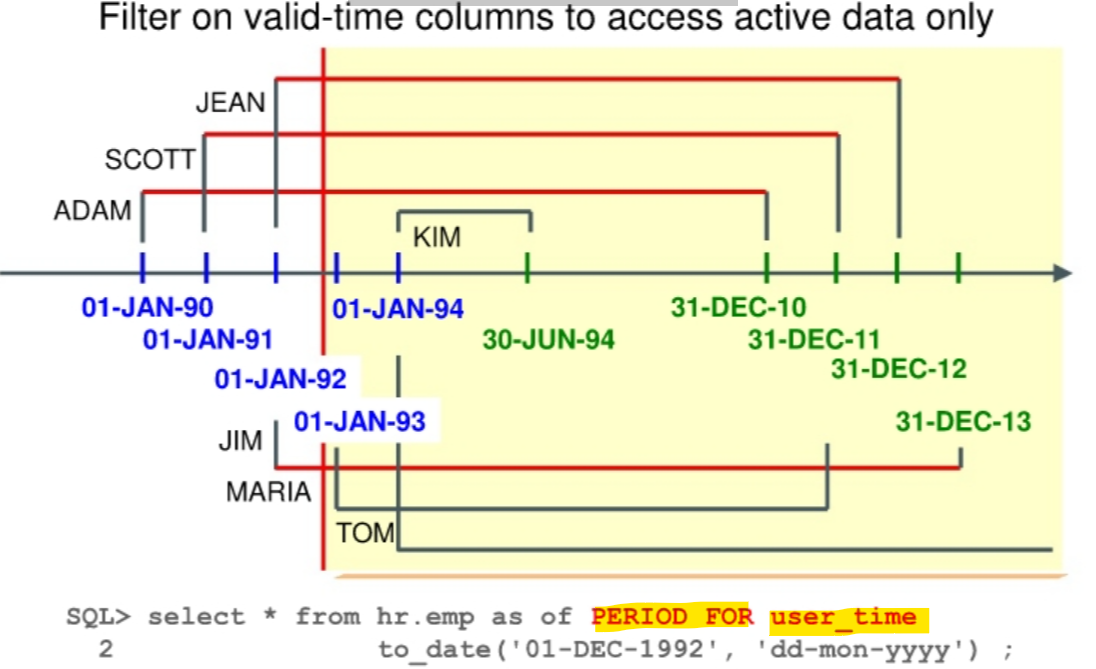
- You can filter the active employees by using the following new
PERIOD FORclause. - The query displays all active employees who were valid at the explicit date of ‘ 01-DEC-1992”, which is the date that belongs to the valid period, that is, between USER_TIME_START and USER_TIME_END.
- You can filter the active employees by using the following new
select * from hr.emp as of PERIOD FOR user_time
to_date('01-DEC-1992', 'dd-mon-yyyy') ;
即使用 period for 自动筛选在某个时间点上时间有效的记录.
- Query:
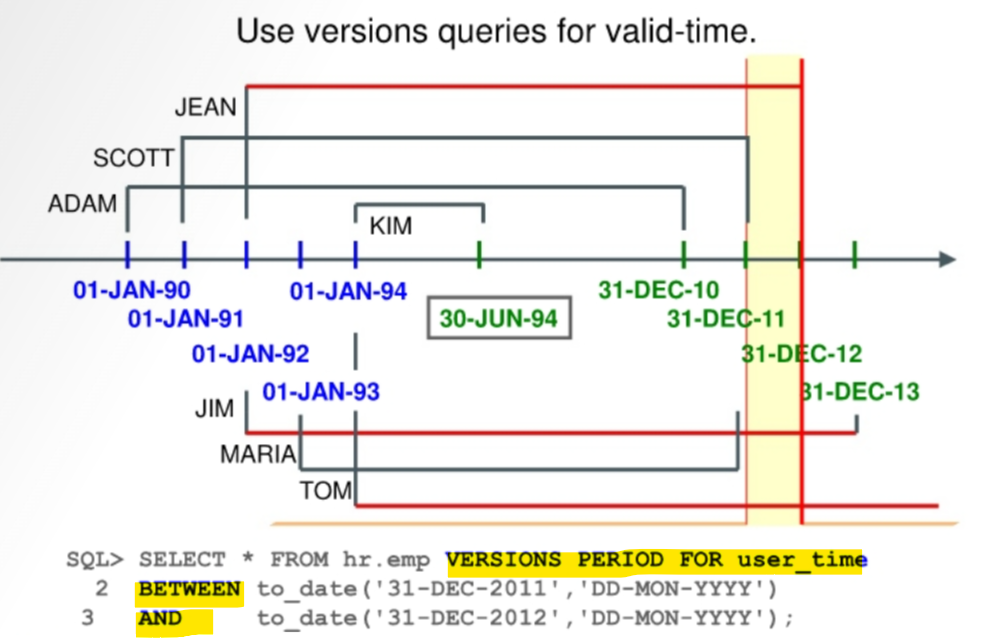
- filter the active employees by using the
VERSIONS PERIOD FOR BETWEENclause:
- filter the active employees by using the
select * from hr.emp VERSIONS PERIOD FOR user_time
BETWEEN to_date('31-DEC-2011', 'dd-mon-yyyy')
AND to_date('31-DEC-2012', 'dd-mon-yyyy');
The query displays all employees whose
VALID_TIME_STARTis less than or equal to ‘31-DEC-2011’andVALID_TIME_ENDgreater than or equal to ‘31-DEC-2012”.
-
bi-temporal queries:- mix
valid-timeandtransaction-timedimensions
- mix
-
Queries
- shows rows as of the specified transaction time that are valid now.
select * from hr.emp
as of period for user time to_date('31-DEC-1992', 'dd-mon-yyyy"')
as of timestamp to_date ('30-mar-2012', 'dd-mon-yyyy');
Using DBMS_FLASHBACK_ARCHIVE
-
Users can modify visibility within a session by using the new
DBMS_FLASHBACK_ARCHIVEpackage.- Visibility control applies to all SQL
SELECTandDMLstatements.
- Visibility control applies to all SQL
-
DDLswill default to getting full visibility to the table data.- e.g., CTAS, online redefinition, and
ALTER TABLE MOVEoperations will have full visibility of the table data. - Hidden columns are also visible to the DDL operations, resulting in preservation of those columns and their data.
- e.g., CTAS, online redefinition, and
-
Example:
-- Set the visibility to data to the full table level, the default temporal table visibility.
DBMS_FLASHBACK_ARCHIVE.ENABLE_AT_VALID_TIME ('ALL')

-- Set the visibility to data valid as of the given time.
-- showing only rows overlapping the given date.
DBMS_FLASHBACK_ARCHIVE.ENABLE_AT_VALID_TIME(
  'ASOF',
  (to_timestamp ('29-SEP-10 05.44.01 PM'))
);

-- Set the visibility to data currently valid within the valid time period at the session level.
DBMS_FLASHBACK_ARCHIVE.ENABLE_AT_VALID_TIME ('CURRENT')