Note_Tech
All technological notes.
Project maintained by simonangel-fong Hosted on GitHub Pages — Theme by mattgraham
Recovery - Tablespace point-in-time recovery (TSPITR)
- Recovery -
Tablespace point-in-time recovery (TSPITR)
Tablespace point-in-time recovery (TSPITR)
-
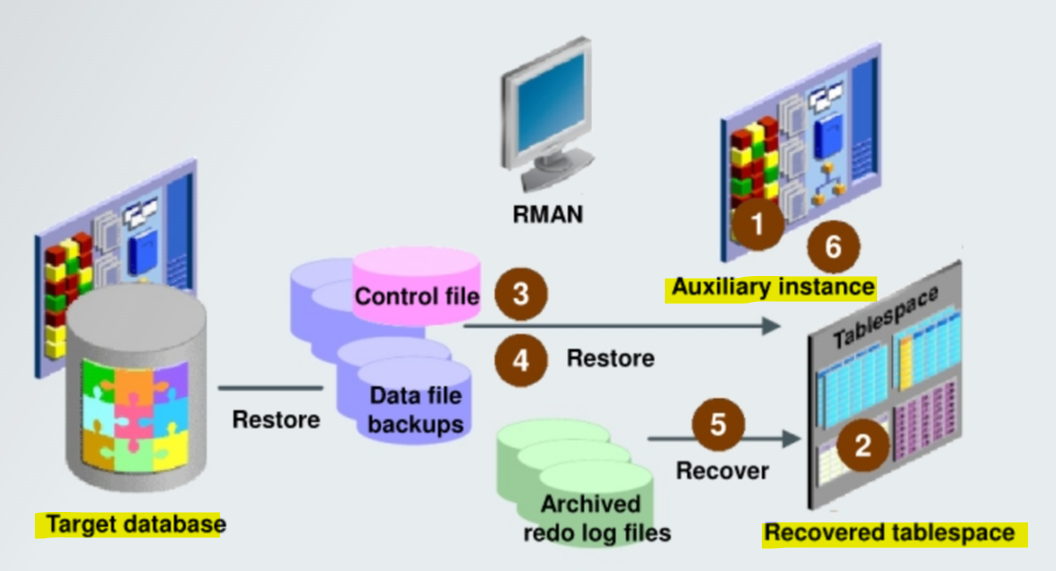
Architecture:
Target database:- Contains the tablespace to be recovered
Control file:- Provides backup information to RMAN
Backup sets:- Come from the target database and are the source of the reconstructed tablespace
Archived redo logs:- Come from the target database and are the source of the reconstructed tablespace
Auxiliary instance:- Is the Oracle database instance used during the recovery process to perform the recovery
-
Steps to
TSPITR:- Creates the
auxiliary instance, starts it, and connects to it - Takes the
tablespacesthat will be recovered offline - Restores a backup
control filefrom a point in time before the target time to theauxiliary instance - Restores the
data filesfrom therecovery setand theauxiliary setto theauxiliary instance - Recovers the restored data files to the specified time
- Opens the
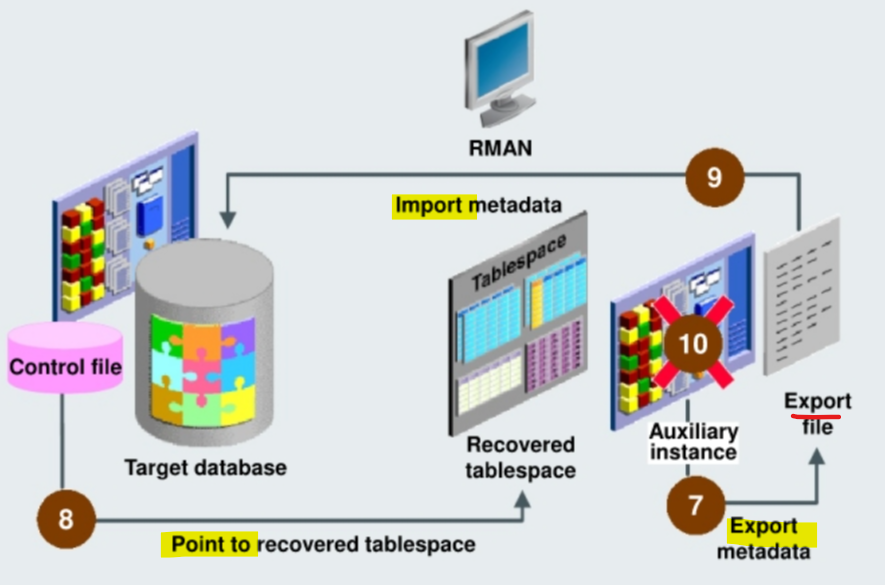
auxiliary databasewith theRESETLOGSoption - Exports the
dictionary metadataabout objects in the recovered tablespaces to thetarget database - Shuts down the
auxiliary instance.- Issues
SWITCHcommands on thetarget databaseso that the target database control file points to thedata filesin therecovery setthat were recovered on the auxiliary instance.
- Issues
- Imports the
dictionary metadatafrom the auxiliary instance to the target instance - Deletes all auxiliary set files
- Creates the
-
Situations for
TSPITR:- recover data lost after an erroneous
TRUNCATE TABLEstatement - recover from logical corruption of a table
- Undo the effects of an incorrect batch job or another
data manipulation language (DMLstatement that has affected only a subset of the database - recover a
logical schemato a different point from the rest of the physical database - recover a dropped tablespace
- Can be performed repeatedly to points-in-time before the tablespace was brought online without requiring a recovery catalog
- recover data lost after an erroneous
-
TSPITRuses transportable tablespaces andData Pump.
Preparing for TSPITR
- To prepare for TSPITR, perform the following steps:
- Determine the correct
target time. - Determine what additional tablespaces is needed in the
recovery set. - Identify and preserve objects that will be lost after PITR.
- should evaluate what objects will be lost as a result of the TSPITR operation and determine how you want to preserve those objects.
- Determine the correct
Determining the Correct Target Time
-
Tools to investigate changes to your database and to help determine the correct target time for TSPITR:
Oracle Flashback QueryOracle Flashback Transaction QueryOracle Flashback Version Query
-
Recovery with a
recovery catalog:- can perform repeated TSPITR operations to different target times.
-
Recovery with a current
control file:-
The current
control filedoes not contain a record of an older incarnation of the recoveredtablespace.- After you perform
TSPITRand bring a tablespace online, you cannot use any backup from a time earlier than the moment you brought the tablespace online. - cannot make a second attempt at
TSPITRif you choose the wrong target time the first time 如果操作错误, 则不能恢复到重新上线之前
- After you perform
-
-
If you can restore a backup
control filefrom before that time: 除非能恢复 cf 到之前- can perform
incomplete recoveryof the whole database to any time prior to or equal to the time when you brought the tablespace online
- can perform
-
Alternatives:
- With the
Flashbacktools and the data still available as undo data, it is usually much simpler to use the Flashback tools for undoing unwanted changes (rather than TSPITR).
- With the
Determining the Tablespaces for the Recovery Set
-
If objects in the tablespace that you are recovering have relationships with objects in other tablespaces, you can:
- Add the tablespace that contains the related objects to the recovery set
- Suspend the relationship for the duration of TSPITR
- Remove the relationship
-
Use the
DBMS_TTS.TRANSPORT_SET_CHECKprocedure to determine whether the tablespaces in the recovery set are self-contained. -
RMAN
TSPITRautomatically executes theDBMS_TTS.TRANSPORT_SET_CHECKprocedure for the recovery set tablespaces and verifies that the query againstTRANSPORT_SET_VIOLATIONSreturns no rows.- If the query returns rows, RMAN stops
TSPITRprocessing, and any tablespace containment violations must be resolved before TSPITR can proceed.
- If the query returns rows, RMAN stops
-
Can execute the procedure and query the view as a precautionary measure:
DBMS_TTS.TRANSPORT_SET_CHECK ('USERS,EXAMPLE') ;
SELECT * FROM TRANSPORT_SET_VIOLATIONS;
Identifying Objects That Will Be Lost
- Objects created in the tablespace after the target recovery time are lost.
- Query
TS_PITR_OBJECTS_TO_BE_DROPPEDto determine which objects will be lost after TSPITR. -
Use Export before TSPITR and Import after TSPTIR to preserve and re-create the lost objects.
- Example:
- performing TSPITR for the USERS and EXAMPLE tablespaces to the target time of April 3, 2018, at 8:30:00 AM.
- Issue the following query to determine whether there are any objects that will be lost after your TSPITR:
SELECT OWNER, NAME, TABLESPACE NAME,
TO_CHAR (CREATION TIME, 'YYYY-MM-DD:HH24:MI:SS')
FROM TS_PITR_OBJECTS_TO_ BE_ DROPPED
WHERE TABLESPACE NAME IN ('USERS', 'EXAMPLE')
AND CREATION TIME >
TO DATE ('2018-APR-03:08:30:00', 'YY-MON-DD:HH24:MI:SS')
ORDER BY TABLESPACE NAME, CREATION TIME;
TSPITR Options
-
Fully automated
TSPITR(recommended method):- Specify an
auxiliary destination. - RMAN manages all aspects of TSPITR.
- Specify an
-
Customized
TSPITRwith an automaticauxiliary instance:- based on fully automated TSPITR.
- Customize the location of files.
- Specify initialization
parameters. - Specify
channelconfigurations.
-
TSPITR using your own
auxiliary instance:- Set up, start, stop, and clean up the
auxiliary instanceused in TSPITR. - can manage the TSPITR process
- Set up, start, stop, and clean up the
Fully Automated TSPITR
-
When you perform fully automated TSPITR, you must:
- Configure any channels required for TSPITR on the target instance
- Specify a destination for RMAN to use for the auxiliary set of data files and other auxiliary instance files
-
Steps:
- Configure channels required for TSPITR on the target instance.
- Specify the
auxiliary destinationby using theAUXILIARY DESTINATIONoption. - After TSPITR has completed, back up the recovered tablespaces and bring them online.
-
cannot use
backupsof any tablespaces that participate in TSPITR taken before TSPITR after you perform TSPITR. 不能使用之前的备份 -
Example:
CONNECT TARGET
RECOVER TABLESPACE users, example
-- assumes that
--      NLS_DATE_FORMAT is setto 'yyyy-mm-dd:hh24:mi:ss’
--      NLS_LANG is set to AMERICAN AMERICA.WE8BMSWIN1252.
UNTIL TIME '2018-06-29:08:00:00'
-- Specify the auxiliary destination
AUXILIARY DESTINATION '/u0l/app/oracle/oradata/aux';
Improving TSPITR Performance
-
To improve TSPITR performance, use the existing
image copiesof therecovery setandauxiliary setdata files- This technique enables RMAN to skip restoring the
data filesfrom a backup.
- This technique enables RMAN to skip restoring the
-
Methods:
CONFIGURE AUXNAMEcommand:- sets a persistent alternative location for an
auxiliary setdata fileimage copy.
- sets a persistent alternative location for an
SET NEWNAMEcommand:- sets an alternative location for the duration of a RUN command.
RUN {
    SET NEWNAME FOR DATAFILE '$ORACLE_BASE/oradata/orcl/users0l.dbf'
        TO '/u0l/backup/users0l.dbf';
    RECOVER TABLESPACE users UNTIL SEQUENCE 1300 THREAD 1;
}
TSPITR with an RMAN-Managed Auxiliary Instance
-
To customize RMAN
TSPITR, can use an RMAN-managedauxiliary instance:-
Rename or relocate your
recovery setdata files.- Use
SET NEWNAMEto rename therecovery setdata filesso that they are not restored and recovered in their original locations.
- Use
-
Specify a location other than the
auxiliary destinationfor some or all of theauxiliary setdata files.- Use
SET NEWNAMEandDB_FILE_NAME_CONVERTto provide rules for convertingdata filenames in thetarget databasetodata filenames for theauxiliary database. 创建映射
- Use
- Create
image copybackups of your data files before TSPITR. - Use a different channel configuration for the
auxiliary instance. - Specify different initialization parameters for your RMAN-managed
auxiliary instance.
-
-
Improve performance:
- Use existing
image copiesof therecovery setandauxiliary setdata fileson disk rather than restoring them frombackup
- Use existing
TSPITR by Using Your Own Auxiliary Instance
-
Recommends
- you allow RMAN to manage the creation and destruction of the auxiliary instance used during RMAN TSPITR.让 rman 控制
-
Not recommended, but supported:
- using your own auxiliary instance
-
To create an auxiliary instance:
- Create an Oracle password file for the
auxiliary instance. - Create an initialization parameter file for the
auxiliary instance. - Verify Oracle Net connectivity to the
auxiliary instance.
- Create an Oracle password file for the
-
To perform TSPITR with auxiliary instance:
- Start the auxiliary instance in
NOMOUNTmode. 注意是 nomount - Connect the
RMANclient to the target and auxiliary instances. - Execute the
RECOVER TABLESPACEcommand.
- Start the auxiliary instance in
Troubleshooting RMAN TSPITR
-
File name conflicts:
- caused by:
- the use of
SET NEWNAME,CONFIGURE AUXNAME, andDB_FILE_NAME_CONVERTcauses multiple files in the auxiliary or recovery sets to have the same name
- the use of
- soluted by:
- specify different values for these parameters to eliminate the duplicate name.
- caused by:
-
RMAN cannot identify
tablespaceswithundo segments:-
Caused by:
-
During TSPITR, RMAN needs information about which
tablespaceshadundo segmentsat the TSPITR target time. - If using
recovery catalog:- information is usually available in the
recovery catalog
- information is usually available in the
- If using
Control fileor if the information is not found in therecovery catalog- RMAN proceeds, assuming that the set of
tablespaceswithundo segmentsat the target time is the same as the set oftablespaceswithundo segmentsat the present 会假设 tbsp 在目标时间和当前都是相同. - If this assumption is not correct, the TSPITR operation fails and an error is reported.
- RMAN proceeds, assuming that the set of
-
-
Solution:
- To prevent this from happening, provide a list of
tablespaceswithundo segmentsat the target time in theUNDO TABLESPACEclause.
- To prevent this from happening, provide a list of
-
-
Restarting manual auxiliary instance after TSPITR failure:
- If you are managing your own
auxiliary instanceand there is a failure in TSPITR, then before you can retry TSPITR, you must shut down the auxiliary instance, correct the problem, and put the auxiliary instance back inNOMOUNTmode. 使用自有实例并在恢复时失败, 需要关闭实例, 处理错误, 然后重新启动实例并处于 nomount 模式.
- If you are managing your own