Note_Tech
All technological notes.
Project maintained by simonangel-fong Hosted on GitHub Pages — Theme by mattgraham
SQL - JOIN
JOIN Statement
-
JOIN:- combine data from multiple tables, based on a related column between them.
-
Types of Joins
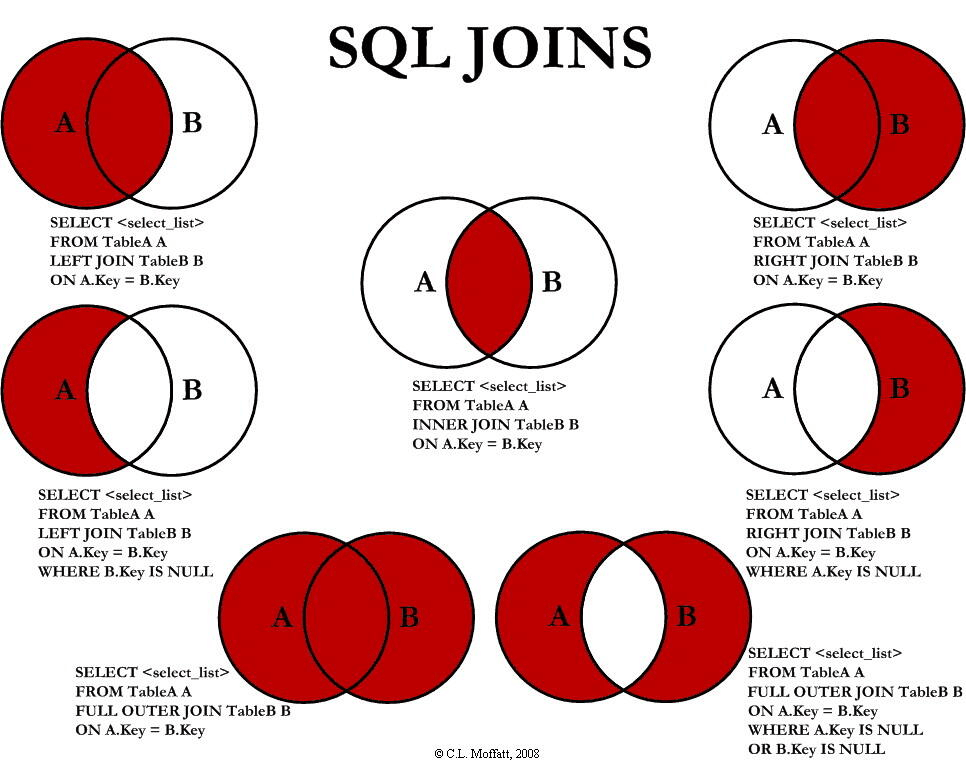
CROSS JOIN:Cartesian Join 笛卡尔连接
-
CROSS JOIN- In a
Cartesian Join(also called aCartesian Product笛卡尔乘积 or aCross Join), each record in the first table is matched with a record from the second table
- In a
-
Syntax:
-- Traditional Method
SELECT table1.column1 , table1.column2, table2.column1...
FROM table1, table2;


-- Cross Join
SELECT table1.column1 , table1.column2, table2.column1...
FROM table1
CROSS JOIN table2;
-
Every row of one table is joined to every row of the second table. So it joins every row with every possible combination of records. 总数是两个集合元素个数的乘积.
-
In the absence of a
WHEREcondition theCARTESIAN JOINwill behave like aCARTESIAN PRODUCT原因是缺少 where 语句. -
In the presence of
WHEREcondition thisJOINwill function like aINNER JOIN有 where 语句时,相当于内联结. -
Generally speaking, Cross join is similar to an
inner joinwhere the join-condition will always evaluate toTrue. 相当于特殊的内联.
INNER JOIN
-
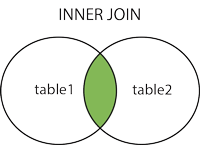
INNER JOIN- return the result set of matched data in both tables.
- Returns records that have matching values in both tables. 返回两表匹配的值,相当于交集 intersection.
Equality Join
-
The most common type of join used in the workplace uses two or more tables with equivalent data stored in a common column. 原因是两表存在相等值在共同列.
-
A common column is a column with equivalent data that exists in two or more tables.
-
Syntax
-- Equality Join
-- Traditional Method
SELECT table1.column1, table2.column2, ...
FROM table1, table2
WHERE table1.common_col = table2.common_col;

-- JOIN ON
SELECT *
FROM tb_1
INNER JOIN tb_2
ON tb_1.col_match = tb_2.col_match;
-
The order of tables does not matter.
- Only applied in
INNER JOIN
- Only applied in
-
JOIN==INNER JOIN -
When performing , a row is returned if there was a corresponding record in each table queried.
-
The Equality Join, Non-Equality Join and Self-Joins are all classified as inner joins because records are only returned if a match is found in each table内联结是指返回匹配的数据. 不匹配的不会返回.
-
The default keyword
INNERcan be included with theJOINkeyword to specify that only the records having a matching row in the corresponding table should be returned in the results. 可以使用关键字INNER. -
进行
SELECT JOIN时, 无论是哪种方法,都要在列名 column name前标明标明表名 table name, 避免报错. 特别是对共同列 common column. -
SELECT JOIN可以使用表别名 table alias.
Non-Equality Joins
-
Non-Equality Joins-
A non-equality join is used when the related columns cannot be joined through an equal sign. 不是相等值
-
Instead of finding a column-to-column match, you use the
non-equality jointo determine whether the weight of the item falls between the minimum and maximum ranges of the columns. 不是行-行匹配,是范围的匹配.
-
-
Syntax:
-- Non-Equality Joins
-- Traditional Method
SELECT A.column1, B.column2, ...
FROM table1 A, table2 B
WHERE A.common_col BETWEEN B.max_col AND B.min_col;

-- JOIN ON
SELECT A.column1, B.column2, ...
FROM table1 A INNER JOIN table2 B
ON A.common_col BETWEEN B.max_col AND B.min_col;
OUTER JOIN
-
OUTER JOIN- allow to specify how to deal with data only present in one of the tables being joined.
FULL OUTER JOIN
-
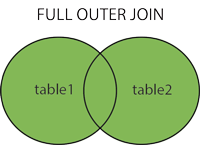
FULL OUTER JOIN- Returns all records when there is a match in either left or right table. 显示左右表所有数据.
- Returns all records when there is a match in either left or right table. 显示左右表所有数据.
- Syntax
-- return any data in both table, non-matched data filled by null
SELECT tb_1.col, tb_2.col
FROM tb_1
FULL OUTER JOIN tb_2
ON tb_1.col_match = tb_2.col_match


-- return unique data in both table, except intersection
-- 即排除重合的集合, 是inner join的逆命题
SELECT *
FROM tb_1
FULL OUTER JOIN tb_2
ON tb_1.col_match = tb_2.col_match
WHERE tb_1.id IS null
OR tb_2.id IS null;
LEFT OUTER JOIN
-
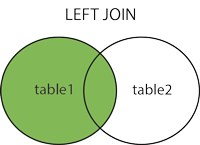
LEFT OUTER JOIN- presents the records in the left table and, if matched, the records in the right table. Otherwise, fill with
null. - Returns all records from the left table, and the matched records from the right table. 显示所有左表,和匹配的右表记录.
- presents the records in the left table and, if matched, the records in the right table. Otherwise, fill with
- Syntax
-- present all data in the left table
-- present match data in the right table
SELECT *
FROM tb_1       -- tb_1 is the left table
LEFT OUTER JOIN tb_2
ON tb_1.col_match = tb_2.col_match;

SELECT *
FROM tb_1
LEFT JOIN tb_2      -- LEFT JOIN = LEFT OUTER JOIN
ON tb_1.col_match = tb_2.col_match;

-- return unique data in the left table
SELECT *
FROM tb_1
LEFT OUTER JOIN tb_2
ON tb_1.col_match = tb_2.col_match
WHERE tb_2.id IS null;
- The table order matters:
- The table after
FROMis the left table.
- The table after
RIGHT OUTER JOIN
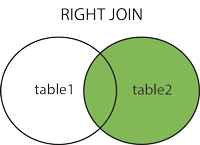
RIGHT (OUTER) JOIN:- Returns all records from the right table, and the matched records from the left table. 显示所有右表,和匹配的左表记录.
-
不常用, 因为和左联结相通. 一般使用左联结.
-
Syntax:
SELECT A.column, B.column...
FROM table1 A Right OUTER JOIN table2 B
ON A.common_col = B.common_col;
Self-Joins
-
Self-Join- a query in which a table is joined itself.
- used to compare values in a column of rows within the same table.
-
Applied when the data in a table references other data stored in the same table. 引用相同表.
- necessary to use an alias; Otherwise table names would be ambiguous.
-
Syntax:
-- Self-Join
-- Traditional Method
SELECT A.column1, A.column2, ...
FROM table1 A, table1 B --自联结, 两个表名相同
WHERE A.common_ref = B.common_id;

-- JOIN ON
SELECT A.column1, B.column2, ...
FROM table1 A
INNER JOIN table1 B
ON A.common_ref = B.common_id
AND A.id !=B.id;
- 注意:
- 一般 self-join 都会发生相同行的配对, 例如 film 表的 self-join, 找出有相同 length 的 title 列. 此时第一个配对的是相同的 title, 这个应该排除.所以可以在 ON 中使用
f1.film_id != f2.film_id
- 一般 self-join 都会发生相同行的配对, 例如 film 表的 self-join, 找出有相同 length 的 title 列. 此时第一个配对的是相同的 title, 这个应该排除.所以可以在 ON 中使用
Join Three or More Tables
- Syntax:
-- Traditional Method
SELECT A.column, B.column, C.column, ...
FROM table1 A, table2 B, table3 C
WHERE A.common_col1 = B.common_col1 -- 联结表A和表B
AND B.common_col2 = C.common_col2; -- 联结表A和表B

-- JOIN Method
SELECT A.column, B.column, C.column
FROM table1 A JOIN table2 B
ON A.common_col1 = B.common_col1 --联结不同表
JOIN talbe3 C
ON B.common_col2 = C.common_col2 --联结不同表
WHERE condition; --筛选条件