Note_Tech
All technological notes.
Project maintained by simonangel-fong Hosted on GitHub Pages — Theme by mattgraham
DSA - Big O
- DSA - Big O
Big O Notation
-
Analyze algorithms
- compare the amount of space they take in memory
- compare how much time it takes each function to run.
- However, we can not use “time to run” as an objective measurement, because that will depend on the speed of the computer itself and hardware capabilities.
- A good place to start would be to compare the number of assignments each algorithm makes, Big-O!
-
Big-O notation- describes how quickly runtime will grow relative to the input as the input get arbitrarily large.
-
Remember, we want to compare how quickly runtime will grows, not compare exact runtimes, since those can vary depending on hardware.
-
Since we want to compare for a variety of input sizes, we are only concerned with runtime grow relative to the input. This is why we use
nfor notation. -
As
ngets arbitrarily large we only worry about terms that will grow the fastest asngets large, to this point.Big-Oanalysis is also known as asymptotic analysis
Space Complexity
- The notation of space complexity is the same, but instead of checking the time of operations, we check the size of the allocation of memory.
Best Case, Average Case, and Worst Case
| Geek Letter | Notation |
|---|---|
Ω(Omiga) |
Best Case |
θ(theta ) |
Average Case |
O(Omikron) |
Worst Case |
- When talking about
big O, it is usually talking about worst case.
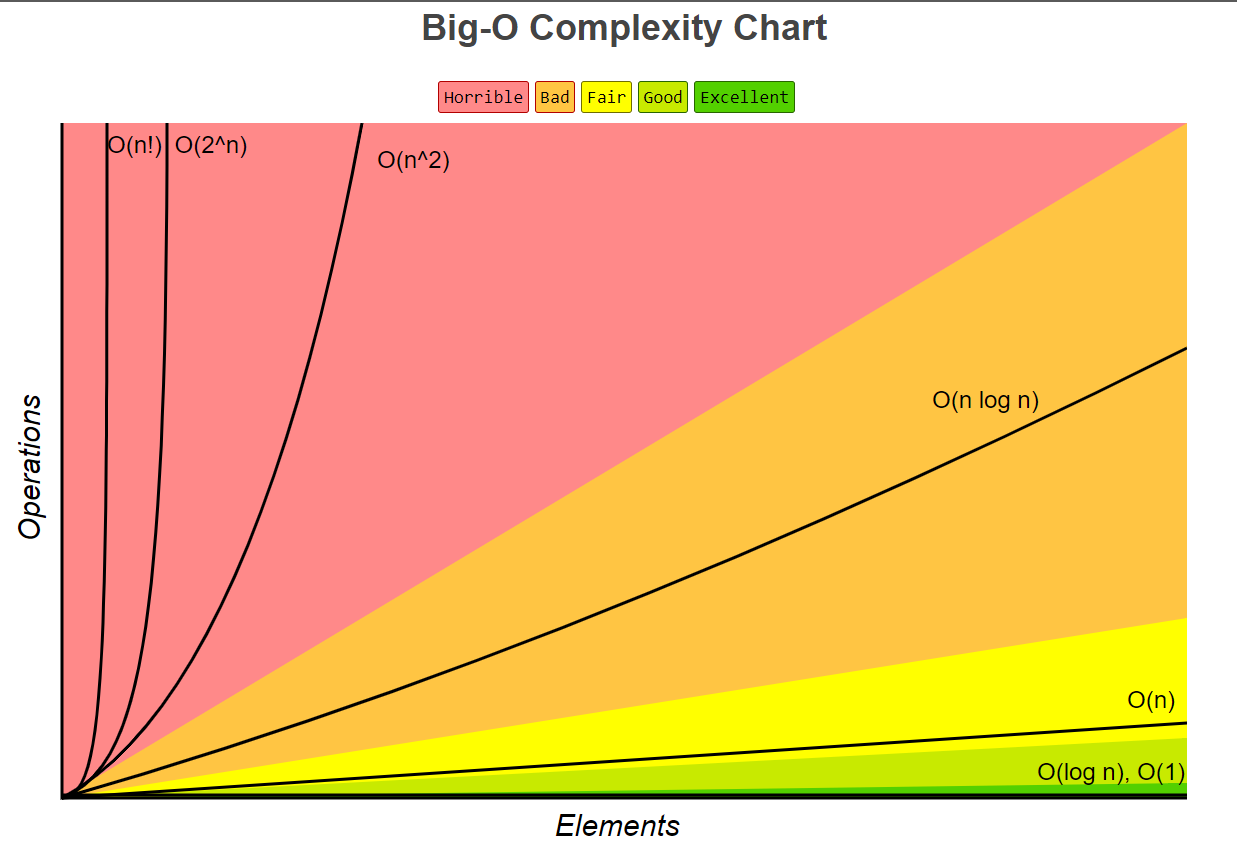
Common Big-O
| Big-O | Name |
|---|---|
O(1) |
Constant |
O(log(n)) |
Logarithmic |
O(n) |
Linear |
O(nlog(n)) |
Log Linear |
O(n^2) |
Quadratic |
O(2^n) |
Exponential |
-
Clearly we want to choose algorithms that stay away from any exponential, quadratic, or cubic behavior!
-
When it comes to
Big O notationwe only care about the most significant terms, remember as the input grows larger only the fastest growing terms will matter.
O(n): Linear / Proportional
-
The function runs in O(n) (linear time).
- This means that the number of operations taking place scales linearly with n
-
图像上, 随着
n的增加, number of operationO(n)呈现线性增长.
def print_items(n):
    '''
    Takes n operations for a specific input n
    '''
    for i in range(n):
        print(i)

func_lin(10)
O(n^2): Quadratic / Loop within a loop
-
The function performs
noperations for every item in the list! - This means in total, we will perform
ntimesnassignments, orn^2. - You can see how dangerous this can get for very large inputs! This is why Big-O is so important to be aware of!
O(n*n) = O(n^2)
def print_items(lst):
    for i in range(n):
        for j in range(n):
            print(i, j)

print_items(10)
O(1): Constant
- The function is constant because regardless of the list size, the function will only ever take a constant step size.
- The most efficient
Big O
def add_items(n):
    return n + n + n

add_items(10)
O(log(n)): Divide and Conquer
-
简化的推导过程:
- 使用 binary search 时, 每次都二分所有元素.
- 所以 worst case 下的方程是
Big O = log(n), 注意该处 log 的底是 2. - 即在自然数范围内对 n 取底为 2 的对数, 其最大值即
Big O(worst case) 2^Big(O)=>Big O = log(n)=>O(log(n))
-
A very efficient
Big O. Flat and close toO(1)
Big O Analysis
Drop Constants
-
Drop Constants- A simplification technique of Big O.
- 由于只关注 input 对 number of operations 的显著影响, 所以常数系数被忽略.
O(n) + O(n) = O(n+n) = O(2n) = O(n)
def print_items(n):
    for i in range(n):
        print(i)

    for j in range(n):
        print(j)

print_items(10)
# 对每个operation都执行两次, 所以time complexity是O(2n), 分析时看作是O(n)
Drop Non-Dominants
Drop Non-Dominants- A simplification technique of Big O.
- 由于只关注显著的影响, 所以非显著的影响将会被忽略
O(n^2) + O(n) = O(n^2 + n) = O(n^2)
def print_items(n):
  # O(n^2)
    for i in range(n):
        for j in range(n):
            print(i,j)

  # O(n)
    for k in range(n):
        print(k)

print_items(10)
Different Terms for Inputs
- 分析时, 参数一般是一个 n; 但当参数是多个时, 不适用 Drop Constants.
- 以下代码为例, 其
Big O是O(a)+O(b) = O(a+b), 不能再简化.因为参数有两个, 不能直接简化为O(2n)
def print_items(a,b):
    for i in range(a):
        print(i)

    for j in range(b):
        print(j)

print_items(1, 10)
- 如果以上代码是 a 与 b 嵌套循环时, 其
big O是O(a)*O(b) = O(a*b)
Big O of List
-
List is a built-in data structure in Python.
- Adding and Removing item at the end of a list:
O(1) - Adding and Removing item at the front of a list:
O(n) - Looking for a value with index of a list:
O(1)
- Adding and Removing item at the end of a list:
| Operation | Big O | Description |
|---|---|---|
.append() |
O(1) |
|
.pop() |
O(1) |
|
.insert(0,value) |
O(n) |
re-indexing |
.pop(0) |
O(n) |
re-indexing |
list[index] |
O(1) |
look for value with index |
Big-O Cheat Sheet
-
Common Data Structure
- 注意: 以上的 space 复杂度几乎都是
O(n), 所以现实中一般注重 time 复杂度.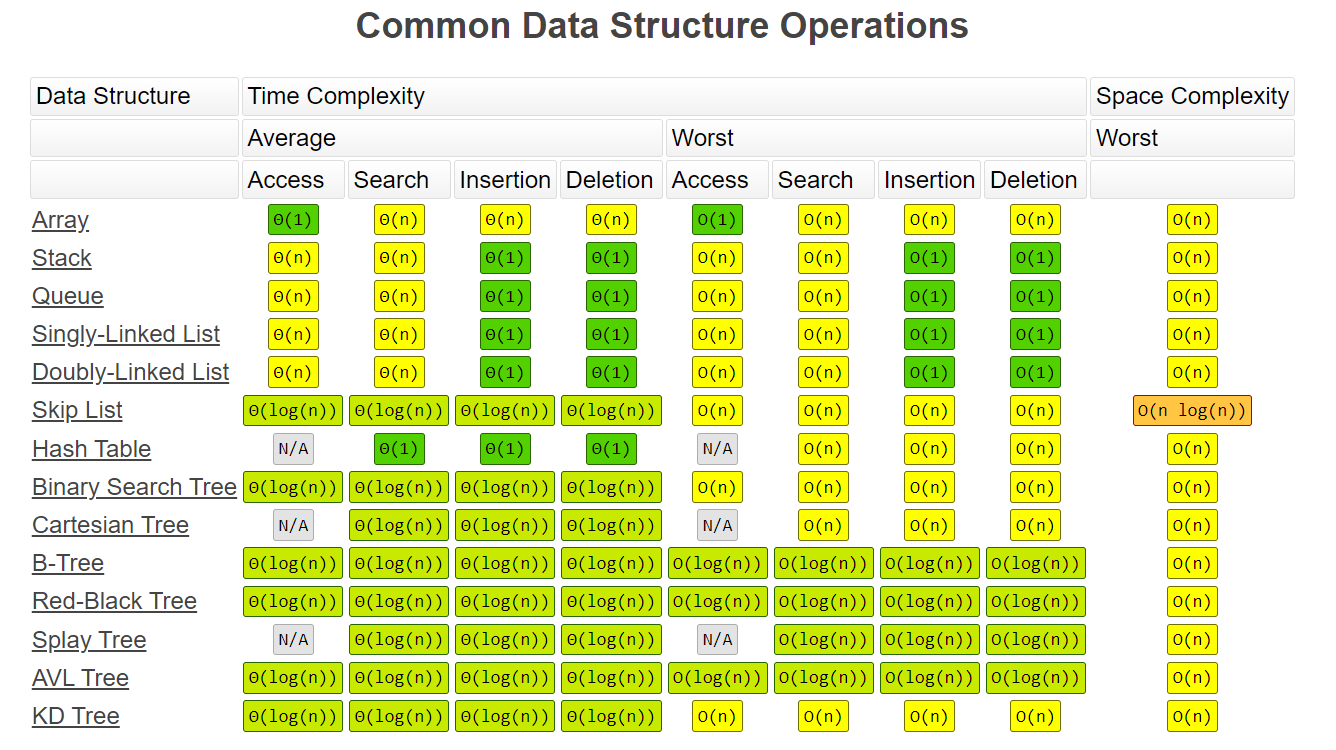
- 注意: 以上的 space 复杂度几乎都是
-
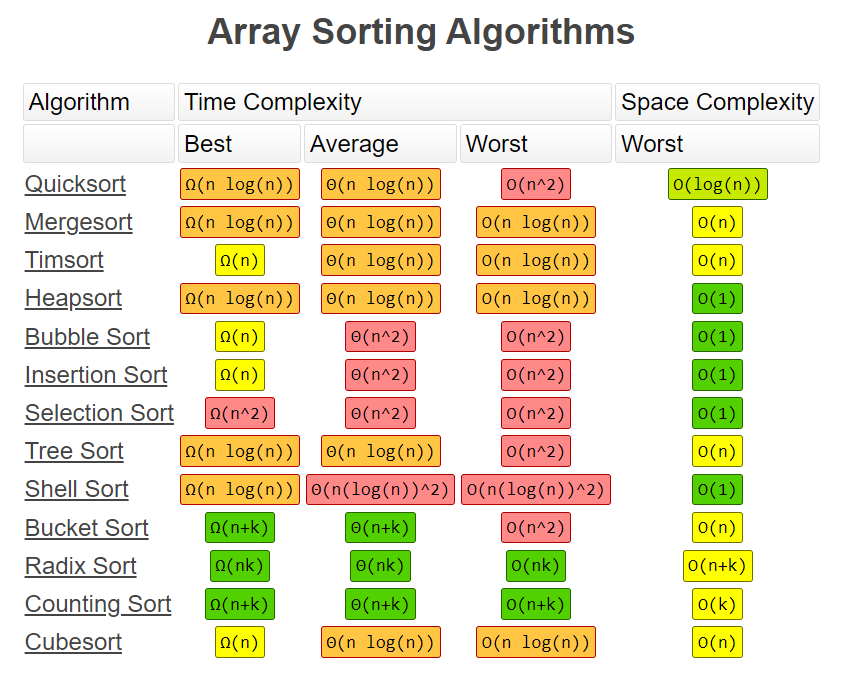
Array Sorting Algorithms
- 对几乎 sorted 的数组, Bubble sort 和 Insertion sort 的 best case 都是 Ω(n), 比其他 sort 都有效率.
- Quick Sort, Merge Sort 的 space 复杂度都不如 Bubble sort, Insertion sort, selection sort.
- Quick sort, merge sort 的 worst case 有些许优势, 但对几乎 sorted 的数组, 效率没有优势.