Note_Tech
All technological notes.
Project maintained by simonangel-fong Hosted on GitHub Pages — Theme by mattgraham
DSA - Graph
Graph
-
Graph- a non-linear data structure consisting of
verticesandedges. -
A graph is an ordered pair
G=(V,E)comprising:V, a set ofvertices(also called nodes or points);E, a set ofedges(also called links or lines), which are unordered pairs of vertices (that is, an edge is associated with two distinct vertices). Each edge is a tuple (v,w) where w,v∈V
- a non-linear data structure consisting of
-
Components of a Graph
-
Vertex / Vertices- also referred to as
node / nodes. -
the fundamental units of the graph.
-
Key- the name of a
vertex
- the name of a
-
Payload- additional information that a vertex has.
- also referred to as
-
Edges- also referred to as
lines,links, orarcs. - lines or arcs that connect any two nodes in the graph show that there is a relationship between them.
- Edges may be one-way or two-way.
- also referred to as
-
Terminology
-
Weight- a cost to go from one vertex to another.
-
Path- a sequence of vertices that are connected by edges.
- Formally we would define a path as w1,w2,…,wn such that (wi,wi+1)∈E for all 1≤i≤n−1.
-
unweighted path length- the number of edges in the path, specifically n−1.
-
weighted path length- the sum of the weights of all the edges in the path.
-
Subgraph- A subgraph s is a set of edges e and vertices v such that e⊂E and v⊂V
-
Undirected Graph- A graph in which edges do not have any direction.
- The nodes of a undirected graphs are unordered pairs in the definition of every edge.
-
Directed Graph- aka
digraph - A graph in which edge has direction.
- The nodes of a directed graph are ordered pairs in the definition of every edge.
- aka
-
cycle graph- a directed graph is a path that starts and ends at the same vertex.
-
Cyclic Graph- A graph containing at least one cycle is known as a Cyclic graph.
-
acyclic graph- A graph with no cycles.
-
directed acyclic graphorDAG- A directed graph with no cycles
Representation of Graphs
-
There are two ways to store a graph:
- Adjacency Matrix
- Adjacency List
| Action | Adjacency Matrix | Adjacency List |
|---|---|---|
| Adding Edge | O(1) | O(1) |
| Removing an edge | O(1) | O(N) |
| Initializing | O(N*N) | O(N) |
Adjacency Matrix
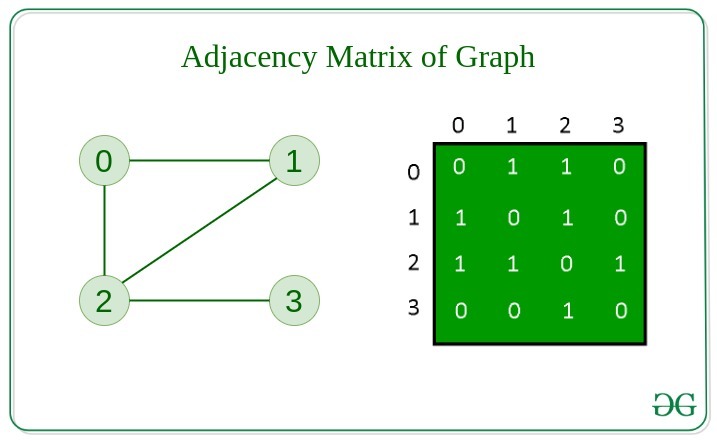
Adjacency Matrix- In this method, the graph is stored in the form of the 2D matrix where rows and columns denote vertices. Each entry in the matrix represents the weight of the edge between those vertices.
-
In this matrix implementation, each of the rows and columns represent a
vertexin the graph. -
The value stored in the cell at the intersection of row v and column w indicates if there is an edge from vertex v to vertex w.
-
When two vertices are connected by an edge, we say that they are adjacent.
-
Sparse matrix- most of the cells in the matrix are empty
-
Full matrix- A matrix is full when every vertex is connected to every other vertex.
-
Advantage of the adjacency matrix
- good for small graphs it is easy to see which nodes are connected to other nodes.
-
a good implementation for a graph when the number of edges is large.
-
Since there is one row and one column for every vertex in the graph, the number of edges required to fill the matrix is ** V ^2**.
-
- A matrix is not a very efficient way to store sparse data.
Adjacency List
-
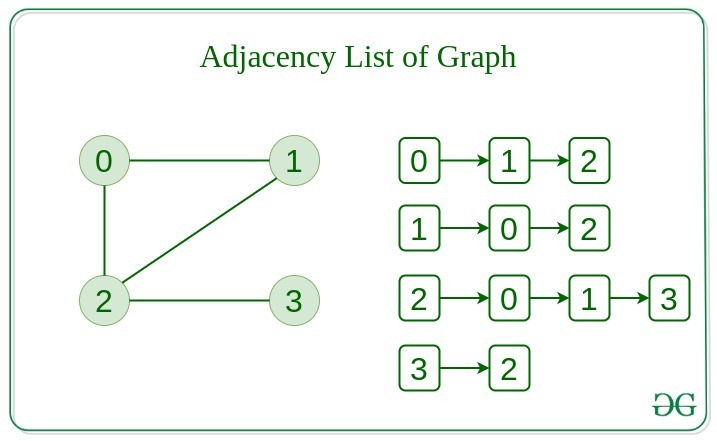
Adjacency List- This graph is represented as a collection of linked lists. There is an array of pointer which points to the edges connected to that vertex.
-
In an adjacency list implementation we keep a master list of all the vertices in the Graph object and then each vertex object in the graph maintains a list of the other vertices that it is connected to.
-
In our implementation of the Vertex class we will use a dictionary rather than a list where the dictionary keys are the vertices, and the values are the weights.
-
Advantage of the adjacency list implementation
- allows us to compactly represent a sparse graph.
- allows us to easily find all the links that are directly connected to a particular vertex.
Implement: Graph using Adjacency List
- Vertex
class Vertex(object):
    '''Implement vertex'''

    def __init__(self, key):
        self.id = key   # key of current vertex
        self.neighbor = {}  # initialize neighbors of current vertex

    def __str__(self):
        return 'Vertex {0} connects to {1}'.format(self.id, str([x.id for x in self.neighbor]))

    def get_id(self):
        return self.id

    def add_neighbor(self, vertex, weight):
        '''add a target vertex with specific weight'''
        # Note that the key here is vertex, an object
        self.neighbor[vertex] = weight
        # set weight for both current and target vertex
        vertex.neighbor[self] = weight

    def get_neighbors(self):
        '''get all neighbors'''
        return [k for k in self.neighbor.keys()]

    def get_weight(self, target_vertex):
        '''get weight from current to target vertex'''

        # if target is in the neighbors
        if target_vertex in self.neighbor:
            return self.neighbor[target_vertex]
        else:
            return None
- Graph
class Graph(object):
    def __init__(self) -> None:
        self.vertice = {}

    def add_vertex(self, key):
        '''create a new vertex with key'''
        new_vertext = Vertex(key)       # create a new vertex
        self.vertice[key] = new_vertext
        return new_vertext

    def get_vertex(self, key):
        if key in self.vertice.keys():
            return self.vertice[key]
        else:
            None

    def add_edge(self, from_key, to_key, cost=0):
        '''add edge'''
        # if from key does not exist, then create a new vertex
        if from_key not in self.vertice:
            self.add_vertex(from_key)

        # if to key does not exist, then create a new vertex
        if to_key not in self.vertice:
            self.add_vertex(to_key)

        self.vertice[from_key].add_neighbor(self.vertice[to_key], cost)

    def get_all_vertice(self):
        '''get all vertice'''
        return [k for k in self.vertice.keys()]

    def __iter__(self):
        return iter(self.vertList.values())

    def __contains__(self, key):
        return key in self.vertice
- Test
g = Graph()

for i in range(6):
    g.add_vertex(i)

print(g.get_vertex(0))  # Vertex 0 connects to []
g.add_edge(0, 1, 1)
g.add_edge(0, 2, 2)
g.add_edge(0, 3, 3)
g.add_edge(0, 7, 3)
print(g.get_vertex(0))      # Vertex 0 connects to [1, 2, 3, 7]
print(g.get_vertex(1))      # Vertex 1 connects to [0]
print(g.get_vertex(2))      # Vertex 2 connects to [0]
print(g.get_vertex(3))      # Vertex 3 connects to [0]
print(g.get_vertex(0))      # Vertex 0 connects to [1, 2, 3, 7]

g.get_all_vertice()     # [0, 1, 2, 3, 4, 5, 7]

3 in g      # True
10 in g     # False
Problem: Word Ladder
-
word ladder.- Transform the word “FOOL” into the word “SAGE”.
- In a word ladder puzzle you must make the change occur gradually by changing one letter at a time.
- At each step you must transform one word into another word, you are not allowed to transform a word into a non-word.
-
example
- FOOL -> POOL -> POLL -> POLE -> PALE -> SALE -> SAGE
-
Solution:
- Use the graph algorithm known as
breadth first searchto find an efficient path from the starting word to the ending word.
- Use the graph algorithm known as
-
Steps:
- turn a large collection of words into a graph.
- have an edge from one word to another if the two words are only different by a single letter.
- Then any path from one word to another is a solution to the word ladder puzzle.
class Vertex:
    def __init__(self,key):
        self.id = key
        self.connectedTo = {}

    def addNeighbor(self,nbr,weight=0):
        self.connectedTo[nbr] = weight

    def __str__(self):
        return str(self.id) + ' connectedTo: ' + str([x.id for x in self.connectedTo])

    def getConnections(self):
        return self.connectedTo.keys()

    def getId(self):
        return self.id

    def getWeight(self,nbr):
        return self.connectedTo[nbr]

class Graph:
    def __init__(self):
        self.vertList = {}
        self.numVertices = 0

    def addVertex(self,key):
        self.numVertices = self.numVertices + 1
        newVertex = Vertex(key)
        self.vertList[key] = newVertex
        return newVertex

    def getVertex(self,n):
        if n in self.vertList:
            return self.vertList[n]
        else:
            return None

    def __contains__(self,n):
        return n in self.vertList

    def addEdge(self,f,t,cost=0):
        if f not in self.vertList:
            nv = self.addVertex(f)
        if t not in self.vertList:
            nv = self.addVertex(t)
        self.vertList[f].addNeighbor(self.vertList[t], cost)

    def getVertices(self):
        return self.vertList.keys()

    def __iter__(self):
        return iter(self.vertList.values())


def buildGraph(wordFile):
    '''function to build graph'''
    d = {}
    g = Graph()

    # 读取单词文件
    wfile = open(wordFile,'r')
    # create buckets of words that differ by one letter
    for line in wfile:
        print(line)
        word = line[:-1]  # 该处-1是去除换行号\n
        print(word)
        for i in range(len(word)):
            bucket = word[:i] + '_' + word[i+1:]  #该处按字母顺序替换为"_"符号作为bucket
            if bucket in d:
                d[bucket].append(word)    # bucket作为字典的键, 目的是如果单词特征相同的,加入到value
            else:
                d[bucket] = [word]    # 如果bucket不存在, 则加入, 注意value是list
    # add vertices and edges for words in the same bucket
    # 思路:
    # 1.遍历所有单词特征
    # 2.嵌套遍历相同特征下的list的成员,
    # 3.如果不是相同单词时, 向graph对象添加edge
    # 效果: 有相同特征的单词之间建立关联
    for bucket in d.keys():
        for word1 in d[bucket]:
            for word2 in d[bucket]:
                if word1 != word2:
                    g.addEdge(word1,word2)
    return g
Breadth First Search (Unfinished)
-
Definition
-
Algorithm
-
Use case
- One good way to visualize what the breadth first search algorithm does is to imagine that it is building a tree, one level of the tree at a time.
- A breadth first search adds all children of the starting vertex before it begins to discover any of the grandchildren.
Depth First Search (Unfinished)
-
Algorithm
-
Use case
- knight’s tour 马走日