Note_Tech
All technological notes.
Project maintained by simonangel-fong Hosted on GitHub Pages — Theme by mattgraham
DSA - Single Linked List
Big O: Linked List vs List
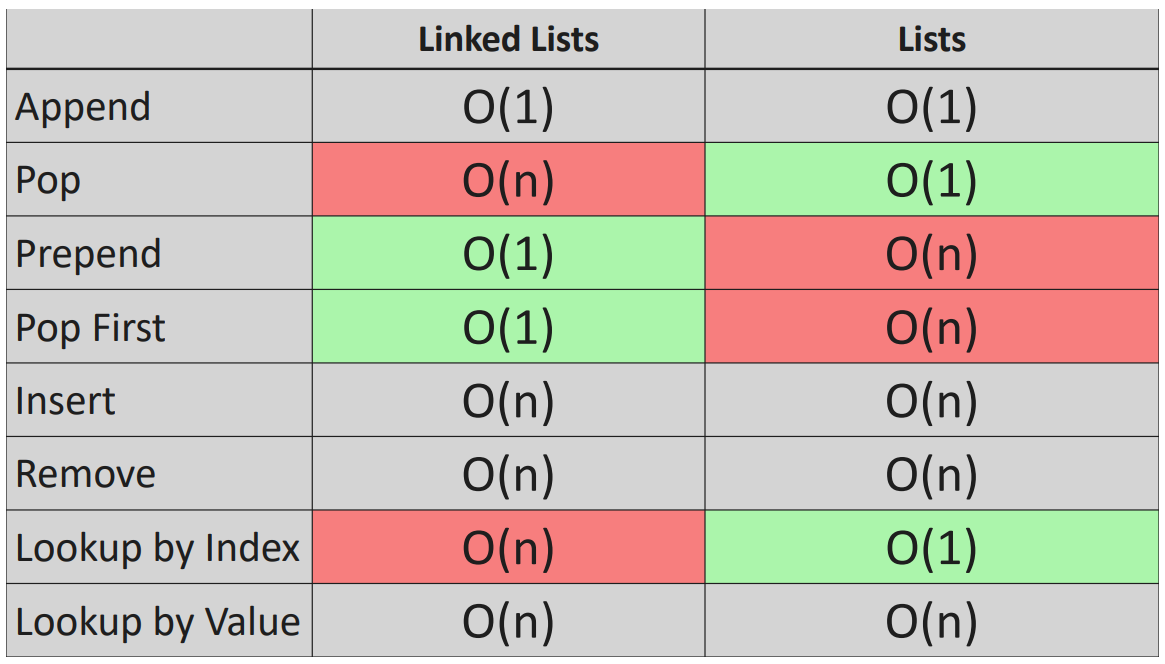
Singly Linked List
-
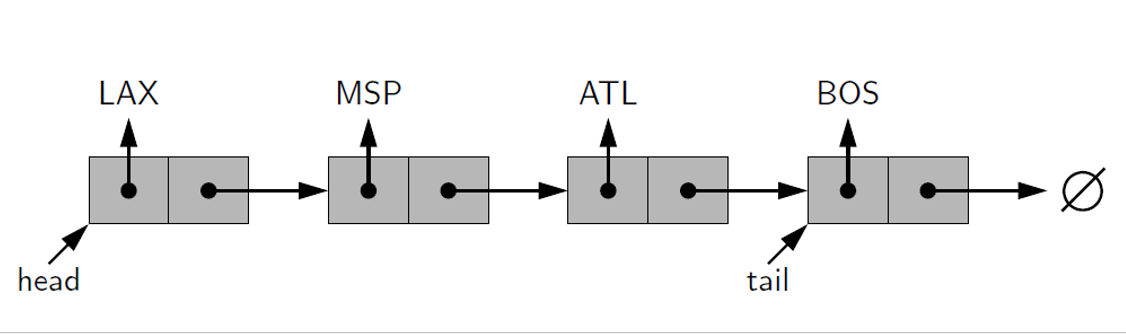
Singly linked list- is a collection of nodes that collectively form a linear sequence.
-
Each
nodestores a reference to an object that is an element of the sequence, as well as a reference to the next node of the list. -
head- the head of the list
- the first node of a linked list
-
tail- the tail of the list
- the last node of a linked list
-
Because the next reference of a node can be viewed as a
linkorpointerto another node, the process oftraversinga list is also known aslink hoppingorpointer hopping.
- An important property of a linked list is that it does not have a predetermined fixed size没有固定长度
class Node(object):
  def __init__(self, value):
    self.value = value
    self.next = None    # the pointer to the next node


class Linked_list(object):
  def __init__(self,value):
    new_node = Node(value)
    # By default, the head and tail of a LL is the first the node
    self.head = new_node
    self.tail = new_node

    self.length = 1
Append(): O(1)
-
Append
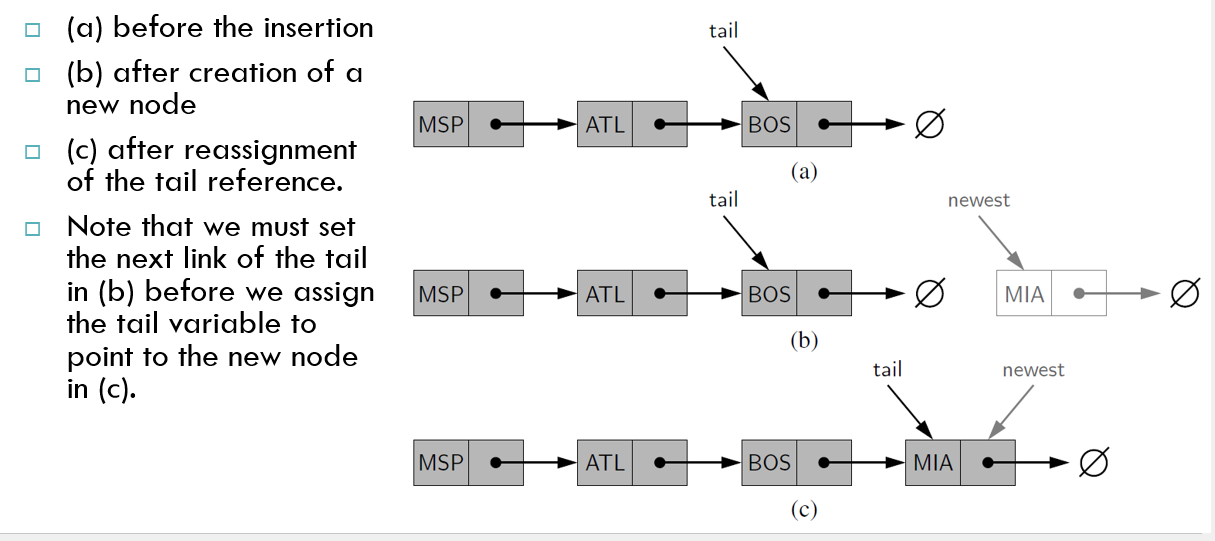
- Inserting an Element at the Tail of a Singly Linked List
-
We can also easily insert an element at the tail of the list, provided we keep a reference to the tail node
- Create a new node
- Assign its next reference to None
- Set the next reference of the tail to point to this new node
- Then update the tail reference itself to this new node.
def append(self, value):
    new_node = Node(value)

    # situation:
    # when the current linked list is empty, then update head and tail
    if self.head is None:
        self.head = new_node
        self.tail = new_node

    # situation:
    # when the current linked list is not empty, then update tail pointer
    else:
        self.tail.next = new_node   # update the next point of current tail node
        self.tail = new_node        # set the tail point as the new node

    self.length += 1    # update length of linked list

    return True
Prepend():O(1)
-
Prepend:
- Inserting an Element at the Head of a Singly Linked List
- It uses space proportionally to its current number of elements.
- To insert a new element at the head of the list:
-
- We create a new node
-
- Set its element to the new element
-
- set its next link to refer to the current head
-
- then set the list’s head to point to the new node.
-
def prepend(self, value):

    new_node = Node(value)

    # when LL is empty, then set head and tail both as new node
    if self.length == 0:
        self.head = new_node
        self.tail = new_node
    # when LL is not empty, then update head
    else:
        new_node.next = self.head
        self.head = new_node

    self.length += 1

    return True
Pop(): O(n)
-
Removing the last Element from a Singly Linked List
-
Removing an element from the
headof a singly linked list is essentially the reverse operation of inserting a new element at the head.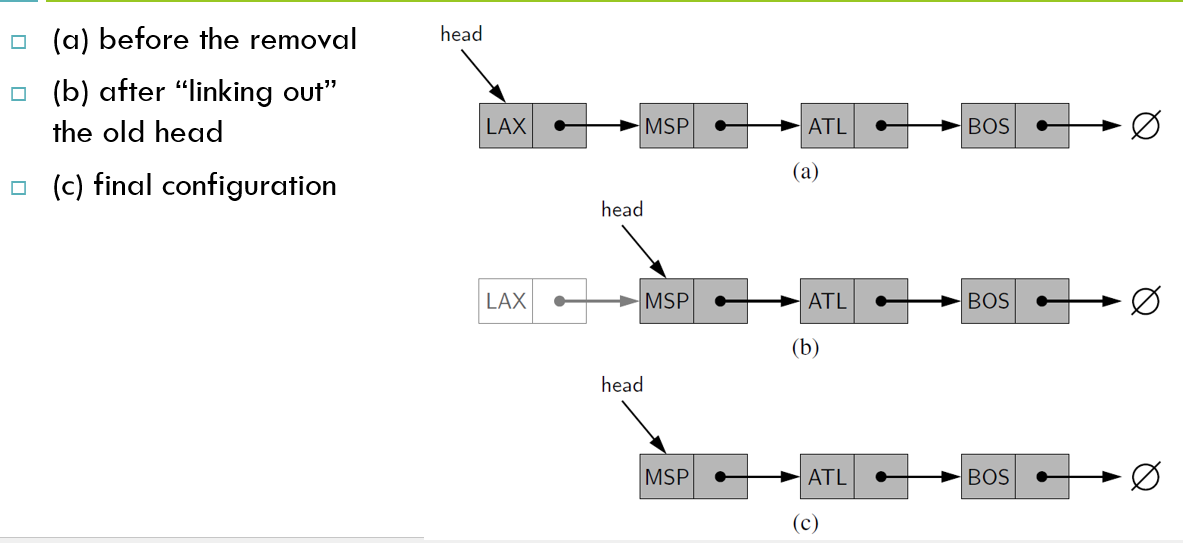
- We cannot easily delete the last node of a singly linked list.
- Even if we maintain a tail reference directly to the last node of the list, we must be able to access the node before the last node in order to remove the last node.
- But we cannot reach the node before the tail by following next links from the tail.
- If we want to support such an operation efficiently, we will need to make our list
doubly linked
def pop(self):

    # when LL is empty
    if self.length == 0:
        return None

    # when LL is not empty
    # initialize helping variables
    current = pre = self.head

    # loop LL until the current is the tail, whose next is None
    # when LL has only one node, that is head equal to tail, loop wont run
    while current.next:
        pre = current
        current = current.next

    self.tail = pre
    self.tail.next = None
    self.length -= 1     # update length

    # when LL has only one node, the length is 0, then set both head and tail as None
    if self.length == 0:
        self.head = None
        self.tail = None

    return current
Pop_first(): O(1)
- Removing the first Element from a Singly Linked List
def pop_first(self):
    # when LL is empty, then return None
    if self.length == 0:
        return None

    # when LL is not empty, then update head
    temp = self.head
    self.head = self.head.next  # when LL has only one node, head next = None
    temp.next = None
    self.length -= 1

    # when LL is empty after pop, set tail as None
    if self.length == 0:
        self.tail = None

    return temp
Get(): O(n)
- Get the node at the specific index
def get(self, index):

    if index < 0:
        raise Exception("invalid index")

    if index >= self.length:
        raise Exception("index out of bound")

    current = self.head
    # 该处使用for loop, 是因为以上代码已经排除了非法index, 所以只需循环指定次数即可
    # 该处使用下划线, 是因为循环中不需要for loop的标记; 如果需要使用, 一般使用for i in range()
    for _ in range(index):
        current = current.next      # 因为range是exclusive, 所以最后的current所在的是index node的前一个node
    return current
Insert(): O(n)
- Insert a new node with a value into a specific index
def insert(self, index, value):

    # when index is invalid
    if index < 0 or index > self.length:
        return False

    # when value is added at the beginning
    if index == 0:
        return self.prepend(value)

    # when value is added at the end
    if index == self.length:
        return self.append(value)

    # when value is added at neither the beginning nor the end
    new_node = Node(value)

    # get the previous node
    pre_node = self.get(index-1)

    new_node.next = pre_node.next        # set new node next
    pre_node.next = new_node            # set pre node next

    self.length +=1
    return True
Remove(): O(n)
- remove a node at a specific index
def remove(self, index):

    # when index is invalid
    if index < 0  or index >= self.length:
        return None

    # when value is added at the beginning
    if index == 0:
        return self.pop_first()

    # when value is added at the end
    if index == self.length-1:
        return self.pop()

    # the invalid index will trigger exception in the get() method
    # get the previous node
    pre_node = self.get(index-1)
    current = pre_node.next

    pre_node.next = current.next        # set pre node next
    current.next = None                 # set current node next

    self.length -=1

    return current
Reverse(): O(n)
- Reverse the order of items in a linked list.
def reverse(self):

    current = self.head
    prev = None
    while current is not None:

        temp_next = current.next
        current.next = prev

        prev = current
        current = temp_next

    self.head, self.tail = self.tail, self.head
Print a Linked List
class Node(object):
    def __init__(self, value):
        self.value = value
        self.next = None    # the pointer to the next node


class Linked_list(object):
    def __init__(self, value):
        new_node = Node(value)
        # By default, the head and tail of a LL is the first the node
        self.head = new_node
        self.tail = new_node

        self.length = 1

    def print_linked_list(self):

        # craete a temporary pointer and initiate by pointing to the head.
        temp = self.head

        # loop until the tail, whose next node is None.
        while temp is not None:
            print(temp.value)
            # update the temporary pointer by pointing to the next node.
            temp = temp.next


ll = Linked_list(4)
ll.print_linked_list()