Note_Tech
All technological notes.
Project maintained by simonangel-fong Hosted on GitHub Pages — Theme by mattgraham
DSA - Queue
Queue
-
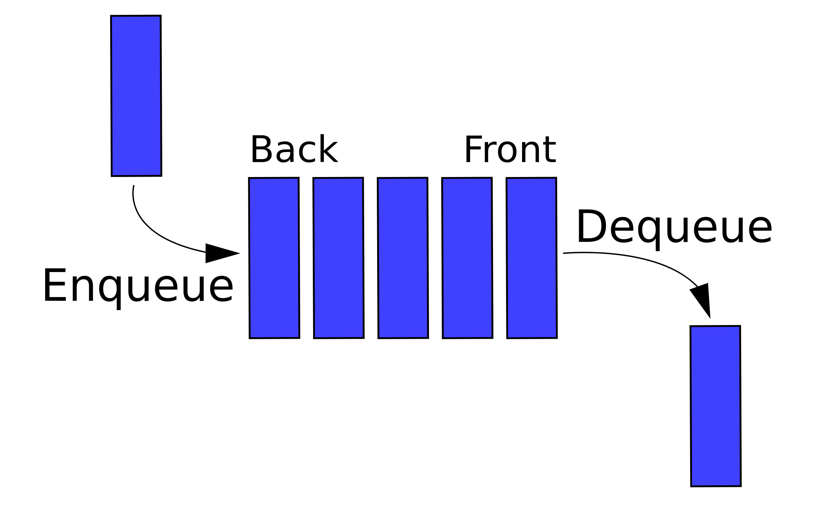
Queue- an ordered collection of items where the addition of new items happens at one end, called the
rear, and the removal of existing items occurs at the other end, commonly called thefront. - As an element enters the queue it starts at the rear and makes its way toward the front, waiting until that time when it is the next element to be removed.
- an ordered collection of items where the addition of new items happens at one end, called the
-
The most recently added item in the queue must wait at the end of the collection. The item that has been in the collection the longest is at the front.
-
First-in first-out (FIFO)- first-come first-served
-
Enqueue- The term describes when a new item is added to the rear of the queue.
-
Dequeue- The term describes removing the front item from the queue.
Implement Queue in Python: Using Linked list
Constructor
class Node:
    def __init__(self, value):
        self.value = value
        self.next = None

class Queue:
    def __init__(self, value):
        new_node = Node(value)
        self.first = new_node
        self.last = new_node
        self.length = 1

    def print_queue(self):
        temp = self.first
        while temp is not None:
            print(temp.value)
            temp = temp.next
Enqueue():O(1)
def enqueue(self, value):
    new_node = Node(value)
    if self.first is None:
        self.first = new_node
        self.last = new_node
    else:
        self.last.next = new_node
        self.last = new_node
    self.length += 1
Dequeue():O(1)
def dequeue(self):
    if self.length == 0:
        return None
    temp = self.first
    if self.length == 1:
        self.first = None
        self.last = None
    else:
        self.first = self.first.next
        temp.next = None
    self.length -= 1
    return temp
Implement Queue in Python: Using a list
class Queue(object):
    def __init__(self):
        self.items = []

    def isEmpty(self):
        return self.items == []

    def size(self):
        return len(self.items)

    def peek(self):
        return self.items[0]

    def push(self, obj):
        self.items.append(obj)

    def pop(self):
        return self.items.pop(0)


print("\n--------Create--------\n")
s = Queue()

print("isEmpty\t", s.isEmpty())         # isEmpty  True


print("\n--------Add--------\n")

s.push(1)
s.push("two")

print("peek\t", s.peek())               # peek     1
print("size\t", s.size())               # size     2
print("isEmpty\t", s.isEmpty())         # isEmpty  False


print("\n--------Remove--------\n")

print("pop\t", s.pop())                 # pop      1
print("pop\t", s.pop())                 # pop      two

print("size\t", s.size())               # size     0
print("isEmpty\t", s.isEmpty())         # isEmpty  True