Note_Tech
All technological notes.
Project maintained by simonangel-fong Hosted on GitHub Pages — Theme by mattgraham
DSA - Stack
Stack
-
stack- an ordered collection of items where the addition of new items and the removal of existing items always takes place at the same end.
- This end is commonly referred to as the
top. - The end opposite the top is known as the
base.
- The
baseof the stack is significant since items stored in the stack that are closer to the base represent those that have been in the stack the longest. -
The most recently added item is the one that is in position to be removed first.
Last-in first-out,(LIFO)- the ordering principle of stack
- an ordering based on length of time in the collection.
- Newer items are near the top, while older items are near the base.
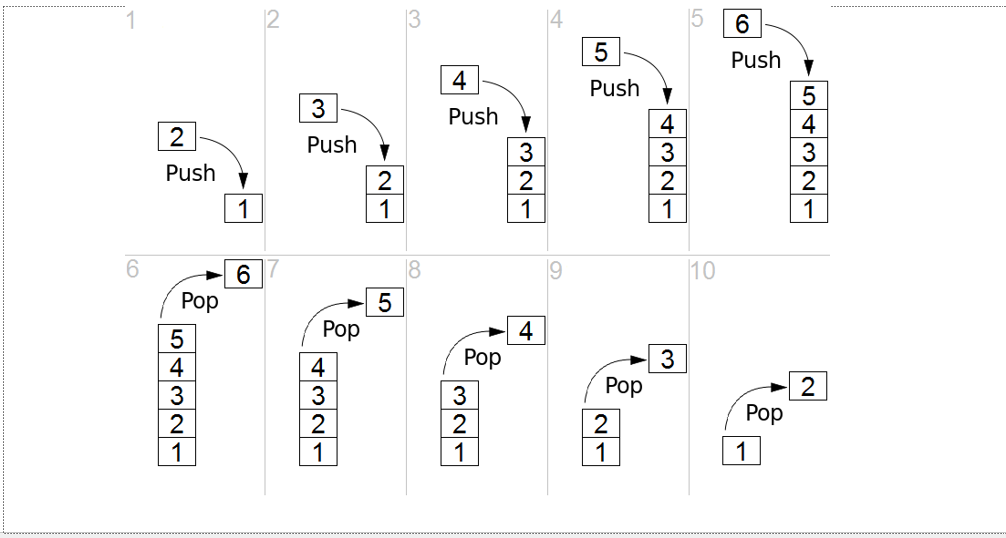
-
The order of insertion is the reverse of the order of removal.
-
For example, every web browser has a Back button.
Implement Stack: Using Linked List
Constructor
class Node:
    def __init__(self, value):
        self.value = value
        self.next = None


class Stack:
    def __init__(self, value):
        new_node = Node(value)
        self.height = 1
        self.top = new_node
Push(): O(1)
def push(self, value):
    new_node = Node(value)
    if self.height == 0:
        self.top = new_node
    else:
        new_node.next = self.top
        self.top = new_node
    self.height += 1
Pop(): O(1)
def pop(self):
    if self.height == 0:
        return None
    temp = self.top
    self.top = self.top.next
    temp.next = None
    self.height -= 1
    return temp
Implement Stack in Python: Using list
class Stack(object):
    def __init__(self):
        self.items = []

    def push(self, obj):
        self.items.append(obj)

    def pop(self):
        return self.items.pop()

    def peek(self):
        return self.items[len(self.items)-1]

    def isEmpty(self):
        return self.items == []

    def size(self):
        return len(self.items)


print("\n--------Create--------\n")
s = Stack()

print("isEmpty\t", s.isEmpty())     # isEmpty  True


print("\n--------Add--------\n")

s.push(1)
s.push("two")

print("peek\t", s.peek())               # peek     two
print("size\t", s.size())               # size     2
print("isEmpty\t", s.isEmpty())         # isEmpty  False


print("\n--------Remove--------\n")

print("pop\t", s.pop())                 # pop      two
print("pop\t", s.pop())                 # pop      1

print("size\t", s.size())               # size     0
print("isEmpty\t", s.isEmpty())         # isEmpty  True
Trick: Implement a Queue - Using Two Stacks
Given the Stack class below, implement a Queue class using two stacks! Note, this is a “classic” interview problem. Use a Python list data structure as your Stack.
class Queue2Stacks(object):

    def __init__(self):

        # Two Stacks
        self.instack = []
        self.outstack = []

    def enqueue(self, element):

        # Add an enqueue with the "IN" stack
        self.instack.append(element)

    def dequeue(self):
        if not self.outstack:
            while self.instack:
                # Add the elements to the outstack to reverse the order when called
                self.outstack.append(self.instack.pop())
        return self.outstack.pop()

'''
## Summary

- 效率:

  - 最好: `O(1)`
  - 最坏: `O(N)`

- 思路:
  - 图解:
    - 结构:|inStack| external |outStack|
    - 插入时: |1,2,3| external | |
    - 取出(目标值是 1): | | external <-1 | 2,3 |
    - 插入 4: |4 | external |2,3|
    - 取出(目标值是 2): | 4 | external <-2 | 3 |
  - 利用进入 stack 可以颠倒顺序
    - 插入的新元素 stack 在 inStack 中
    - 从 inStack 提取时, 即颠倒了顺序, 并将颠倒顺序的元素存储在 outStack
    - outStack 作用是 buffer
    - pop 时, 直接从 outStack pop 即可.
  - 只有当 outStack 为空时才需要颠倒顺序; 如果不为空, 则直接从 outStack 中 pop. 提高效率.
'''