Note_Tech
All technological notes.
Project maintained by simonangel-fong Hosted on GitHub Pages — Theme by mattgraham
DSA - Tree
Tree
-
Tree- a tree consists of a set of nodes and set of edges that connect pairs of nodes.
-
Properties:
- One node of the tree is designated as the root node.根唯一性
- Each node, except the root node, is connected by an edge from exactly one parent node. 父节唯一.
- A unique path traverses from the root to each node.根路径唯一.
-
Binary tree- a tree has a maximum of two children.
Terminology
-
Node- a fundamental part of a tree.
key: the name of a node- A node may have additional information, aka
payload
-
Edge- connects two nodes to show relationship between them.
- Each node, except the root, is connected by exactly one incoming edge from another node.
- Each node may have several outgoing edges.
-
Root- the only node in the tree that has no incoming edges.
-
Path- an ordered list of nodes that are connected by edges.
-
Childrenof a node- the set of nodes “c” that have incoming edges from the that node.
-
Parentof a node- the node that connects to another nodes with outgoing edges.
-
Sibling- the children of the same parent.
-
Leaf Node- a node that has no children.
-
Subtree- a set of nodes and edges comprised of a parent and its all the descendants.
-
Level- the number of edges on the path from the root node to a specific node.
-
Height- the maximum level of any node in the tree.
Recursive Definition
-
A tree is either empty or consists of a root and zero or more subtrees, each of which is also a tree.
-
The root of each subtree is connected to the root of the parent tree by an edge.
Tree Traversals
-
Three commonly used patterns to visit all the nodes in a tree:
- preorder,
- inorder,
- and postorder.
-
The difference between these patterns is the order in which each node is visited (a
traversal) -
Best Implementation
- Implementing preorder as an external function is probably better in this case.
- The reason is that you very rarely want to just traverse the tree.
- In most cases you are going to want to accomplish something else while using one of the basic traversal patterns.
- We will write the rest of the traversals as external functions.
Preorder
-
In a
preorder traversal, we visit the root node first, then recursively do a preorder traversal of the left subtree, followed by a recursive preorder traversal of the right subtree. -
root node » left subtree » right subtree
class Binary_Tree(object):

    def __init__(self, node_name):
        self.name = node_name
        self.left_child = None
        self.right_child = None

    def get_rootName(self):
        return self.name

    def set_rootName(self, new_rootName):
        self.name = new_rootName

    def get_leftChild(self):
        return self.left_child

    def get_rightChild(self):
        return self.right_child

    def insert_leftChild(self, leftChild_name):

        # when left_child has an existing node
        if self.left_child != None:
            # create a new child
            new_node = Binary_Tree(leftChild_name)

            # copy the existing child to the left child of the new node
            new_node.left_child = self.left_child

            # insert the new child to this node
            self.left_child = new_node

        else:
            self.left_child = Binary_Tree(leftChild_name)

    def insert_rightChild(self, rightChild_name):

        # when right_child has an existing node
        if self.right_child != None:
            # create a new child
            new_node = Binary_Tree(rightChild_name)

            # copy the existing child to the right child of the new node
            new_node.right_child = self.right_child

            # insert the new child to this node
            self.right_child = new_node

        else:
            self.right_child = Binary_Tree(rightChild_name)


def preorder(tree):

    acc = []

    if tree:
        acc.append(tree.name)
        acc.extend(preorder(tree.left_child))
        acc.extend(preorder(tree.right_child))

    return acc


print("\n--------Tree (list)--------\n")
bi_tree = Binary_Tree("root")

bi_tree.insert_leftChild("leftChild")
bi_tree.insert_rightChild("rightChild")

l_ch = bi_tree.get_leftChild()
l_ch.insert_rightChild("Child_child")

# preoder:         ['root', 'leftChild', 'Child_child', 'rightChild']
print("preoder:\t", preorder(bi_tree))
Inorder
-
In an
inorder traversal, we recursively do an inorder traversal on the left subtree, visit the root node, and finally do a recursive inorder traversal of the right subtree. -
在 bst 排序中使用
def inorder(tree):
  if tree:
    preorder(tree.getLeftChild())
    print(tree.getRootVal())
    preorder(tree.getRightChild())
Postorder
-
In a
postorder traversal, we recursively do a postorder traversal of the left subtree and the right subtree followed by a visit to the root node. -
在 bst 的 trim 问题中使用
def postorder(tree):
  if tree:
    preorder(tree.getLeftChild())
    preorder(tree.getRightChild())
    print(tree.getRootVal())
Binary Tree
-
binary tree- a data structure in which each node has at most two children, which are referred to as the left child and the right child.
-
full binary tree- 对每个字节, 要么没有子节, 要么有两个字节
-
perfect binary tree- a binary tree in which all interior nodes have two children and all leaves have the same depth or same level. 每层都填满
-
complete binary tree- a binary tree in which every level, except possibly the last, is completely filled, and all nodes in the last level are as far left as possible.从左到右填充
-
balanced binary tree- a binary tree structure in which the left and right subtrees of every node differ in height by no more than 1.
-
Use case:
- used to implement
binary search treesandbinary heaps - used for efficient searching and sorting. In computing, binary trees are used in two very different ways:
- used to implement
Implement a Binary Tree: Using linked list
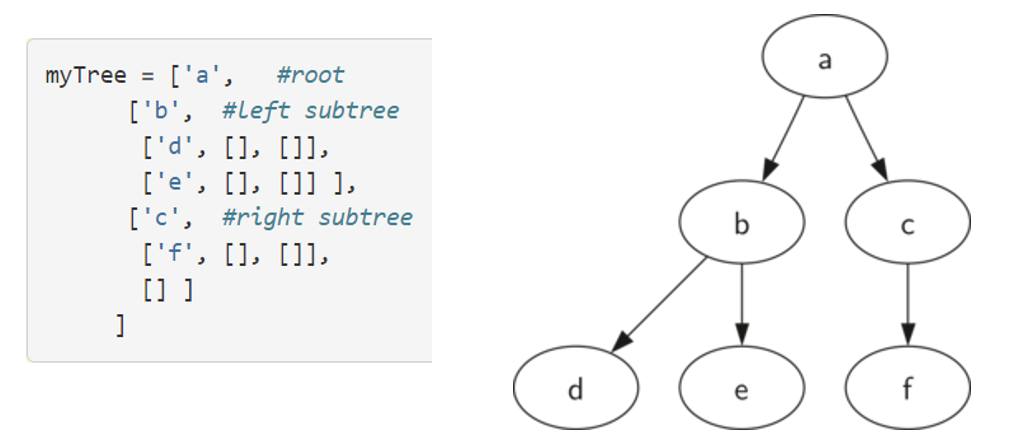
Implement a Binary Tree in Python: Using List
- store the value of the root node as the first element of the list.
- The second element of the list will itself be a list that represents the left subtree.
- The third element of the list will be another list that represents the right subtree.
def binary_tree(root_value):
    return [root_value, [], []]


def get_root(b_tree):
    return b_tree[0]


def set_root(b_tree, new_root_value):
    b_tree[0] = new_root_value


def get_leftChild(b_tree):
    return b_tree[1]


def get_rightChild(b_tree):
    return b_tree[2]


def insert_leftChild(b_tree, branch_value):

    # remove the left child
    t = b_tree.pop(1)

    # when left child is not empty
    # condition: length over 1.
    # It can be 1, means the left child has a name but no subchild.
    # Over 1, means the left child has subchildren.
    if len(t) > 1:
        b_tree.insert(1, [branch_value, t, []])

    # when left child is empty
    else:
        b_tree.insert(1, [branch_value, [], []])

    return b_tree


def insert_rightChild(b_tree, branch_value):

    # remove the right child
    t = b_tree.pop(2)

    # when right child is not empty
    # condition: length over 1.
    # It can be 1, means the right child has a name but no subchild.
    # Over 1, means the right child has subchildren.
    if len(t) > 1:
        b_tree.insert(2, [branch_value, [], t])

    # when right child is empty
    else:
        b_tree.insert(2, [branch_value, [], []])


print("\n--------Tree (list)--------\n")
bi_tree = binary_tree("root")

insert_leftChild(bi_tree, "leftChild")
insert_rightChild(bi_tree, "rightChild")


print("get root\t", get_root(bi_tree))

set_root(bi_tree, "newRoot")
print("get new root\t", get_root(bi_tree))

l_child = get_leftChild(bi_tree)
r_child = get_rightChild(bi_tree)
print("left child:\t", l_child)
print("right child:\t", r_child)

set_root(l_child, "newLeftChild")

print("new left child\t", get_root(bi_tree))
print("new left child:\t", l_child)
Implement a Binary Tree in Python: Using OOP
- define a class that has attributes for the root value, as well as the left and right subtrees.
class Binary_Tree(object):

    def __init__(self, node_name):
        self.name = node_name
        self.left_child = None
        self.right_child = None

    def get_rootName(self):
        return self.name

    def set_rootName(self, new_rootName):
        self.name = new_rootName

    def get_leftChild(self):
        return self.left_child

    def get_rightChild(self):
        return self.right_child

    def insert_leftChild(self, leftChild_name):

        # when left_child has an existing node
        if self.left_child != None:
            # create a new child
            new_node = Binary_Tree(leftChild_name)

            # copy the existing child to the left child of the new node
            new_node.left_child = self.left_child

            # insert the new child to this node
            self.left_child = new_node

        else:
            self.left_child = Binary_Tree(leftChild_name)

    def insert_rightChild(self, rightChild_name):

        # when right_child has an existing node
        if self.right_child != None:
            # create a new child
            new_node = Binary_Tree(rightChild_name)

            # copy the existing child to the right child of the new node
            new_node.right_child = self.right_child

            # insert the new child to this node
            self.right_child = new_node

        else:
            self.right_child = Binary_Tree(rightChild_name)


print("\n--------Tree (Class)--------\n")
bi_tree = Binary_Tree("root")

bi_tree.insert_leftChild("leftChild")
bi_tree.insert_rightChild("rightChild")


print("get root\t", bi_tree.get_rootName())

bi_tree.set_rootName("newRoot")
print("get new root\t", bi_tree.get_rootName())

l_child = bi_tree.get_leftChild()
r_child = bi_tree.get_rightChild()
print("left child:\t", l_child)
print("left child name:\t", l_child.get_rootName())
print("right child:\t", r_child)
print("right child name:\t", r_child.get_rootName())

l_child.set_rootName("newLeftChild")

print("new left child name:\t", l_child.get_rootName())