Note_Tech
All technological notes.
Project maintained by simonangel-fong Hosted on GitHub Pages — Theme by mattgraham
HTML - Fundamental
Two types of pages
-
Static pages
- The content in pages cant be changed;
- Everyone see same content
-
Dynamic pages
- The content are connected to the database which return different data e.g.: hotel.com different people have different contents. php 不用学, 所以主要学 html, css, js, Jquery
HTML File
HTML files end with the extension of .html.
- HTML stands for Hyper Text Markup Language
- HTML is the standard markup language for creating Web pages
- HTML describes the structure of a Web page
- HTML consists of a series of elements
- HTML elements tell the browser how to display the content
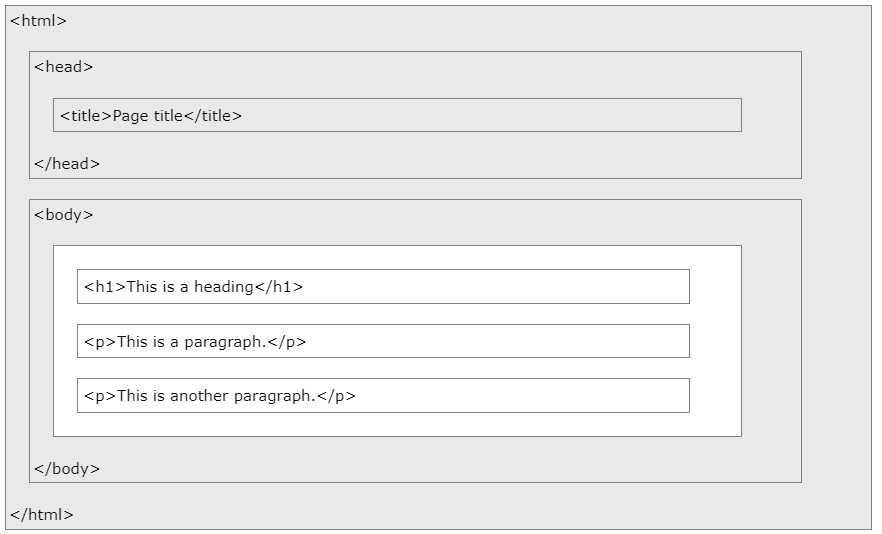
HTML Page Structure
<!-- All HTML documents must start with a document type declaration that represents the document type, and helps browsers to display web pages correctly. -->
<!-- It must only appear once, at the top of the page (before any HTML tags). -->
<!-- not case sensitive -->
<!DOCTYPE html>

<!-- The HTML document itself begins with <html> and ends with </html>. It is the root element of an HTML page -->
<html>
  <!-- The element contains meta information about the HTML page -->
  <head>
    <!-- element specifies a title for the HTML page -->
    <title>Page Title</title>
  </head>
  <!-- The visible part of the HTML document is between <body> and </body>. -->
  <body>
    <!-- element defines a large heading -->
    <h1>My First Heading</h1>
    <!-- element defines a paragraph -->
    <p>My first paragraph.</p>
  </body>
</html>
HTML Element
-
An HTML element is defined by a start tag, some content, and an end tag.
-
Empty elements do not have content and the end tag!
e.g.:<br>
Nested HTML Elements
-
HTML elements can be nested (this means that elements can contain other elements).
嵌套 -
All HTML documents consist of nested HTML elements.
Comment
HTML comments are not displayed in the browser, but they can help document your HTML source code.
<!-- this is a comment line. -->
-
Notice that there is an exclamation point (!) in the start tag, but not in the end tag.
-
Everything between the
<!--and the-->will be hidden from the display.
Attribute
- HTML Attribute allow to add more information to HTML tags.
| Attribute | Description |
|---|---|
<a href=""></a> |
URL that the link goes to |
<img src=""> |
Source of image |
<img alt=""> |
Alternate of image |