Note_Tech
All technological notes.
Project maintained by simonangel-fong Hosted on GitHub Pages — Theme by mattgraham
Kubernetes - Fundamental
kubernetes
-
kubernetes-
Greek for helmsman
- An open-source orchestration solution that automates the deployment, scaling, networking, and lifecycle management of applications across clusters of containerized environments.
- maintained by the
Cloud Native Computing Foundation (CNCF)
- maintained by the
- Kubernetes schedules the components of a distributed application onto individual computers in the underlying computer cluster and acts as an interface between the application and the cluster.
-
-
Feature
- provides an abstraction layer over the underlying hardware to both users and applications.
- Standardizing application deployment
- A single manifest that describes the application can be used for local deployment and for deploying on any cloud provider.
- Deploying applications declaratively
- takes over the daily management of the application
Architecture of a Kubernetes cluster
Kubernetes clusterconsists of nodes divided into two groups:master nodes- the node hosts the
Control Planecomponents, which are the brains of the system, since they control the entire cluster.
- the node hosts the
worker nodes- the nodes that form the
Workload Plane, which is where your workloads (or applications) run.
- the nodes that form the
the process of deploying the application:
- submit the application manifest to the Kubernetes
API. TheAPI Serverwrites the objects defined in the manifest toetcd. - A
controllernotices the newly created objects and creates several new objects - one for each application instance. - The
Schedulerassigns a node to each instance. - The
Kubeletnotices that an instance is assigned to the Kubelet’s node. It runs the application instance via theContainer Runtime. - The
Kube Proxynotices that the application instances are ready to accept connections from clients and configures a load balancer for them. - The
Kubeletsand theControllersmonitor the system and keep the applications running.
Virtualization vs. Containerization vs. Orchestration
-
Virtualization- A hardware-abstraction solution that partitions a physical machine into multiple independent environment, called
virtual machines, each with its ownoperating system. - purpose:
- Run multiple OS instances on one physical machine
- tool:
- VMware, Hyper-V, KVM, Proxmox VE
- A hardware-abstraction solution that partitions a physical machine into multiple independent environment, called
-
Containerization- An application-abstraction solution that packages an application and its dependencies into a consistent, called
container, isolated environment running on a shared operating system. - purpose:
- Ensure consistent application environments across systems
- tool:
- Docker, Podman, LXC
- An application-abstraction solution that packages an application and its dependencies into a consistent, called
-
Orchestration- An automation solution that coordinates the deployment, scaling, and operation of applications across distributed containerized environments.
- purpose:
- Automate and optimize containerized application lifecycle at scale
- tool:
- Kubernetes, Docker Swarm, Amazon ECS
| Aspect | Virtualization | Containerization | Orchestration |
|---|---|---|---|
| Level of Abstraction | Hardware / OS | Application / runtime | Infrastructure management |
| Isolation Target | Operating systems | Applications | Application operations |
| Overhead | High (each VM runs its own OS) | Low (containers share the host OS kernel) | Variable |
Microservices
-
Microservices- a software architecture that structures a large application as a collection of small, independent, and loosely coupled services, each responsible for a specific business function.
- vs
monolithic architectures- services communicate with each other via lightweight APIs
- services can be developed, deployed, and scaled independently, offering benefits like enhanced agility, resilience, and easier maintenance
Example - Voting system
- Basic services
| Service | description |
|---|---|
| Voting service | Receive votes from users |
| Cache service | Cache vote data |
| backend service | handle vote transaction |
| database service | persist vote data |
| result service | return vote data |
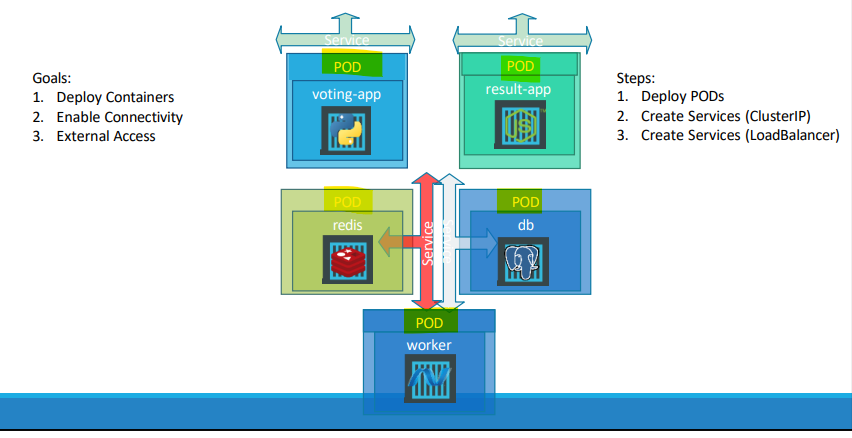
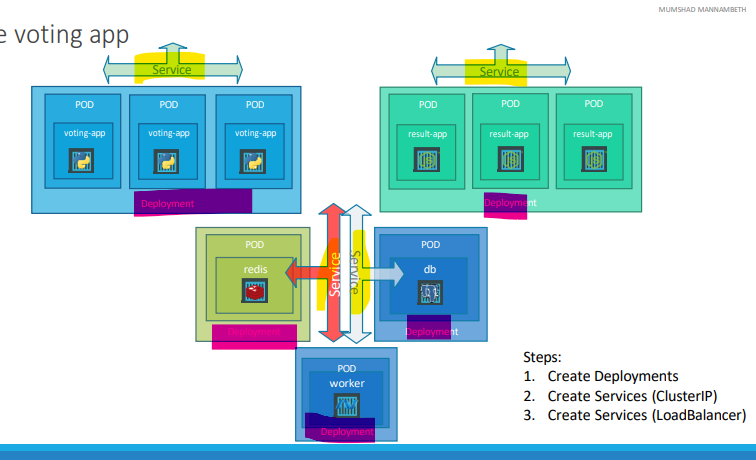
- Application Architecture with deployment
Declarative vs Imperative vs Functional vs Procedural
-
Declarative Programming- A paradigm to describe what the program should accomplish, not how to do it.
- The control flow is abstracted away by the language or framework.
- Focuses on results rather than steps.
- Examples: SQL, HTML, regular expressions, Prolog.
-
Imperative Programming- A paradigm to explicitly tell the computer how to perform tasks, step by step.
- define the control flow with statements that change program state.
- Focuses on commands and state changes.
- Examples: C, Python (when used with loops and assignments), Assembly.
-
Functional Programming- A style of
declarative programmingwhere computation is treated as the evaluation of mathematical functions without changing state or mutable data. - Emphasizes pure functions, immutability, and avoiding side effects.
- Examples: Haskell, Lisp, Scala, Python (functional features: map, lambda, etc.).
- A style of
-
Procedural Programming- A subset of
imperative programmingthat organizes code into procedures (functions or routines). - Each procedure performs a specific task and can be reused.
- Focuses on procedures (reusable blocks of code).
- Examples: C, Pascal, Fortran, Python (when structured into functions).
- A subset of
-
Object-Oriented Programming (OOP)- A paradigm that organizes software design around
objects- bundles of data (attributes) and behavior (methods).
- emphasizes encapsulation, inheritance, and polymorphism.
- Focuses on objects that model real-world entities.
- Examples: Java, C++, C#, Python (when using classes/objects).
- A paradigm that organizes software design around
-
Categorization
Imperative(broad category: how to do it)ProceduralObject-Oriented
Declarative(broad category: what to achieve)Functional
K8s = Declarative
- Kubernetes is a Declarative style
- describe the desired state
Kubernetes controllerswork continuously to reconcile the actual state with the desired state.
K8s: Imperative vs Declarative
-
Imperative Approach in k8s
- tell Kubernetes what action to do right now using direct commands.
- e.g.,
kubectl runkubectl createkubectl exposekubectl edit- …
-
Categories:
- create objects:
- run, create, expose
- update object:
- edit, scale, set image
- create objects:
-
Declarative Approach in k8s
- declare the desired state in a manifest file (YAML/JSON), and Kubernetes continuously works to match the actual state to that desired state.
- e.g., kubectl apply -f deployment.yaml
- Create object:
- the object must not exist; Otherwise error
- yaml + create
- Update object:
- the object must exist; Otherwise error
- edit + yaml
- yaml + replace
- Create/update object:
- yaml + apply
Contiainerization
-
Container Runtime Interface (CRI)- a Kubernetes API standard (gRPC-based) that lets the
kubelet(Kubernetes node agent) communicate with variouscontainer runtimes(likecontainerd,CRI-O) to manage container lifecycles (pulling images, starting/stopping containers) without needing specific code for each. - Common
OCI-compliant container runtime:rktrunC: The foundational, low-level tool that directly interacts with the OS to create and run containerscontainerd: high-level runtime that manages the full container lifecycle,runcCRI-O: a lightweightcontainer runtimespecifically built forKubernetespodman: A daemonless alternative to DockerKata Containers: Provides strong isolation by running containers inside lightweight virtual machines, enhancing security.
- a Kubernetes API standard (gRPC-based) that lets the