Note_Tech
All technological notes.
Project maintained by simonangel-fong Hosted on GitHub Pages — Theme by mattgraham
Kubernetes Networking: Gateway API & GatewayClass
- Kubernetes Networking:
Gateway API\&GatewayClass
Gateway
- Ingress limitation
- Ingress cannot support for
- multi-tenancy:
- ingress paths must be managed by one tenancy
- Namespace isolation
- No RBAC
- No resource isolations
- …
- multi-tenancy:
- Ingress cannot support for
Gateway API- represents the instantiation of a
logical load balancer - used to provide dynamic infrastructure provisioning and advanced traffic routing.
- provide layer 4 and 7 routing
- represents the instantiation of a
GatewayClass:- defines the load balancer template when users create a
Gateway. - Defines a set of
gatewayswith common configuration. - infractructure providers
- e.g., nginx, loadbalancer
- defines the load balancer template when users create a
- Gateway:
- Cluster Operators
- HttpRouter / TCPRoute / GRPCRoute
- application Developers
Four API Kinds
GatewayClass:- Defines a set of gateways with common configuration and managed by a
controllerthat implements the class.
- Defines a set of gateways with common configuration and managed by a
Gateway:- Defines an instance of traffic handling infrastructure
- e.g., cloud load balancer.
HTTPRoute:- Defines HTTP-specific rules for mapping traffic from a
Gateway listenerto a representation of backend network endpoints. - These endpoints are often represented as a
Service.
- Defines HTTP-specific rules for mapping traffic from a
GRPCRoute:- Defines gRPC-specific rules for mapping traffic from a
Gateway listenerto a representation of backend network endpoints. - These endpoints are often represented as a
Service.
- Defines gRPC-specific rules for mapping traffic from a
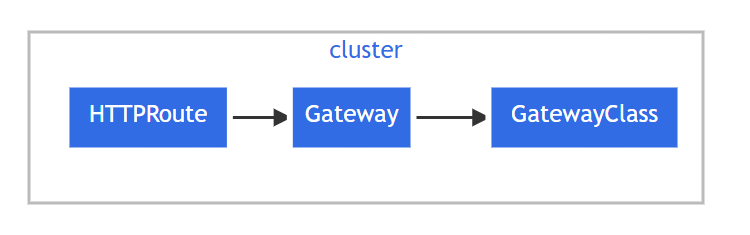
Service vs Ingress vs Gateway API
| Feature | Service | Ingress | Gateway API |
|---|---|---|---|
| Primary Goal | Basic connectivity & load balancing between pods. | Routing external HTTP(S) traffic into the cluster. | Advanced, role-oriented traffic management (L4 & L7). |
| OSI Layer | Layer 4 (TCP/UDP). | Layer 7 (HTTP/HTTPS only). | Layers 4 and 7 (HTTP, TCP, gRPC, etc.). |
| Config Style | Single resource (Service). | Single resource + custom Annotations. | Modular (GatewayClass, Gateway, Routes). |
| Persona | App Developer. | App Developer (often oversteps). | Infra Admin + Cluster Op + App Developer. |
| Traffic Splitting | No (all pods get equal share). | Limited (requires vendor annotations). | Built-in (e.g., 90% to v1, 10% to v2). |
Declarative Manifests
apiVersion: gateway.networking.k8s.io/v1
kind: Gateway
metadata:
  name: example-gateway
  namespace: example-namespace
spec:
  gatewayClassName: example-class
  listeners:
    - name: http
      protocol: HTTP
      port: 80
      hostname: "www.example.com"
      allowedRoutes:
        namespaces:
          from: Same
listeners.allowedRoutes.namespaces.from:- indicates where Routes will be selected for this Gateway
- values:
All: Routes in all namespaces may be used by this Gateway.Selector: Routes in namespaces selected by the selector may be used by this Gateway.from:selector
Same: Only Routes in the same namespace may be used by this Gateway.
Imperative Commands
| Command | Description |
|---|---|
kubectl get gtw |
Shows the Address and Programmed status. |
kubectl get gtw -A |
Lists all gateways across all namespaces. |
kubectl describe gtw NAME |
Critical for debugging. Shows why a gateway is stuck in “Pending.” |
kubectl edit gtw NAME |
Imperatively change ports (e.g., changing 8080 to 9090) on the fly. |
kubectl wait --for=condition=programmed gtw/NAME |
Useful in scripts to wait until the proxy is ready before sending traffic. |
Gateway Class
Gateway Class- the object contains the name of the
controllerthat implements the class. - a cluster-scoped resource that defines which controller (e.g., Envoy, Istio, Nginx) should manage the Gateway.
- the object contains the name of the
-
A
Gatewaymust reference aGatewayClass - Example:
apiVersion: gateway.networking.k8s.io/v1
kind: GatewayClass
metadata:
  name: demo-class
spec:
  # specify the controller name
  controllerName: example.com/gateway-controller
Imperative Commands
| Command | Description |
|---|---|
kubectl get gc |
Lists all available classes and their controller names. |
kubectl describe gc NAME |
Checks the Status to see if the controller has “Accepted” the class. |
kubectl delete gc NAME |
Removes the class definition (will break Gateways relying on it). |
kubectl get gc -o yaml |
Quickest way to see the controllerName string needed for new classes. |
HTTPRoute
HTTPRoute- specifies routing behavior of HTTP requests from a
Gateway listenerto backend network endpoints.
- specifies routing behavior of HTTP requests from a
- represents configuration that is applied to the underlying Gateway implementation.
- For example, defining a new
HTTPRoutemay result in configuring additional traffic routes in a cloud load balancer or in-cluster proxy server.
- For example, defining a new
- For a
Servicebackend, an implementation may represent the backend networkendpointas aService IPor the backingEndpointSlicesof the Service.
Request flow

the request flow for a Gateway implemented as a reverse proxy is:
- The
clientstarts to prepare an HTTP request for the URL http://www.example.com - The
client’sDNS resolverqueries for the destination name and learns a mapping to one or more IP addresses associated with the Gateway. - The
clientsends a request to theGateway IP address; thereverse proxyreceives the HTTP request and uses theHost: headerto match a configuration that was derived from theGatewayand attachedHTTPRoute. - Optionally, the
reverse proxycan perform request header and/or path matching based on match rules of theHTTPRoute. - Optionally, the
reverse proxycan modify the request; for example, to add or remove headers, based on filter rules of the HTTPRoute. - Lastly, the
reverse proxyforwards the request to one or morebackends
Declarative Manifest
apiVersion: gateway.networking.k8s.io/v1
kind: HTTPRoute
metadata:
  name: example-httproute
spec:
  parentRefs:
    - name: example-gateway
  hostnames:
    - "www.example.com"
  rules:
    - matches:
        - path:
            type: PathPrefix
            value: /login
      backendRefs:
        - name: example-svc
          port: 8080
Imperative Commands
| Command | Description |
|---|---|
kubectl get httproute |
|
kubectl describe httproute |
GRPCRoute
GRPCRoute- specifies routing behavior of gRPC requests from a
Gateway listenerto backend network endpoints. - represents configuration that is applied to the underlying Gateway implementation.
- For example, defining a new
GRPCRoutemay result in configuring additional traffic routes in a cloud load balancer or in-cluster proxy server.
- For example, defining a new
- specifies routing behavior of gRPC requests from a
- For a
Servicebackend, an implementation may represent the backend network endpoint as a Service IP or the backingEndpointSlicesof the Service.
Declarative Manifests
- Example:
- traffic from
Gatewayexample-gateway with the host set to svc.example.com directed to theserviceexample-svc on port 50051
- traffic from
apiVersion: gateway.networking.k8s.io/v1
kind: GRPCRoute
metadata:
  name: example-grpcroute
spec:
  parentRefs:
    - name: example-gateway
  hostnames:
    - "svc.example.com"
  rules:
    - backendRefs:
        - name: example-svc
          port: 50051
- Example:
- traffic for svc.example.com and apply its routing rules to forward the traffic to the correct backend.
- only requests for the
com.example.User.Loginmethod to svc.example.com will be forwarded.
apiVersion: gateway.networking.k8s.io/v1
kind: GRPCRoute
metadata:
  name: example-grpcroute
spec:
  parentRefs:
    - name: example-gateway
  hostnames:
    - "svc.example.com"
  rules:
    - matches:
        - method:
            service: com.example
            method: Login
      backendRefs:
        - name: foo-svc
          port: 50051
Lab: Install Gateway Controller envoy
# Install the Gateway API CRDs
kubectl apply -f https://github.com/kubernetes-sigs/gateway-api/releases/download/v1.0.0/standard-install.yaml
# customresourcedefinition.apiextensions.k8s.io/gatewayclasses.gateway.networking.k8s.io created
# customresourcedefinition.apiextensions.k8s.io/gateways.gateway.networking.k8s.io created
# customresourcedefinition.apiextensions.k8s.io/httproutes.gateway.networking.k8s.io created
# customresourcedefinition.apiextensions.k8s.io/referencegrants.gateway.networking.k8s.io created

# Install Envoy Gateway (the controller)
kubectl apply -f https://github.com/envoyproxy/gateway/releases/download/v1.0.0/install.yaml
# customresourcedefinition.apiextensions.k8s.io/backendtlspolicies.gateway.networking.k8s.io created
# customresourcedefinition.apiextensions.k8s.io/gatewayclasses.gateway.networking.k8s.io configured
# customresourcedefinition.apiextensions.k8s.io/gateways.gateway.networking.k8s.io configured
# customresourcedefinition.apiextensions.k8s.io/grpcroutes.gateway.networking.k8s.io created
# customresourcedefinition.apiextensions.k8s.io/httproutes.gateway.networking.k8s.io configured
# customresourcedefinition.apiextensions.k8s.io/referencegrants.gateway.networking.k8s.io configured
# customresourcedefinition.apiextensions.k8s.io/tcproutes.gateway.networking.k8s.io created
# customresourcedefinition.apiextensions.k8s.io/tlsroutes.gateway.networking.k8s.io created
# customresourcedefinition.apiextensions.k8s.io/udproutes.gateway.networking.k8s.io created
# customresourcedefinition.apiextensions.k8s.io/backendtrafficpolicies.gateway.envoyproxy.io created
# customresourcedefinition.apiextensions.k8s.io/clienttrafficpolicies.gateway.envoyproxy.io created
# customresourcedefinition.apiextensions.k8s.io/envoypatchpolicies.gateway.envoyproxy.io created
# customresourcedefinition.apiextensions.k8s.io/envoyproxies.gateway.envoyproxy.io created
# customresourcedefinition.apiextensions.k8s.io/securitypolicies.gateway.envoyproxy.io created
# namespace/envoy-gateway-system created
# serviceaccount/envoy-gateway created
# configmap/envoy-gateway-config created
# clusterrole.rbac.authorization.k8s.io/eg-gateway-helm-envoy-gateway-role created
# clusterrolebinding.rbac.authorization.k8s.io/eg-gateway-helm-envoy-gateway-rolebinding created
# role.rbac.authorization.k8s.io/eg-gateway-helm-infra-manager created
# role.rbac.authorization.k8s.io/eg-gateway-helm-leader-election-role created
# rolebinding.rbac.authorization.k8s.io/eg-gateway-helm-infra-manager created
# rolebinding.rbac.authorization.k8s.io/eg-gateway-helm-leader-election-rolebinding created
# service/envoy-gateway-metrics-service created
# service/envoy-gateway created
# deployment.apps/envoy-gateway created
# serviceaccount/eg-gateway-helm-certgen created
# role.rbac.authorization.k8s.io/eg-gateway-helm-certgen created
# rolebinding.rbac.authorization.k8s.io/eg-gateway-helm-certgen created
# job.batch/eg-gateway-helm-certgen created

# confirm
kubectl get pods -n envoy-gateway-system
# NAME                             READY   STATUS    RESTARTS   AGE
# envoy-gateway-655f47c4c5-nxntr   1/1     Running   0          22m
Lab: Create Gateway API with GatewayClass
Create GatewayClass
# demo-gw-gc.yaml
apiVersion: gateway.networking.k8s.io/v1
kind: GatewayClass
metadata:
  name: envoy
spec:
  controllerName: gateway.envoyproxy.io/gatewayclass-controller
kubectl apply -f demo-gw-gc.yaml
# gatewayclass.gateway.networking.k8s.io/envoy created

# confirm
kubectl get gc
# NAME    CONTROLLER                                      ACCEPTED   AGE
# envoy   gateway.envoyproxy.io/gatewayclass-controller   True       14s

kubectl describe gc envoy
# Name:         envoy
# Namespace:
# Labels:       <none>
# Annotations:  <none>
# API Version:  gateway.networking.k8s.io/v1
# Kind:         GatewayClass
# Metadata:
#   Creation Timestamp:  2026-01-05T23:02:20Z
#   Finalizers:
#     gateway-exists-finalizer.gateway.networking.k8s.io
#   Generation:        1
#   Resource Version:  3157914
#   UID:               2b42919b-9d4d-4825-97db-04f6aa78a357
# Spec:
#   Controller Name:  gateway.envoyproxy.io/gatewayclass-controller
# Status:
#   Conditions:
#     Last Transition Time:  2026-01-05T23:02:21Z
#     Message:               Valid GatewayClass
#     Observed Generation:   1
#     Reason:                Accepted
#     Status:                True
#     Type:                  Accepted
# Events:                    <none>
Create Gateway
- Deployment with svc
# demo-gwapi-deploy-svc.yaml
apiVersion: apps/v1
kind: Deployment
metadata:
  name: nginx-app
spec:
  replicas: 2
  selector:
    matchLabels:
      app: nginx
  template:
    metadata:
      labels:
        app: nginx
    spec:
      containers:
        - name: nginx
          image: nginx:latest
          ports:
            - containerPort: 80
---
apiVersion: v1
kind: Service
metadata:
  name: nginx-service
spec:
  selector:
    app: nginx
  ports:
    - port: 8080
      targetPort: 80
kubectl apply -f demo-gwapi-deploy-svc.yaml
# deployment.apps/nginx-app created
# service/nginx-service created

# confirm
kubectl get deploy
# NAME        READY   UP-TO-DATE   AVAILABLE   AGE
# nginx-app   2/2     2            2           2m34s

kubectl get svc
# NAME            TYPE        CLUSTER-IP     EXTERNAL-IP   PORT(S)   AGE
# nginx-service   ClusterIP   10.111.49.12   <none>        8080/TCP   13m
- Create the Gateway
# demo-gwapi.yaml
apiVersion: gateway.networking.k8s.io/v1
kind: Gateway
metadata:
  name: nginx-gateway
  namespace: default
spec:
  gatewayClassName: envoy # specify controller
  listeners:
    - name: http
      protocol: HTTP
      port: 8080
      allowedRoutes:
        namespaces:
          from: Same
kubectl apply -f demo-gwapi.yaml
# gateway.gateway.networking.k8s.io/nginx-gateway created

# confirm
kubectl get gtw
# NAME            CLASS   ADDRESS   PROGRAMMED   AGE
# nginx-gateway   envoy             Unknown      74s

kubectl describe gtw nginx-gateway
# Name:         nginx-gateway
# Namespace:    default
# Labels:       <none>
# Annotations:  <none>
# API Version:  gateway.networking.k8s.io/v1
# Kind:         Gateway
# Metadata:
#   Creation Timestamp:  2026-01-05T22:42:25Z
#   Generation:          2
#   Resource Version:    3156987
#   UID:                 87a88038-6610-4eef-94a8-651b7c869890
# Spec:
#   Gateway Class Name:  envoy
#   Listeners:
#     Allowed Routes:
#       Namespaces:
#         From:  Same
#     Name:      http
#     Port:      8080
#     Protocol:  HTTP
# Status:
#   Conditions:
#     Last Transition Time:  1970-01-01T00:00:00Z
#     Message:               Waiting for controller
#     Reason:                Pending
#     Status:                Unknown
#     Type:                  Accepted
#     Last Transition Time:  1970-01-01T00:00:00Z
#     Message:               Waiting for controller
#     Reason:                Pending
#     Status:                Unknown
#     Type:                  Programmed
# Events:                    <none>
- Create the HTTPRoute
# demo-gw-httproute.yaml
apiVersion: gateway.networking.k8s.io/v1
kind: HTTPRoute
metadata:
  name: nginx-route
  namespace: default
spec:
  parentRefs:
    - name: nginx-gateway # specify gtw
  rules:
    - matches:
        - path:
            type: PathPrefix
            value: /
      backendRefs:
        - name: nginx-service # specify svc
          port: 8080
kubectl apply -f demo-gw-httproute.yaml
# httproute.gateway.networking.k8s.io/nginx-route created

kubectl get httproutes
# NAME          HOSTNAMES   AGE
# nginx-route               55s

kubectl describe httproutes
# Name:         nginx-route
# Namespace:    default
# Labels:       <none>
# Annotations:  <none>
# API Version:  gateway.networking.k8s.io/v1
# Kind:         HTTPRoute
# Metadata:
#   Creation Timestamp:  2026-01-05T22:46:27Z
#   Generation:          3
#   Resource Version:    3157317
#   UID:                 bde701f2-54f7-4017-922d-9a47ed217ffd
# Spec:
#   Parent Refs:
#     Group:  gateway.networking.k8s.io
#     Kind:   Gateway
#     Name:   nginx-gateway
#   Rules:
#     Backend Refs:
#       Group:
#       Kind:    Service
#       Name:    nginx-service
#       Port:    8080
#       Weight:  1
#     Matches:
#       Path:
#         Type:   PathPrefix
#         Value:  /
# Events:         <none>
- verify
# wait for gw programmed = true
kubectl get gtw
# NAME            CLASS   ADDRESS     PROGRAMMED   AGE
# nginx-gateway   envoy   127.0.0.1   True         20m

# confirm
curl http://localhost:8080
# <!DOCTYPE html>
# <html>
# <head>
# <title>Welcome to nginx!</title>
# <style>
# html { color-scheme: light dark; }
# body { width: 35em; margin: 0 auto;
# font-family: Tahoma, Verdana, Arial, sans-serif; }
# </style>
# </head>
# <body>
# <h1>Welcome to nginx!</h1>
# <p>If you see this page, the nginx web server is successfully installed and
# working. Further configuration is required.</p>

# <p>For online documentation and support please refer to
# <a href="http://nginx.org/">nginx.org</a>.<br/>
# Commercial support is available at
# <a href="http://nginx.com/">nginx.com</a>.</p>

# <p><em>Thank you for using nginx.</em></p>
# </body>
# </html>
Lab: Simple Gateway
apiVersion: gateway.networking.k8s.io/v1
kind: Gateway
metadata:
  name: prod-web
spec:
  gatewayClassName: example
  listeners:
  - protocol: HTTP
    port: 80
    name: prod-web-gw
    allowedRoutes:
      namespaces:
        from: Same