Note_Tech
All technological notes.
Project maintained by simonangel-fong Hosted on GitHub Pages — Theme by mattgraham
Kubernetes - StatefulSet
StatefulSet Object
-
stateful workload- a piece of software that must store and maintain state in order to function.
- state must be maintained when the workload is restarted or relocated.
- harder to scale
- can’t simply add and remove replicas without considering their state,
-
statefulset- the API object designed to manage applications that need to maintain their identity and state.
-
Limitation of PV to share state:
- in most cloud environments, the underlying storage technology typically only supports the
ReadWriteOnceandReadOnlyManyaccess modes, notReadWriteMany, - can’t mount the volume on multiple nodes in
read/write mode.
- in most cloud environments, the underlying storage technology typically only supports the
Associated Objects
-
the
Podis controlled and managed by theStatefulSetStatefulSetsown thePodsdirectly
-
PersistentVolumeClaim:- each
Podinstance gets its ownPersistentVolumeClaim. - The name of the claim is made up of the
claimNameand the name of the Pod.
- each
-
Additional labels in pod:
apps.kubernetes.io/pod-index: the order of the podcontroller-revision-hash: hash value calculated based on the statefulset template to track the versionstatefulset.kubernetes.io/pod-name: specifies the Pod name
Pod Replacement
-
StatefulSet Controllerensures that there are always the desired number ofPodsconfigured in the replicas field.- if a
StatefulSet Podis deleted and replaced by thecontrollerwith a new instance - the replica retains the same identity and is associated with the same
PersistentVolumeClaim.
- if a
Headless Service
-
peer discovery- the ability for each cluster member to find the other members.
- an application deployed via a
StatefulSetneeds to find all otherPodsin theStatefulSetviaDNS
-
For example, a client connecting to a MongoDB replica set must know the addresses of all the replicas, so it can find the primary replica when it needs to write data.
- You must specify the addresses in the connection string you pass to the MongoDB client.
-
Exposing stateful Pods through DNS individually
- The
headless ServiceprovideAorAAAArecord that resolves directly to the individual Pod’s IP. - the pod’s resolvable address:
POD_NAME.SVC_NAME.NAMESPACE.CLUSTER_DOMAIN- e.g.,
mongo-1.mongodb-svc.default.svc.cluster.local
- The
-
Exposing stateful Pods via SRV records
- SRV record address:
PORT_NAME.PROTOCOL_NAME.SVC_NAME.NAMESPACE.CLUSTER_DOMAIN- e.g.,
_mongodb._tcp.mongodb-svc.default.svc.cluster.local - MongoDB connection string:
mongodb+srv://mongodb-svc.default.svc.cluster.local
- SRV record address:
- it’s common for a
StatefulSetto be associated with both aregular Serviceand aheadless Service.headless Service: helpssts podto find each otherregular service: help client traffice to forwards to those pod are ready.- since the
stsneeds to find each other event they are unready.
- since the
Declarative Manifest
-
podManagementPolicy- specify how pods are created
OrderedReady- default
- pods are created in increasing order
Parallel- create pods in parallel
-
volumeClaimTemplates- specify the templates for the
PersistentVolumeClaimsthat the controller creates for each replica. - must specify the name
- name must match the name in the volumes
- specify the templates for the
Imperative Commands
| CMD | DESC |
|---|---|
kubectl explain statefulset |
API schema |
kubectl get sts <name> -o yaml |
Export YAML |
kubectl get statefulset / kubectl get sts |
List StatefulSets |
kubectl describe sts <name> |
Detailed info & events |
kubectl create sts <name> --image=<img> --replicas=N |
Create StatefulSet imperatively |
kubectl scale sts <name> --replicas=N |
Scale replicas |
kubectl rollout status sts <name> |
Watch rolling update |
kubectl rollout history sts <name> |
View revision history |
kubectl rollout undo sts <name> |
Rollback to previous revision |
kubectl delete sts <name> |
Delete StatefulSet |
kubectl delete pod <sts-pod> |
Restart a single replica |
kubectl edit sts <name> |
Live edit |
kubectl get pods -l app=<label> -o wide |
View ordered pods |
kubectl get pvc |
List persistent volumes |
kubectl get pvc -l app=<label> |
View volumes per pod |
Lab: StatefulSet
Explain
kubectl explain sts
# GROUP:      apps
# KIND:       StatefulSet
# VERSION:    v1

# DESCRIPTION:
#     StatefulSet represents a set of pods with consistent identities. Identities
#     are defined as:
#       - Network: A single stable DNS and hostname.
#       - Storage: As many VolumeClaims as requested.

#     The StatefulSet guarantees that a given network identity will always map to
#     the same storage identity.

# FIELDS:
#   apiVersion    <string>
#     APIVersion defines the versioned schema of this representation of an object.
#     Servers should convert recognized schemas to the latest internal value, and
#     may reject unrecognized values. More info:
#     https://git.k8s.io/community/contributors/devel/sig-architecture/api-conventions.md#resources

#   kind  <string>
#     Kind is a string value representing the REST resource this object
#     represents. Servers may infer this from the endpoint the client submits
#     requests to. Cannot be updated. In CamelCase. More info:
#     https://git.k8s.io/community/contributors/devel/sig-architecture/api-conventions.md#types-kinds

#   metadata      <ObjectMeta>
#     Standard object's metadata. More info:
#     https://git.k8s.io/community/contributors/devel/sig-architecture/api-conventions.md#metadata

#   spec  <StatefulSetSpec>
#     Spec defines the desired identities of pods in this set.

#   status        <StatefulSetStatus>
#     Status is the current status of Pods in this StatefulSet. This data may be
#     out of date by some window of time.

kubectl explain sts.spec
# GROUP:      apps
# KIND:       StatefulSet
# VERSION:    v1

# FIELD: spec <StatefulSetSpec>


# DESCRIPTION:
#     Spec defines the desired identities of pods in this set.
#     A StatefulSetSpec is the specification of a StatefulSet.

# FIELDS:
#   minReadySeconds       <integer>
#     Minimum number of seconds for which a newly created pod should be ready
#     without any of its container crashing for it to be considered available.
#     Defaults to 0 (pod will be considered available as soon as it is ready)

#   ordinals      <StatefulSetOrdinals>
#     ordinals controls the numbering of replica indices in a StatefulSet. The
#     default ordinals behavior assigns a "0" index to the first replica and
#     increments the index by one for each additional replica requested.

#   persistentVolumeClaimRetentionPolicy  <StatefulSetPersistentVolumeClaimRetentionPolicy>
#     persistentVolumeClaimRetentionPolicy describes the lifecycle of persistent
#     volume claims created from volumeClaimTemplates. By default, all persistent
#     volume claims are created as needed and retained until manually deleted.
#     This policy allows the lifecycle to be altered, for example by deleting
#     persistent volume claims when their stateful set is deleted, or when their
#     pod is scaled down.

#   podManagementPolicy   <string>
#   enum: OrderedReady, Parallel
#     podManagementPolicy controls how pods are created during initial scale up,
#     when replacing pods on nodes, or when scaling down. The default policy is
#     `OrderedReady`, where pods are created in increasing order (pod-0, then
#     pod-1, etc) and the controller will wait until each pod is ready before
#     continuing. When scaling down, the pods are removed in the opposite order.
#     The alternative policy is `Parallel` which will create pods in parallel to
#     match the desired scale without waiting, and on scale down will delete all
#     pods at once.

#     Possible enum values:
#      - `"OrderedReady"` will create pods in strictly increasing order on scale
#     up and strictly decreasing order on scale down, progressing only when the
#     previous pod is ready or terminated. At most one pod will be changed at any
#     time.
#      - `"Parallel"` will create and delete pods as soon as the stateful set
#     replica count is changed, and will not wait for pods to be ready or complete
#     termination.

#   replicas      <integer>
#     replicas is the desired number of replicas of the given Template. These are
#     replicas in the sense that they are instantiations of the same Template, but
#     individual replicas also have a consistent identity. If unspecified,
#     defaults to 1.

#   revisionHistoryLimit  <integer>
#     revisionHistoryLimit is the maximum number of revisions that will be
#     maintained in the StatefulSet's revision history. The revision history
#     consists of all revisions not represented by a currently applied
#     StatefulSetSpec version. The default value is 10.

#   selector      <LabelSelector> -required-
#     selector is a label query over pods that should match the replica count. It
#     must match the pod template's labels. More info:
#     https://kubernetes.io/docs/concepts/overview/working-with-objects/labels/#label-selectors

#   serviceName   <string>
#     serviceName is the name of the service that governs this StatefulSet. This
#     service must exist before the StatefulSet, and is responsible for the
#     network identity of the set. Pods get DNS/hostnames that follow the pattern:
#     pod-specific-string.serviceName.default.svc.cluster.local where
#     "pod-specific-string" is managed by the StatefulSet controller.

#   template      <PodTemplateSpec> -required-
#     template is the object that describes the pod that will be created if
#     insufficient replicas are detected. Each pod stamped out by the StatefulSet
#     will fulfill this Template, but have a unique identity from the rest of the
#     StatefulSet. Each pod will be named with the format
#     <statefulsetname>-<podindex>. For example, a pod in a StatefulSet named
#     "web" with index number "3" would be named "web-3". The only allowed
#     template.spec.restartPolicy value is "Always".

#   updateStrategy        <StatefulSetUpdateStrategy>
#     updateStrategy indicates the StatefulSetUpdateStrategy that will be employed
#     to update Pods in the StatefulSet when a revision is made to Template.

#   volumeClaimTemplates  <[]PersistentVolumeClaim>
#     volumeClaimTemplates is a list of claims that pods are allowed to reference.
#     The StatefulSet controller is responsible for mapping network identities to
#     claims in a way that maintains the identity of a pod. Every claim in this
#     list must have at least one matching (by name) volumeMount in one container
#     in the template. A claim in this list takes precedence over any volumes in
#     the template, with the same name.
Create StatefulSet
- Headless serive
# demo-mongodb-svc.yaml
apiVersion: v1
kind: Service
metadata:
  name: mongodb-svc
  labels:
    app: mongodb
spec:
  clusterIP: None # Headless
  selector:
    app: mongodb
  ports:
    - name: mongodb
      port: 27017
      targetPort: 27017
- Mongodb with statefulset
# demo-mongodb.yaml
apiVersion: apps/v1
kind: StatefulSet
metadata:
  name: mongodb
spec:
  serviceName: mongodb-svc
  replicas: 3
  selector:
    matchLabels:
      app: mongodb
  template:
    metadata:
      labels:
        app: mongodb
    spec:
      containers:
        - name: mongodb
          image: mongo
          ports:
            - containerPort: 27017
          volumeMounts:
            - name: data
              mountPath: /data/db
  volumeClaimTemplates: # a unique PVC for each pod
    - metadata:
        name: data
      spec:
        accessModes: ["ReadWriteOnce"]
        resources:
          requests:
            storage: 10Gi
kubectl apply -f demo-mongodb-svc.yaml
# service/mongodb-svc created

kubectl apply -f demo-mongodb.yaml
# statefulset.apps/mongodb created

kubectl get sts -o wide
# NAME      READY   AGE   CONTAINERS   IMAGES
# mongodb   3/3     55s   mongodb      mongo

# confirm: no rs
kubectl get rs
# No resources found in default namespace.

kubectl rollout status sts mongodb
# Waiting for 3 pods to be ready...
# Waiting for 2 pods to be ready...
# Waiting for 2 pods to be ready...
# Waiting for 1 pods to be ready...
# Waiting for 1 pods to be ready...
# partitioned roll out complete: 3 new pods have been updated...

kubectl describe sts mongodb
# Name:               mongodb
# Namespace:          default
# CreationTimestamp:  Wed, 31 Dec 2025 17:50:43 -0500
# Selector:           app=mongodb
# Labels:             <none>
# Annotations:        <none>
# Replicas:           3 desired | 3 total
# Update Strategy:    RollingUpdate
#   Partition:        0
# Pods Status:        3 Running / 0 Waiting / 0 Succeeded / 0 Failed
# Pod Template:
#   Labels:  app=mongodb
#   Containers:
#    mongodb:
#     Image:        mongo
#     Port:         27017/TCP
#     Host Port:    0/TCP
#     Environment:  <none>
#     Mounts:
#       /data/db from data (rw)
#   Volumes:         <none>
#   Node-Selectors:  <none>
#   Tolerations:     <none>
# Volume Claims:
#   Name:          data
#   StorageClass:
#   Labels:        <none>
#   Annotations:   <none>
#   Capacity:      10Gi
#   Access Modes:  [ReadWriteOnce]
# Events:
#   Type    Reason            Age    From                    Message
#   ----    ------            ----   ----                    -------
#   Normal  SuccessfulCreate  2m33s  statefulset-controller  create Claim data-mongodb-0 Pod mongodb-0 in StatefulSet mongodb success
#   Normal  SuccessfulCreate  2m33s  statefulset-controller  create Pod mongodb-0 in StatefulSet mongodb successful
#   Normal  SuccessfulCreate  2m30s  statefulset-controller  create Claim data-mongodb-1 Pod mongodb-1 in StatefulSet mongodb success
#   Normal  SuccessfulCreate  2m30s  statefulset-controller  create Pod mongodb-1 in StatefulSet mongodb successful
#   Normal  SuccessfulCreate  2m27s  statefulset-controller  create Claim data-mongodb-2 Pod mongodb-2 in StatefulSet mongodb success
#   Normal  SuccessfulCreate  2m27s  statefulset-controller  create Pod mongodb-2 in StatefulSet mongodb successful


kubectl get pod -o wide
# NAME        READY   STATUS    RESTARTS   AGE     IP           NODE             NOMINATED NODE   READINESS GATES
# mongodb-0   1/1     Running   0          2m54s   10.1.3.214   docker-desktop   <none>           <none>
# mongodb-1   1/1     Running   0          2m50s   10.1.3.215   docker-desktop   <none>           <none>
# mongodb-2   1/1     Running   0          2m48s   10.1.3.216   docker-desktop   <none>           <none>

# confirm pod:
#   Controlled By:  StatefulSe
#   mount read/write volume
kubectl describe pod mongodb-0
# Labels:           app=mongodb
#                   apps.kubernetes.io/pod-index=0
#                   controller-revision-hash=mongodb-86954b94c4
#                   statefulset.kubernetes.io/pod-name=mongodb-0
# Controlled By:  StatefulSet/mongodb
# Volumes:
#   data:
#     Type:       PersistentVolumeClaim (a reference to a PersistentVolumeClaim in the same namespace)
#     ClaimName:  data-mongodb-0
#     ReadOnly:   false


# confirm: pvc
kubectl get pvc -o wide
# NAME             STATUS   VOLUME                                     CAPACITY   ACCESS MODES   STORAGECLASS   VOLUMEATTRIBUTESCLASS   AGE    VOLUMEMODE
# data-mongodb-0   Bound    pvc-76d4f6d8-c326-478a-b1b8-9fa9bb1064f2   10Gi       RWO            hostpath       <unset>                 175m   Filesystem
# data-mongodb-1   Bound    pvc-4e72560b-6a6d-4cc2-8f40-5efd8e2ab85d   10Gi       RWO            hostpath       <unset>                 175m   Filesystem
# data-mongodb-2   Bound    pvc-5b70bd9e-f4d9-4ecd-a4f3-919e926dbe38   10Gi       RWO            hostpath       <unset>                 174m   Filesystem

kubectl get pv -o wide
# NAME                                       CAPACITY   ACCESS MODES   RECLAIM POLICY   STATUS   CLAIM                    STORAGECLASS   VOLUMEATTRIBUTESCLASS   REASON   AGE    VOLUMEMODE
# pvc-4e72560b-6a6d-4cc2-8f40-5efd8e2ab85d   10Gi       RWO            Delete           Bound    default/data-mongodb-1   hostpath       <unset>                          175m   Filesystem
# pvc-5b70bd9e-f4d9-4ecd-a4f3-919e926dbe38   10Gi       RWO            Delete           Bound    default/data-mongodb-2   hostpath       <unset>                          175m   Filesystem
# pvc-76d4f6d8-c326-478a-b1b8-9fa9bb1064f2   10Gi       RWO            Delete           Bound    default/data-mongodb-0   hostpath       <unset>                          175m   Filesystem
- Run pod to verify
# run mongo cli
kubectl run mongo-client --rm -it --image=mongo -- mongosh --host mongodb-0.mongodb-svc --eval "db.adminCommand('ping')"
# { ok: 1 }

# test using svr url
kubectl run mongo-client --rm -it --image=mongo -- mongosh "mongodb+srv://mongodb-svc.default.svc.cluster.local/?tls=false"
# test>

# insert test data
kubectl run mongo-client --rm -it --image=mongo -- mongosh "mongodb+srv://mongodb-svc.default.svc.cluster.local/?tls=false" --eval "db.getSiblingDB('testdb').inventory.insertOne({ item: 'notebook', qty: 50, status: 'ready' })"
# {
#   acknowledged: true,
#   insertedId: ObjectId('6955e00d90775733ee8de666')
# }

# confirm
kubectl run mongo-client --rm -it --image=mongo -- mongosh "mongodb+srv://mongodb-svc.default.svc.cluster.local/?tls=false" --eval "db.getSiblingDB('testdb').inventory.find().pretty()"
# [
#   {
#     _id: ObjectId('6955e00d90775733ee8de666'),
#     item: 'notebook',
#     qty: 50,
#     status: 'ready'
#   },
# ]


kubectl run mongo-client --rm -it --image=mongo -- mongosh "mongodb+srv://mongodb-svc.default.svc.cluster.local/?tls=false" --eval "rs.hello().primary"
Pod Replacement
kubectl delete pod mongodb-1
# pod "mongodb-1" deleted from default namespace

# confirm pod replacement
kubectl get po
# NAME        READY   STATUS    RESTARTS   AGE
# mongodb-0   1/1     Running   0          84m
# mongodb-1   1/1     Running   0          22s
# mongodb-2   1/1     Running   0          84m
Deleting StatefulSet
# before deletion
kubectl get sts
# NAME      READY   AGE
# mongodb   3/3     17h

kubectl get pvc
# NAME             STATUS   VOLUME                                     CAPACITY   ACCESS MODES   STORAGECLASS   VOLUMEATTRIBUTESCLASS   AGE
# data-mongodb-0   Bound    pvc-76d4f6d8-c326-478a-b1b8-9fa9bb1064f2   10Gi       RWO            hostpath       <unset>                 19h
# data-mongodb-1   Bound    pvc-4e72560b-6a6d-4cc2-8f40-5efd8e2ab85d   10Gi       RWO            hostpath       <unset>                 19h
# data-mongodb-2   Bound    pvc-5b70bd9e-f4d9-4ecd-a4f3-919e926dbe38   10Gi       RWO            hostpath       <unset>                 19h

kubectl get pv
# NAME                                       CAPACITY   ACCESS MODES   RECLAIM POLICY   STATUS   CLAIM                    STORAGECLASS   VOLUMEATTRIBUTESCLASS   REASON   AGE
# pvc-4e72560b-6a6d-4cc2-8f40-5efd8e2ab85d   10Gi       RWO            Delete           Bound    default/data-mongodb-1   hostpath       <unset>                          19h
# pvc-5b70bd9e-f4d9-4ecd-a4f3-919e926dbe38   10Gi       RWO            Delete           Bound    default/data-mongodb-2   hostpath       <unset>                          19h
# pvc-76d4f6d8-c326-478a-b1b8-9fa9bb1064f2   10Gi       RWO            Delete           Bound    default/data-mongodb-0   hostpath       <unset>                          19h

kubectl delete sts mongodb
# statefulset.apps "mongodb" deleted from default namespace

# confirm
kubectl get sts
# No resources found in default namespace.

# confirm: pvc preserved
kubectl get pvc
# NAME             STATUS   VOLUME                                     CAPACITY   ACCESS MODES   STORAGECLASS   VOLUMEATTRIBUTESCLASS   AGE
# data-mongodb-0   Bound    pvc-76d4f6d8-c326-478a-b1b8-9fa9bb1064f2   10Gi       RWO            hostpath       <unset>                 19h
# data-mongodb-1   Bound    pvc-4e72560b-6a6d-4cc2-8f40-5efd8e2ab85d   10Gi       RWO            hostpath       <unset>                 19h
# data-mongodb-2   Bound    pvc-5b70bd9e-f4d9-4ecd-a4f3-919e926dbe38   10Gi       RWO            hostpath       <unset>                 19h

kubectl get pv
# NAME                                       CAPACITY   ACCESS MODES   RECLAIM POLICY   STATUS   CLAIM                    STORAGECLASS   VOLUMEATTRIBUTESCLASS   REASON   AGE
# pvc-4e72560b-6a6d-4cc2-8f40-5efd8e2ab85d   10Gi       RWO            Delete           Bound    default/data-mongodb-1   hostpath       <unset>                          20h
# pvc-5b70bd9e-f4d9-4ecd-a4f3-919e926dbe38   10Gi       RWO            Delete           Bound    default/data-mongodb-2   hostpath       <unset>                          20h
# pvc-76d4f6d8-c326-478a-b1b8-9fa9bb1064f2   10Gi       RWO            Delete           Bound    default/data-mongodb-0   hostpath       <unset>                          20h

# manually delete pvc
kubectl delete pvc data-mongodb-0 data-mongodb-1 data-mongodb-2
# persistentvolumeclaim "data-mongodb-0" deleted from default namespace
# persistentvolumeclaim "data-mongodb-1" deleted from default namespace
# persistentvolumeclaim "data-mongodb-2" deleted from default namespace

kubectl get pv
# No resources found
Handling Node Failure
-
if a node is disconnected, the pod of the
StatefulSetthat runs on the failed node will be marked asTerminatingdue toNode is not ready, even though it is still running on the node.StatefulSet Controllerwill not delete and restart a new pod automatically.
Solution A: Manual Intervention
kubectl delete podcommand has no effect, because the pod is alreadyTerminating- it works only when the
kubeleton the failure node report the deleteion completes.
- it works only when the
-
kubectl delete pod NAME --force --grace-period 0: force to delete pod- should confirm the node fails and the pod get deleted beforehand.
StatefulSet controllerthen recreate the pod automatically.
- The recreated pod may not start.
- Scenario 1: using local volume
- the underlying
pvis a local volume on the failed node. - recreated pod is
Pendingkubectl describefor detailed events1 node had volume node affinity conflict.
- the underlying
- Scenario 2: using network attached volumes
- Pod will be scheduled on another node but requires the
volumeto be detached from the failed node - recreated pod is
ContainerCreating - events:
FailedAttachVolume - solution: delete the old
pvcand thepodkubectl delete pvc/PVC_NAME pod/POD_NAME- then the controller recreates the PVC and pod, the replica will sync the data.
- Pod will be scheduled on another node but requires the
- Scenario 1: using local volume
Solution B: Fix the disconnection
- When the node is back online, the deletion of the Pod is complete, and the new Pod is created.
Scaling a StatefulSet
-
When you scale up a
StatefulSet, thecontrollercreates both- a new
Pod - a new
PersistentVolumeClaim
- a new
-
Scaling down
- the
Podwith the highest ordinal number is deleted first. - by default, the
PersistentVolumeClaimsare preserved- because the pvc deletion causes the bound
PersistentVolumeto be recycled or deleted, resulting in data loss. - can be change by
persistentVolumeClaimRetentionPolicy - When the
stsscale up again, the preserve pvc can be reattached.
- because the pvc deletion causes the bound
- the
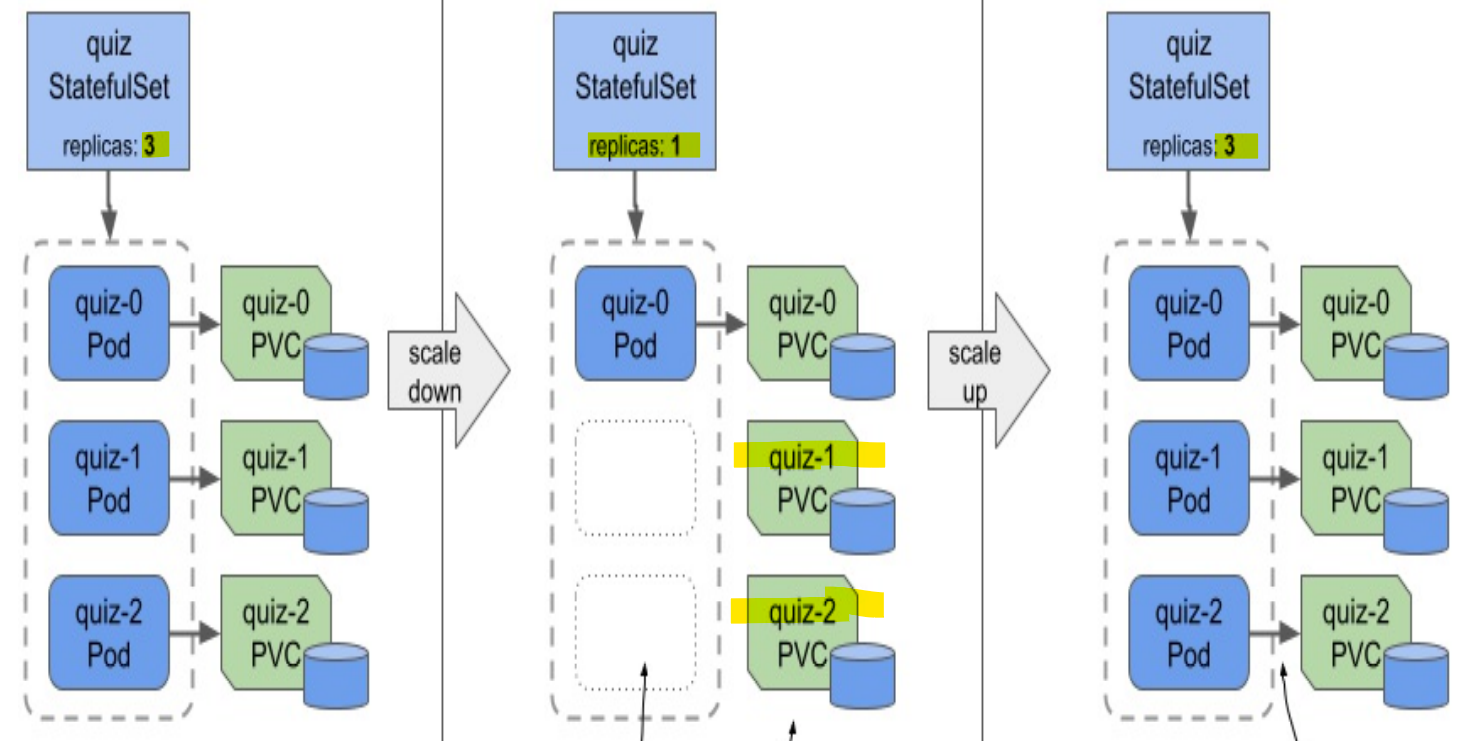
- for some database, if scale down to 1, may lead to the Service is no longer available due to lack of
quorum
Pod Management Policy
-
podManagementPolicyfieldOrderedReady:- default,
- scale up/down the
Podssequentially- wait for each pod ready before create the next pod
- wait for graceful time to terminate the pod before the next one.
- the policy doesn’t apply when you delete the
StatefulSet. - possible scenario:
- when the app has bug to be ready; the technology need multiple instance to be ready;
- the
stsget stuck because Pod is never ready - when debug by deletion, because it still wait a graceful termination, it could be the case it gets stuck during the deletion.
- used depends on the technology; can prevent race condition or concurrent startup problem
Parallel:- scale up/down all Pods at the same time
- no waiting
- scale up/down all Pods at the same time
-
Common use:
podManagementPolicy+minReadySecondsminReadySeconds: applied when scale up, can avoid race condition; not applied when scale down
-
NOTE:
- the policy doesn’t apply for
StatefulSetDeletion - good practices: scale down to zero, then delete
- the policy doesn’t apply for
PersistentVolumeClaim Retention Policy
-
persistentVolumeClaimRetentionPolicyfield:- specify the retention policy to be used during scaledown and when the
StatefulSetis deleted. Retain- default
- pvc will be preserved.
Delete- can be deleted if the workload managed by the
StatefulSetnever requires data to be preserved
- can be deleted if the workload managed by the
- specify the retention policy to be used during scaledown and when the
-
Example
spec:
  persistentVolumeClaimRetentionPolicy:
    whenScaled: Delete
    whenDeleted: Retain
-
also can configure the
StatefulSetAutoDeletePVCfeature when creating cluster -
If you want to delete a
StatefulSetbut keep thePodsand thePersistentVolumeClaims, you can use the--cascade=orphanoption.- In this case, the
PersistentVolumeClaimswill be preserved even if the retention policy is set toDelete.
- In this case, the