Multi-tenant Cluster
One Cluster. Multi-tenant. GitOps practices.
A multi-tenant EKS cluster that runs many teams on shared infrastructure. Terraform provisions AWS; ArgoCD runs everything above the API server via GitOps.
- AWS EKS
- Terraform
- ArgoCD
- Karpenter
- Istio ambient
- AWS Load Balancer Controller
- cert-manager
- External Secrets
- Kyverno
Business Challenge & Solution
For a small or mid-size enterprise, giving every product team its own Kubernetes cluster drives up cost, slows onboarding, and leaves governance inconsistent.
How can one cluster serve many teams while keeping workloads isolated, secure, and easy to operate?
This project answers the challenge with a multi-tenant cluster on AWS EKS.
Benefits
- Lower cost. Pooled capacity replaces per-team over-provisioning.
- One platform to run. One control plane, one upgrade path, one security baseline.
- Consistent governance. The same guardrails apply to every tenant.
- Fast onboarding. A new team goes live in minutes, driven by GitOps.
Architecture & Capabilities
Terraform provisions the AWS foundation. ArgoCD bootstraps everything above the API server via GitOps.
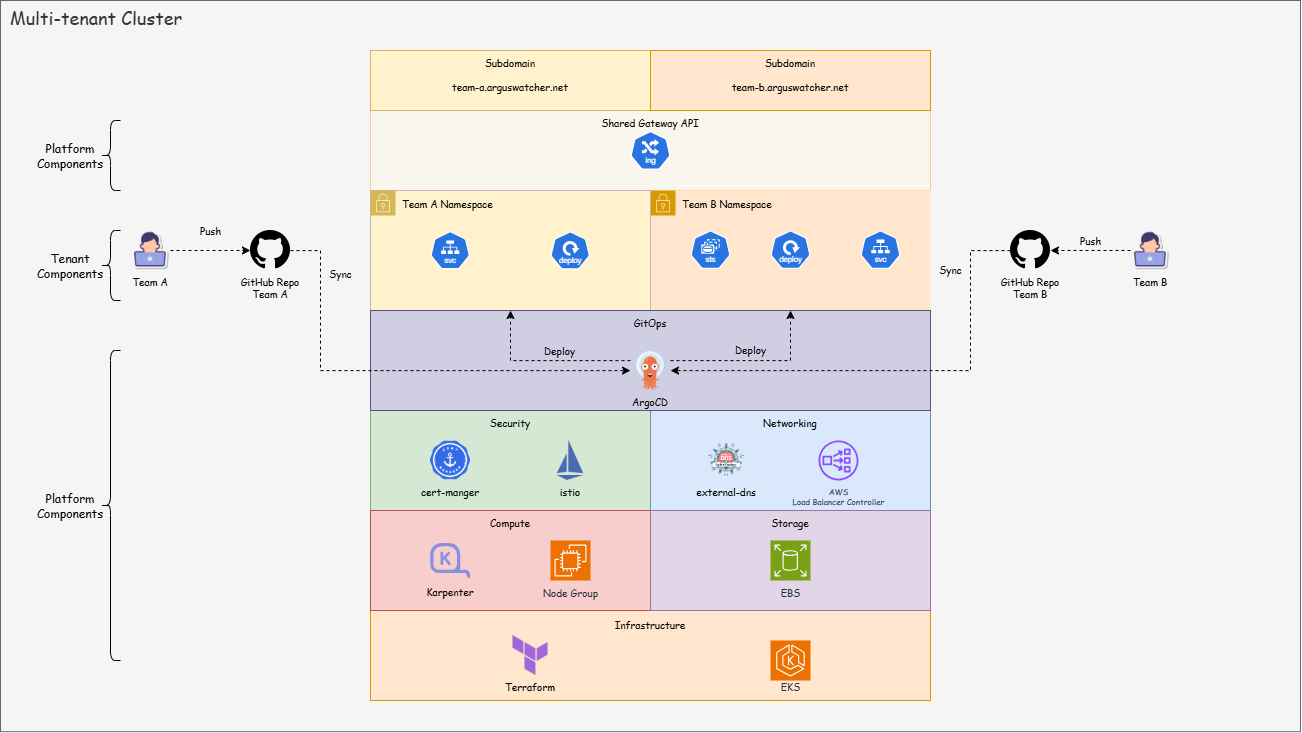
- Terraform provisions the AWS foundation (VPC, EKS, IAM, Route53).
- ArgoCD bootstraps platform capabilities on the cluster.
- Per-tenant AppProjects and ApplicationSets sync each team’s own manifest repo.
Four out-of-the-box capabilities
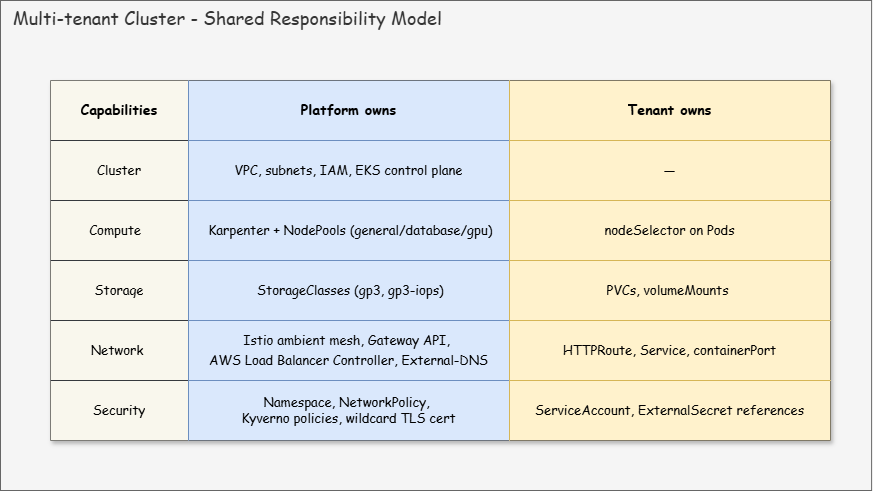
| Capability | Tooling | What tenants get |
|---|---|---|
| Compute | Karpenter + workload classes | On-demand nodes by class (general / database / gpu) |
| Storage | AWS EBS CSI + StorageClasses | PVCs on gp3 (default) or gp3-iops (high-IOPS) |
| Network | Istio ambient + Gateway API + ALBC + external-dns | Public URL under <team>.arguswatcher.net, TLS, DNS, mTLS |
| Security | ESO + Pod Identity + cert-manager + Kyverno | Secret vending, AWS access, wildcard TLS, admission control |
Shared responsibility model
Tenant Onboarding
Onboarding a new team takes 3 pieces of info and 1 JSON file. GitOps handles the rest.
The onboarding recipe
-
Tenant provides.
Three fields:
name,sourceRepo,manifestPath. -
Platform commits.
A single
tenants/<team>.jsonin the platform repo. - GitOps handles. Namespace, AppProject, ApplicationSet, subdomain, TLS, policy.
{
  "name": "team-a",
  "sourceRepo": "https://github.com/simonangel-fong/eks-multi-tenant-cluster",
  "manifestPath": "demo-app/team-a"
}Sample Demo: Team A, Stateless App
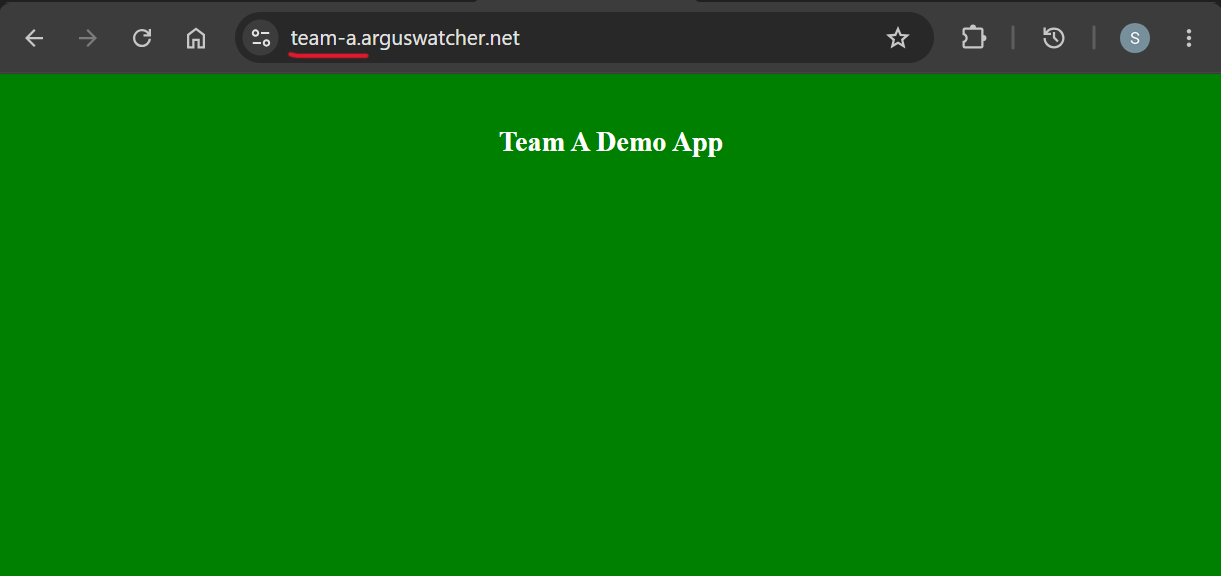
Team AA simple nginx web app deployed with plain Kubernetes manifests.
- Node class
general- Public URL
team-a.arguswatcher.net
Sample Demo: Team B, Stateful App
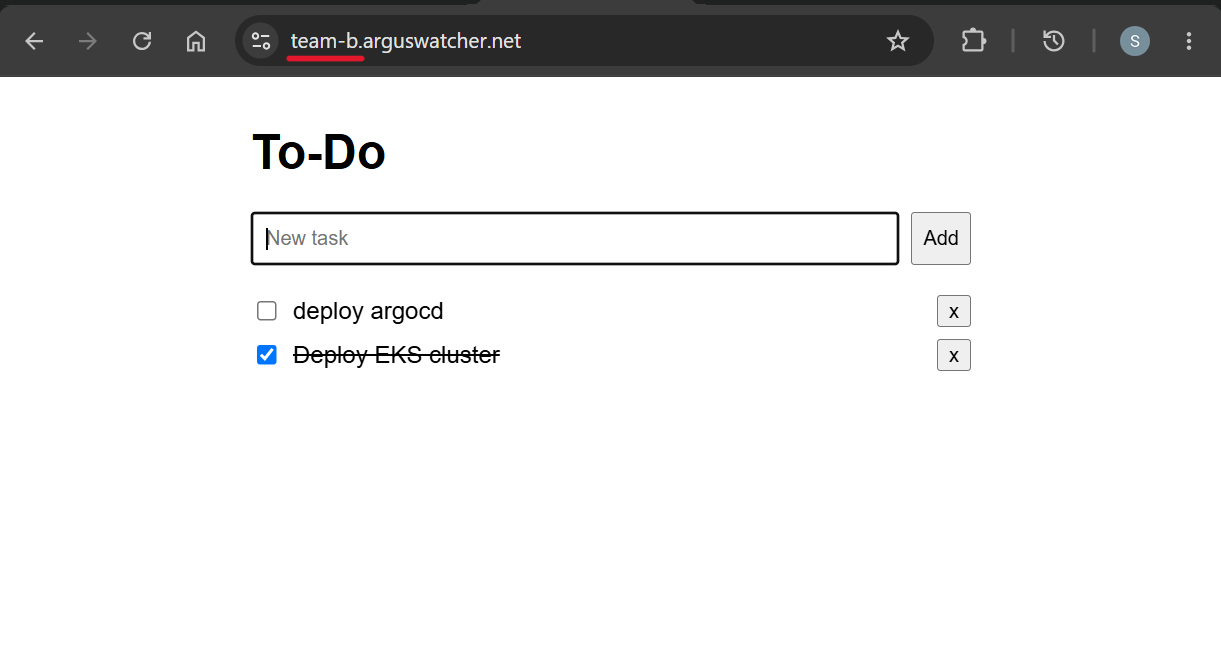
Team BA full-stack to-do app packaged as a Helm chart with a persistent database.
- Node classes
general·database- Public URL
team-b.arguswatcher.net
Summary
A multi-tenant cluster gives small and mid-size companies a clear responsibility boundary between the platform team and tenant teams.
For the platform team
-
Clear ownership
Focus on
platform capabilitiesand the underlying infrastructure. Nothing tenant-specific. -
Lower operational overhead
Run
one clusterinstead of one per team. One upgrade path, one security baseline. - Centralized compliance One policy set applies to every tenant, enforced automatically at admission.
For the tenant team
-
Clear ownership
Focus on the
application. Manifests live in the tenant’s own Git repo; GitOps keeps the cluster in sync. - Automatic infrastructure Compute, storage, network, and security come out of the box. No manual configuration.
-
Simple onboarding
Three fields (
name,sourceRepo,manifestPath). App is live in minutes.